 Antaryami
Tarot card meanings
The Chariot tarot card: direction matters more than looking fast
You can be busy all day and still finish unsure where the effort went. The Chariot gives that experience a different question: not how fast are you moving, but what is holding the movement together? A driver, a vehicle and contrasting figures create a picture of direction under competing pressures. In this Antaryami guide, Nitish Raj Walia explores determination as coordination rather than force. The card can help you reflect on a chosen route, but it cannot promise victory, predict a journey or make every obstacle disappear because you decide to push harder.
The Chariot meaning: bring competing demands into a workable direction
Contemporary Rider-Waite-Smith-inspired readings commonly connect The Chariot with determination, purposeful movement, self-direction and the coordination of competing forces. The useful emphasis is on coordination. A vehicle cannot follow every route at once, and a person cannot give full attention to every demand simultaneously. The card can prompt you to identify the destination and decide what needs to move together. It is not a judgement that your worth depends on momentum or that slowing down means you have failed.
Imagine preparing for an examination while also working and caring for someone. The challenge is not solved by declaring that you are determined. You need a realistic arrangement that acknowledges the demands, protects essentials and allows the study to proceed. A Chariot-themed question could be which commitments must be coordinated before progress becomes possible. The answer may involve fewer tasks rather than greater intensity. Direction is often strengthened by deciding what will not be attempted during a particular period.
In a spread's resource position, the card might frame focused effort or an ability to stay with a chosen task. In a challenge position, it may bring attention to divided aims or the pressure to force an outcome. Those are different questions prompted by the same scene. Keep the position visible, especially when a short interpretation uses words such as success or control. A useful reading should explain what those words mean in context instead of presenting them as guaranteed results.
The sphinxes and canopy: the image holds tension, not only movement
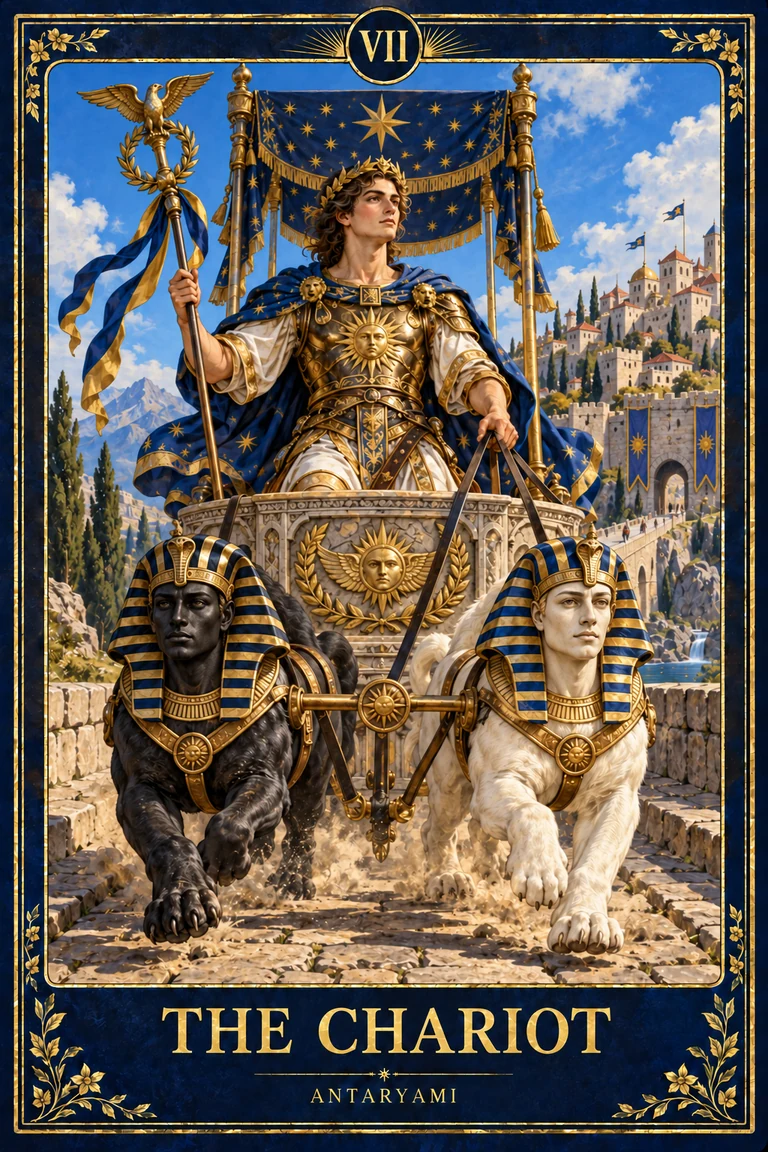
Antaryami's original Chariot illustration shows a formal driver beneath a starry canopy, with contrasting sphinx figures at the front. The picture looks composed, yet the different figures suggest that movement requires something more than a single impulse. As a modern reflection, you might compare two competing demands: urgency and care, ambition and rest, independence and cooperation. Those pairs are examples, not hidden assignments in the artwork. The image does not identify the specific forces operating in a reader's life.
Waite describes the charioteer and two sphinxes, explaining the latter as a variation he accepted from Eliphas Levi. His historical discussion emphasises a particular kind of outward triumph and explicitly distinguishes it from other spiritual accomplishments. That source is useful because it prevents the card from becoming an unlimited claim that the figure has mastered everything. Our examples of planning and coordination are contemporary adaptations. The Antaryami Museum Tarot scene is newly generated artwork, not an exact reproduction of the historical design.
The canopy's stars should not be mistaken for an astronomical calculation or a personal transit chart. They belong to the composition. Similarly, a vehicle in the picture cannot determine whether travel will occur, whether a driving test will be passed or whether a route is safe. Those questions have factual inputs outside tarot. You can enjoy the image's sense of purpose without treating visual movement as an operational forecast. Symbolic direction and verified logistics are different kinds of information.
Sources: Waite: The Chariot, sphinxes and limits of its triumph
Upright: define the route and the next checkpoint
An upright Chariot reflection can be useful when you have chosen a goal but keep dispersing effort across unrelated tasks. Suppose you want to complete a portfolio. You could spend weeks changing software, studying competitors and announcing plans without selecting the work that must actually be finished. The card may prompt you to define a limited set of pieces and a sensible checkpoint. That makes movement inspectable. It does not guarantee that the portfolio will win a role or that the chosen route is the only worthwhile one.
For a group project, coordination might mean agreeing on the dependency that must be resolved first. One person cannot complete a task because another decision is missing; everybody keeps working around the gap. A Chariot-themed discussion could identify the order of work and the person responsible for the blockage. Progress then becomes a shared arrangement, not a demand that each individual push independently. Direction is often lost when everyone appears active but the sequence needed for completion has never been made explicit.
Persistence also needs a review point. If a method repeatedly fails, continuing unchanged is not automatically admirable. Decide what evidence would support staying with the route and what would justify adjusting it. An upright reading can encourage commitment while allowing learning. That balance protects determination from becoming stubbornness disguised as strength. You may discover that the goal remains worthwhile but the current method is unsuitable. Changing the method can be a sign of attention rather than a betrayal of the original intention.
Reversed: scattered effort and excessive force are different problems
Modern reversed Chariot interpretations may examine loss of direction, conflicting aims, stalled movement or trying to control an outcome too aggressively. Those themes should be separated before advice is offered. A scattered plan may need simplification, while a coercive approach may need a limit. The card cannot determine which is happening or diagnose a person's capacity. Look at the actual sequence of actions and consequences. What is being attempted, what is competing with it and which part of the situation lies outside your influence?
Consider someone who schedules every hour tightly and then becomes angry whenever another person's needs disrupt the plan. The problem may not be insufficient determination. The plan may be demanding a degree of control that real life cannot supply. A reversed reflection could ask where flexibility belongs and what must remain non-negotiable. That is a more useful distinction than declaring that discipline is always good or that structure is always oppressive. A workable route includes predictable limits and enough room for circumstances to change.
In another example, someone abandons every goal when a new possibility appears. Here the issue may be divided attention rather than rigidity. A practical response could be choosing one modest commitment for a defined period and recording the other ideas without immediately pursuing them. You are still free to reconsider after review. The reversed card does not require a permanent identity as an unfocused person. It can frame a temporary pattern that becomes clearer when described in ordinary actions rather than dramatic labels.
Relationships: travelling together does not mean steering another person
In relationship reflection, The Chariot can prompt questions about shared direction, competing priorities and independence. Two people may want to remain connected while moving at different speeds or towards different goals. The card cannot decide that one person's route is superior. Ask where coordination is needed and where separate choices are legitimate. A shared plan becomes more dependable when both participants can describe it in their own words, rather than one person interpreting agreement on the other's behalf.
Imagine a couple planning a move. One is excited about career opportunities, while the other is concerned about support and practical costs. A Chariot-themed conversation could make those forces visible without treating concern as sabotage. Compare the real options, timelines and responsibilities. The symbolic exercise may help organise the discussion, but documents, finances and the participants' consent determine what is possible. A favourable-looking card cannot guarantee that the move will improve the relationship or that every difficulty is worth enduring.
If you are pursuing a new connection, determination must remain compatible with the other person's freedom. Repeated unwanted contact is not transformed into devotion by a card associated with persistence. Respect a refusal, uncertainty or a request for space. The useful personal question may be how to direct your own energy after disappointment rather than how to make someone change their mind. The Chariot can support self-direction without granting authority over anyone else's feelings, time or participation.
Work: measure progress by the task, not by the appearance of effort
At work, a Chariot reflection can ask whether activity is producing the result the project actually needs. A busy calendar, many messages or a dramatic deadline can conceal the absence of a completed dependency. Choose a measure tied to the task: an approved requirement, a tested function, a clear draft or a delivered item. The card does not calculate performance, but it can prompt a more useful question about evidence. What changed because the effort was directed, and what remains unfinished?
Rest belongs in that plan because capacity is not limitless. You cannot infer a medical or psychological condition from the card, and this article does not prescribe a treatment or productivity regime. It simply rejects the idea that determination always means increasing intensity. Sometimes the responsible route requires reducing scope, obtaining support or allowing recovery before continuing. A reading that makes exhaustion sound like proof of dedication can leave the reader less able to assess their circumstances. Direction should serve the person, not consume them.
For commercial decisions, keep the language of triumph separate from factual assessment. The Chariot cannot assure a profitable launch, favourable litigation or a successful application. Review costs, conditions and relevant expertise independently. You might use the image to clarify which actions are within your control, then stop asking it to guarantee the response of customers, authorities or markets. A good plan remains uncertain about some outcomes. Honest uncertainty does not make the effort meaningless; it keeps the claim proportional to what can actually be known.
The Chariot and Strength: directing movement is not the same as meeting intensity
The Chariot and Strength are often described with similar words, such as willpower or courage, but their scenes offer different questions. In this series, The Chariot foregrounds a route, coordination and outward movement. Strength foregrounds the way a powerful response is met without automatically escalating it. You may need one theme while organising a project and the other while handling a difficult conversation. Treating them as identical success cards would remove the distinction that makes comparison educational.
A modern reader may see the Chariot as mastery of competing impulses, but that interpretation should be named as a reading, not an empirically validated account of self-control. Human behaviour is more complex than a pair of symbolic figures. Ask what the metaphor helps you notice and where it becomes too simple. For instance, a conflict between work and care may require practical support, not merely greater inner discipline. The image is useful only when it leaves room for the real conditions surrounding the reader.
The same principle applies to timing questions. A card associated with movement cannot specify how many days remain before an event or certify a good date for departure. Do not convert its number into a deadline without a clearly labelled convention, and do not present the convention as a factual forecast. A better timing reflection asks which prerequisite must be completed before you can proceed. That question has an answer in your actual arrangements, rather than in a calendar date invented to make the reading sound precise.
An Antaryami route note: destination, competing demand and checkpoint
When The Chariot appears in Antaryami, first identify whether you are viewing the stable daily card or a revealed card in an interactive spread. Keep the spread position and reversal choice attached to any explanation. You might ask what competing demand needs coordination or where an approach has become unnecessarily forceful. A contextual Ask response can discuss the symbolic theme, but it cannot know unprovided logistics or guarantee an external outcome. Bring the answer back to the facts you can inspect.
Write a destination in one sentence, then identify the strongest competing demand and the next useful checkpoint. A learner might choose one chapter, acknowledge limited evening time and plan to review a worked example. A team might choose a release milestone, identify a missing decision and agree when it must be resolved. If the plan fails, examine which assumption was wrong instead of declaring the card negative. The exercise aims to produce a clearer route, including permission to revise it when evidence changes.
For Antaryami Journal, Temior Technologies Pvt Ltd presents this AI-assisted guide under Nitish Raj Walia's byline with original Chariot artwork and a named historical source. Visit the app page for verified availability before expecting a particular personal feature to be usable. Let the card's formal movement leave you with a grounded distinction: resolve the direction, coordinate what needs coordination and recognise what you cannot steer. Purposeful progress does not require pretending that the entire road is already under your control.
Give the movement a destination
I am busy, but the important result is not getting closer
Choose one concrete checkpoint and identify the dependency preventing it. Reduce unrelated activity long enough to address that dependency. The Chariot theme concerns directed effort; the actual result must be checked through the work, not through the card.
I am pushing harder and everyone is resisting
Check whether the plan has clear consent, adequate resources and realistic flexibility. Resistance may contain useful information. Determination does not entitle you to control another person, and the appropriate adjustment may be to change the route rather than increase pressure.
Astrological interpretations are for reflection, not a diagnosis, a guaranteed prediction or a substitute for professional advice. Journal guides are prepared with AI assistance; they are educational content, not individual consultations.


