 Antaryami
Tarot card meanings
The Hanged Man tarot card: a useful pause changes the question, not just the pace
There is a difference between stopping because nothing can be done and pausing because the next useful thing is not yet clear. The Hanged Man asks you to examine that difference. Its inverted figure makes the familiar world look unfamiliar, and that shift is the heart of this Antaryami guide by Nitish Raj Walia. We will explore contemporary upright and reversed meanings, the image's historical details and everyday situations in which another viewpoint matters. We will also separate voluntary reflection from being trapped by someone else's demands. A pause can be valuable, but no card earns the right to keep your life on hold indefinitely.
The Hanged Man meaning: changing your viewpoint may change the available action
A contemporary Hanged Man interpretation commonly concerns perspective, suspension, relinquishing an unhelpful approach or allowing time for understanding. The emphasis is not simply inactivity. You can stop moving while remaining mentally fixed on the same assumption, which may change nothing. A more useful pause allows you to examine what you have been taking for granted. Perhaps the goal is poorly defined, the obstacle has been misunderstood or the question assumes only two options when several are possible. The image invites that reconsideration without promising an insight on demand.
Imagine redesigning a room because nobody uses its central table. The first response is to move the table repeatedly, but every new position creates another inconvenience. A different viewpoint might ask whether the table is needed at all, what activities actually happen in the room and which furniture supports them. The pause matters because it changes the question from where this object belongs to what the space is for. You can then act with a clearer purpose rather than continuing to optimise an assumption that has not been examined.
Spread position should narrow the reflection. As an obstacle, The Hanged Man might frame a stalled process or a viewpoint that needs revision. As a resource, it might suggest permission to suspend an unnecessary decision while gathering information. Neither interpretation means every delay is beneficial. A missed deadline or an unresolved obligation may require action. Ask what the pause is for, who is affected and what would indicate that it is time to move. Without those questions, an apparently thoughtful suspension can become avoidance dressed in spiritual language.
The living tree and calm face distinguish this image from a punishment scene
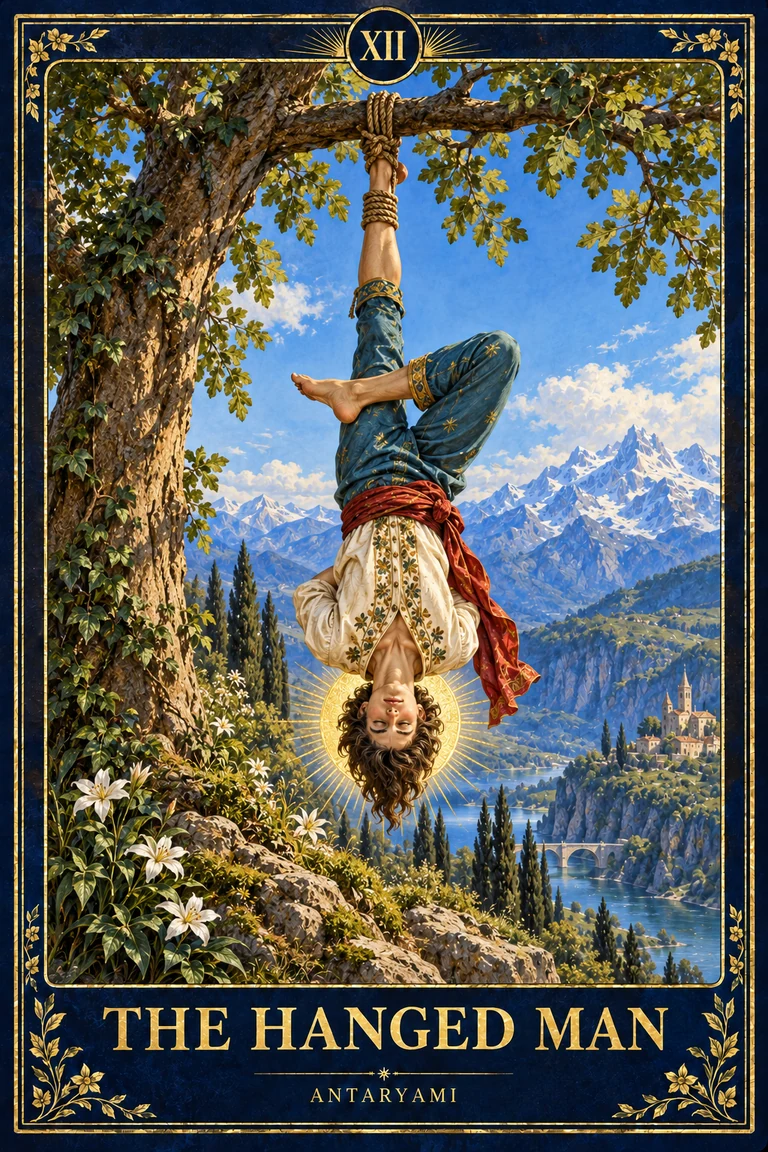
Antaryami's original illustration shows the figure suspended by one ankle from a leafy tree, with a halo around the head and a composed expression. The landscape continues beyond the figure. For a reflective reading, that contrast can suggest that movement in the wider world continues while one person changes their relationship to it. This is not an instruction to copy the pose, attempt a physical suspension or expose yourself to danger. Study the artwork as an image; its symbolic invitation does not require reenacting its bodily position.
Waite draws attention to the living wood, the halo, the crossed legs and a face that does not express suffering. He describes life in suspension rather than death and disputes some interpretations that reduce the card to martyrdom. His account is explicitly mystical, so it should not be presented as identical to a modern productivity technique or a universal psychological rule. The historical source helps identify what is in the image and how its author discussed it. Our examples below translate a contemporary perspective theme into ordinary decisions.
The halo can easily tempt a reader to say that anyone who waits becomes enlightened. The picture does not establish that claim. Insight depends on what you notice, the information available and your willingness to revise a mistaken view. You can remain patient and still be wrong. You can also reach a useful understanding quickly. The card's unusual orientation is most helpful as a reminder to look differently, not as a ranking system that makes delay spiritually superior to action or makes practical urgency a sign of insufficient depth.
Sources: Waite: The Hanged Man, living wood and life in suspension
Upright: make a deliberate pause with a purpose and a return point
An upright Hanged Man reflection may fit a decision that would benefit from more understanding before commitment. You might be about to answer an invitation while missing important details, or repeat a conversation in which the same arguments have stopped helping. A purposeful pause names what you need to learn. It might involve requesting information, trying a different approach or allowing another person time to explain. It is not simply a refusal to decide. The distinction matters because uncertainty does not resolve merely by being left untouched.
Suppose a group is choosing between two proposals. Instead of debating the preferred design again, they pause to agree on the problem each proposal must solve. That change can reveal that one option answers a different question entirely. The useful suspension is brief and specific: define the criteria, then return to the choice. A card-themed exercise could support that change of view, but the group still needs to compare evidence. An upright card cannot tell them which proposal works or excuse them from testing the assumptions behind it.
A return point protects the pause from becoming indefinite. You might decide to revisit the question after receiving a missing document or after one scheduled conversation. The return point should be appropriate to the actual deadline and the people involved, not a mystical duration invented from the number XII. You may discover that a decision can remain open; you may also discover that waiting has a cost. Either outcome can be part of a thoughtful response. The Hanged Man's constructive theme is reconsideration, not a command to suspend every important choice.
Reversed: ask whether waiting is helping, resisting or concealing the problem
Reversed Hanged Man interpretations often explore stagnation, resistance to a necessary shift or a pause that no longer has a clear purpose. A useful question is what has changed during the waiting period. If you are gathering information, recovering capacity or considering another view, the pause may be doing something. If the same worry is being repeated without new evidence or a next step, the process may need adjustment. The card cannot diagnose the reason; your circumstances determine whether the issue is avoidance, an external barrier or a legitimate need for more time.
For example, someone may postpone a manageable conversation because they hope the other person will somehow understand the concern without being told. Waiting has become a substitute for communication. A reversed reflection could help them prepare a clear, respectful message and choose a suitable moment. In another situation, the person may be unable to speak safely, and the appropriate response may require support rather than direct confrontation. The same symbolic theme must not be forced onto both cases as though context does not matter.
Reversal can also concern a false sacrifice: giving up something important without a meaningful reason or freely chosen agreement. Ask who benefits from the suspension and whether you can change or end it. If another person repeatedly demands that you put your needs aside while their own plans proceed, patience may not be the relevant virtue. A thoughtful reading should leave room for boundaries and practical help. It should not turn a feeling of being stuck into proof that you must wait longer to earn permission to act.
Relationships: understand another viewpoint without abandoning your own
The Hanged Man can frame a relationship conversation in which both people keep defending their own interpretation without understanding the other. Changing viewpoint does not require agreeing with everything you hear. You might ask the person to describe what they experienced, reflect back the part you understood and then explain where your account differs. That can make a disagreement more specific. The card does not guarantee reconciliation, but a clearer understanding of the actual difference may prevent both people from arguing against positions nobody really holds.
Consider a friend who sees an unanswered message as rejection while you see it as an ordinary delay during a busy day. Neither interpretation becomes automatically correct because it feels obvious to its holder. A useful discussion could clarify expectations about response times and the kind of message that needs an urgent answer. The perspective shift is not mind-reading; it comes from asking and listening. Tarot may prompt the conversation, but the friend must speak for themselves. An image cannot establish a hidden motive behind their behaviour.
There is also a limit to perspective-taking. Understanding why someone acts as they do does not require accepting conduct that harms you. You can recognise their explanation and still refuse the arrangement. Nor must you remain indefinitely available while another person decides whether they want a relationship. A mutual agreement to take space should have understandable terms. The Hanged Man becomes more humane when it supports clarity about that space, rather than telling the waiting person that uncertainty is a spiritual obligation they have no right to question.
Work: before doing more, check that you are solving the right problem
In a work setting, The Hanged Man can prompt a useful distinction between effort and problem definition. A team may add more reminders when the actual difficulty is that a process requires information nobody can obtain. A designer may polish a feature that users do not need. A student may keep rereading a passage when a worked example would clarify it better. These situations call for examining the approach, not automatically adding hours. The card can supply a memorable cue to ask what the work is really trying to accomplish.
A practical pause might involve watching how someone performs a task, asking which step creates difficulty or testing a small alternative. You should not use the card to justify ignoring a real deadline. Instead, consider whether a short investigation could prevent a larger waste of effort. Make the purpose visible to colleagues so that pausing does not look like silently dropping responsibility. If the obstacle is outside your authority, communicate it to someone who can act. A changed viewpoint is useful only when it can inform an appropriate response.
Around money, suspension language needs particular care. The Hanged Man does not advise you to leave a risky commitment untouched until a favourable outcome arrives. Review actual terms, costs and available alternatives, and seek qualified guidance where necessary. Waiting can increase costs in some situations and reduce pressure in others. The card cannot determine which applies. Its reflective value lies in asking whether your current approach rests on an assumption that needs examination, not in promising that surrender will recover a loss or make an unaffordable arrangement sustainable.
The Hanged Man, The Hermit and Death do not ask for the same kind of space
The Hermit and The Hanged Man can both look quiet, but their questions differ. A Hermit reflection may concern reducing noise so you can study, consider or seek guidance. A Hanged Man reflection may concern suspending an established approach so a different viewpoint becomes possible. You can study carefully while remaining attached to the wrong question, or change a viewpoint through conversation rather than solitude. Comparing the cards helps you avoid the simplistic instruction to go away and think whenever any contemplative image appears.
Death introduces another distinction: a pause is not the same as an ending. If an arrangement is temporarily suspended, the question may be what needs to happen before it resumes. If the arrangement has actually ended, the question may be what responsibilities or feelings remain after closure. Confusing these states can keep someone waiting for a return that has not been promised. Check the real agreement or circumstances before interpreting the card. No symbolic image can convert a clear refusal into a temporary delay simply because that interpretation feels more comfortable.
Finally, surrender in this guide means relinquishing an unhelpful assumption or an attempt to control what you cannot control. It does not mean surrendering your rights, consent or access to professional support. You can stop insisting that an event must follow your preferred script while still protecting your interests. That distinction prevents a poetic word from becoming dangerous advice. The Hanged Man's changed viewpoint should create room to see your options more accurately, not remove options that the card has no authority to take away.
An Antaryami viewpoint exercise: give the pause something specific to reveal
Use The Hanged Man in Antaryami with the displayed spread position and reversal setting intact. A productive question might ask which assumption deserves reconsideration or what information would make a stalled decision clearer. Avoid asking how long you must wait for another person to change their feelings. The card cannot answer that on their behalf. If you request a contextual explanation, check that it offers a perspective to consider rather than presenting an invented event or another person's unspoken intention as a fact.
Take a question you have been repeating and rewrite it from two viewpoints. Instead of asking how to make an unwanted arrangement succeed, ask what need the arrangement was intended to meet and whether another approach could meet it better. Then identify one piece of evidence that would help compare the alternatives. Finish by naming when or under what condition you will revisit the decision. This gives the reflection a practical shape: a changed question, a way to learn and a return point, rather than a vague promise that clarity will arrive eventually.
This AI-assisted Antaryami Journal guide carries Nitish Raj Walia's byline and Temior Technologies Pvt Ltd attribution, alongside the existing Hanged Man portrait from our original deck. The current app information remains the place to check availability and access. You do not have to become motionless to appreciate the card. Let it interrupt a tired assumption, reveal a neglected viewpoint and help you decide whether the next useful response is to wait, ask, revise or move. The answer belongs to your circumstances, not to a command hidden in the image.
Give your pause a purpose
I need missing information before deciding
Name the information, how you can obtain it and the real deadline. A purposeful pause has a question to answer and a return point. The Hanged Man can frame that reconsideration without inventing a special waiting period from its number.
I have been waiting without anything changing
Ask what the waiting is achieving and who can alter the situation. You may need a revised question, a clear conversation or appropriate support. The card does not require endless suspension or make another person responsible for eventually fulfilling an unspoken hope.
Astrological interpretations are for reflection, not a diagnosis, a guaranteed prediction or a substitute for professional advice. Journal guides are prepared with AI assistance; they are educational content, not individual consultations.


