 Antaryami
Tarot card meanings
The Moon tarot card: stay curious when a feeling arrives before the facts
You notice a tone in a message, remember an unsettling dream or feel that something is not quite right. The feeling may deserve attention, but what does it actually establish? The Moon places that question in a landscape lit indirectly, with a path running toward an unknown distance. In this Antaryami guide, Nitish Raj Walia explores uncertainty, imagination and the difference between noticing an impression and treating it as proof. We will study the card's imagery, upright and reversed meanings and practical ways to ask clearer questions. This is tarot's Moon card, not a calculation of your natal Moon, lunar phase or Nakshatra.
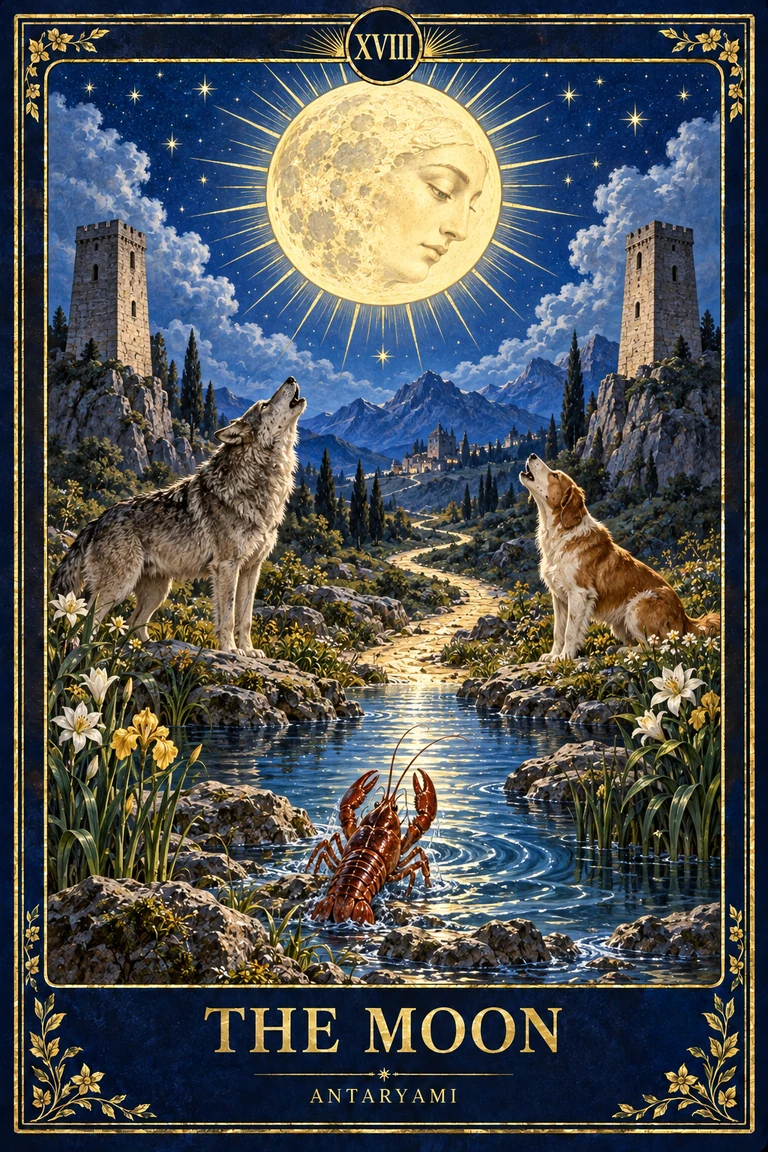
The Moon meaning: incomplete information leaves room for imagination
Contemporary Moon interpretations often involve uncertainty, illusion, intuition, dreams and the difficulty of seeing a situation clearly. These ideas need careful separation. Uncertainty means information is incomplete; illusion concerns a misleading appearance; intuition is an impression that may or may not be accurate. The card cannot tell you which one applies simply by appearing. A constructive reflection asks what you know, what you are imagining and which missing fact would help. It does not require you to suppress a feeling or promote it immediately into a reliable conclusion.
Imagine receiving a brief reply from someone who usually writes warmly. You may interpret the brevity as anger, disinterest or a hidden problem. Several explanations remain possible: they may be busy, tired or simply answering a straightforward question. A Moon-themed reflection could help you recognise how much of the story has been supplied by your imagination. If the issue matters, an appropriate question or a longer pattern of conduct may clarify it. A card cannot inspect the person's private state or select the correct explanation on their behalf.
Spread position helps frame the uncertainty. In a situation position, The Moon might highlight an unclear context. In a challenge position, it could concern an assumption being treated as certainty. In a resource position, it may prompt openness to an impression worth investigating. The last angle is not a declaration that your intuition is infallible. A feeling can be meaningful as an experience even when the explanation attached to it is mistaken. The reading becomes more useful when it preserves that distinction rather than dividing every response into rational truth or mystical certainty.
The path, towers and animals show a landscape whose details remain partly hidden
Antaryami's original Moon portrait shows a luminous moon above two towers, a winding path, a dog and wolf, and a crustacean emerging from water. The scene gives the eye several things to notice without showing where the path finally leads. As our contemporary visual reading, the landscape can represent moving with partial information. The animal figures can prompt a question about familiar and less familiar responses to uncertainty. They do not establish a person's biological instincts, psychological diagnosis or a hidden threat waiting beyond the visible scene.
Waite describes the path between the towers as an entry into the unknown and connects the dog and wolf with fear under reflected light. He treats the image through imagination and a specific mystical account of the mind. Our guide does not adopt all of that doctrine as a factual description of a reader. The historical source identifies the visual language and its author's explanation. The practical distinction we draw between observation and inference is a contemporary application, not an experimentally validated ability of tarot to reveal unseen information.
Reflected light is also a useful reminder that what you perceive may have passed through a medium. A message has tone added by the reader; a photograph has framing; a memory has omissions. This does not mean every impression is false. It means the route by which information reaches you matters. Ask whether you are seeing the event directly or a selected account of it. The Moon's atmosphere can make that question memorable without becoming a general accusation that the world, another person or your own mind is deliberately deceiving you.
Sources: Waite: The Moon, reflected light and the path into the unknown
Upright: keep the question open until evidence narrows it
An upright Moon reflection may fit a decision made difficult by incomplete or ambiguous information. You might have a proposal with unclear responsibilities, a conversation with an unresolved point or an impression that deserves examination. Begin by listing the uncertainties in ordinary language. Which term is undefined? Which statement has not been confirmed? Which observation supports the concern? The card can help you notice the gap, but the next useful step is usually to ask, inspect or compare rather than draw another image and call it an answer.
Suppose a group invitation describes an activity enthusiastically without explaining the time commitment or cost. Your hesitation may be reasonable even if the offer sounds appealing. A Moon-themed question could identify the missing details and lead to a direct request for them. You do not have to accuse the organiser of deception, nor agree because your first impression was positive. The issue is clarity. A complete answer may make the invitation suitable, unsuitable or still uncertain. Each is more informative than a symbolic verdict based on atmosphere alone.
The upright theme can also support creativity. An ambiguous image, dream or mood may inspire writing, music or art without being decoded as a prediction. You can ask what associations it brings to mind and explore them freely. That use does not require the associations to be factual. Keep the distinction visible when moving from creative interpretation to a real-world decision. Something can be rich material for a poem and poor evidence for an accusation, a medical concern or a claim about what will happen next.
Reversed: clarity may be emerging, or you may be rushing to declare it
Reversed Moon interpretations often concern emerging clarity, confusion beginning to lift or a refusal to examine uncertainty. The orientation alone cannot tell you which applies. Ask what new information has actually arrived. A direct explanation, a verified document or an observable change may narrow the question. Merely feeling more certain does not necessarily add evidence. A useful reflection distinguishes the relief of having a story from the reliability of the story itself, especially when you have been waiting anxiously for an answer.
For example, you may learn that a delayed project is awaiting a routine approval rather than being secretly abandoned. That information changes the practical next step. You can ask about the approval process instead of continuing to speculate about hidden motives. A reversed reflection can frame this clarification, but the source of clarity is the actual update. Do not claim that the card exposed the truth independently. Recognising where information came from helps keep the practice honest and makes it easier to assess whether the answer is trustworthy.
Another reversed angle is deciding too quickly that a concern has disappeared because a reassuring explanation sounds plausible. You may still need to verify a detail. Conversely, you may keep suspecting a hidden problem after evidence has reasonably addressed the concern. Both patterns deserve proportionate attention. The card is not a tool for diagnosing anxiety or deception. It can prompt a question about your relationship to uncertainty while leaving significant distress or consequential factual concerns to appropriate support and reliable sources.
Relationships: ask about an ambiguity without claiming access to private thoughts
The Moon is often drawn into relationship questions about secrecy. This guide does not use it to confirm an affair, dishonesty or another person's hidden feelings. Such claims can affect real people and require actual evidence. A constructive reflection asks which part of the relationship feels unclear and what would make a respectful conversation possible. Perhaps expectations were never stated, a message was ambiguous or the person has behaved inconsistently. Describe the conduct rather than treating the card's atmosphere as proof of a motive.
If you are unsure whether a connection is mutual, ask in a way that leaves the other person free to answer. A clear response should not be reinterpreted as concealed affection because tarot suggests mystery. Where the person does not want contact, respect that boundary. Uncertainty does not create permission to keep investigating their private life. The Moon's reflective theme is about what you can responsibly know and ask, not a method for overcoming another person's refusal through symbolic certainty or repeated readings.
Within a healthy relationship, discussing how each person handles ambiguity can be useful. One may prefer to ask immediately; another may need time to formulate an answer. Agreeing on a workable approach can reduce unnecessary speculation. This is an example, not a universal relationship formula. If the circumstances involve intimidation or harm, appropriate support and safety take priority. Do not tell someone to disregard observable danger because the card supposedly means their concern is only an illusion. Partial information requires care, not automatic dismissal or alarm.
Work and dreams: interpretation can generate a question, but it cannot verify the answer
In a work context, The Moon can prompt attention to a vague brief, an undocumented assumption or information that has changed as it passed between people. A team might discover that everyone has a different understanding of the same term. Clarifying it can prevent an avoidable mistake. The card does not certify that a colleague is withholding information. Ask which part of the process needs a clearer source or definition. Documentation and relevant checks do the verifying; the image simply gives you a lens through which to notice the gap.
Dreams deserve a similar distinction. You may find a dream personally interesting and use it to reflect on feelings or creative associations. There is no single card-based translation that establishes its meaning for every person. The Moon does not prove that a dream is prophetic, reveal a message from another person or predict pregnancy, illness or a future event. If a dream brings up a concern, consider the concern itself and the real circumstances. A memorable image can be meaningful without being evidence of information received from an unseen source.
Around financial or medical decisions, ambiguity is a reason to seek reliable information rather than rely more heavily on symbolism. Read actual terms, check relevant facts and use appropriate professional advice. Neither a mysterious upright Moon nor a clearer-looking reversal determines whether a proposal is safe or a symptom is serious. The article's educational scope remains reflective. Keeping that scope visible allows imagination to be enjoyed in its own role without asking it to perform the job of a contract review, clinical assessment or verified calculation.
Tarot Moon, Jyotish Moon and lunar phase are three different kinds of information
A tarot card bearing the name The Moon is not your natal Moon placement. It is an illustrated card selected according to the reading's method. A Jyotish Moon discussion concerns a calculated celestial position and its traditional interpretation within an astrological framework. A lunar phase describes an astronomical relationship of illumination. These subjects can share language and imagery without being interchangeable. Drawing card XVIII does not tell you your Rashi, Nakshatra, Moon longitude or the phase at your birth, and it does not change any of those calculated values.
Antaryami's instrument guides keep calculation and symbolic interpretation distinguishable. The company's Swiss Ephemeris licence does not make a tarot selection a measured lunar observation or validate its interpretation as a prediction. If you want an astronomical or chart value, use the appropriately labelled calculation and the relevant time, place and method. If you want to explore a tarot image, use the card's symbolic context. A trustworthy product can place both in one experience while resisting the temptation to make an impressive engine name confer authority on an unrelated reading.
The Moon also differs from The High Priestess in this series. The High Priestess can frame withheld information, attentive listening or a question that is not ready for immediate disclosure. The Moon can frame uncertain perception, imagination and the need to distinguish inference from observation. Both may invite patience, but patience serves a different purpose in each. Comparing them helps you ask whether the issue is a boundary around information or an interpretation of information you already have. Neither card proves that your first impression is a hidden truth.
An Antaryami uncertainty exercise: separate what you observed from what you inferred
When The Moon appears in Antaryami, preserve the spread position, orientation and selection method. You might ask which missing fact would clarify a situation or what assumption has become stronger than its evidence. Avoid requesting a diagnosis, secret thought or definitive dream prediction. A contextual explanation should label its suggestions as interpretations and keep your supplied facts separate. The app cannot learn another person's private intentions from a card, and the article does not make any such ability part of its product promise.
Write three short lines: what you observed, what you inferred and what remains unknown. For a brief message, the observation may be its actual wording, the inference may be that the sender is annoyed and the unknown may be why it was brief. Choose an appropriate way to clarify the unknown if it matters. If it does not require action, you can leave it unresolved without forcing a story. This exercise is useful because it narrows the question, not because the Moon magically turns uncertainty into knowledge.
This AI-assisted Antaryami Journal guide carries Nitish Raj Walia's byline and Temior Technologies Pvt Ltd attribution with our existing original Moon portrait. Consult current product pages for app availability and access. Let the winding path remind you that not seeing the whole route does not require inventing what lies beyond it. You can notice a feeling, respect its significance to you and still ask what it establishes. Curiosity becomes more useful when it can tolerate an unanswered question long enough for reliable information to arrive.
Keep the observation separate from the story
A message feels different, but I do not know why
Record the actual wording before interpreting the tone. Several explanations may remain possible. If clarification matters and contact is appropriate, ask respectfully; The Moon cannot confirm anger, dishonesty or affection hidden behind a short reply.
I want to know whether this is my astrological Moon
The selected tarot image is not a natal Moon calculation, Rashi, Nakshatra or lunar phase. Use the properly labelled chart instrument for those values. Shared imagery does not make a symbolic card an astronomical measurement.
Astrological interpretations are for reflection, not a diagnosis, a guaranteed prediction or a substitute for professional advice. Journal guides are prepared with AI assistance; they are educational content, not individual consultations.


