 Antaryami
Tarot card meanings
The World tarot card: recognise completion without expecting a perfect life
Finishing something can feel surprisingly complicated. You may be proud, tired, relieved and already wondering what comes next. The World gives tarot a final numbered Major Arcana image that can hold completion without demanding that life be permanently complete. In this Antaryami guide, Nitish Raj Walia explores integration, acknowledgment and the difference between a finished chapter and a flawless existence. We will study the wreath and corner figures, upright and reversed meanings and ordinary ways to close work responsibly. The card does not guarantee a dream outcome or announce that you have reached spiritual perfection. It can ask a simpler question: what is genuinely complete, and have you allowed that completion to count?
The World meaning: a chapter can be complete while life continues
Contemporary World interpretations commonly concern completion, integration, fulfilment and recognising the whole of a completed process. These themes need a defined scope. A course can finish, a project can be delivered or a transition can settle into a workable routine. That does not make every part of your life resolved. The card can prompt you to acknowledge a particular completion without turning it into a claim that nothing more remains to learn. A meaningful endpoint is compatible with continuing responsibilities, mixed feelings and another question waiting beyond it.
Imagine finishing a long practical project at home. The work involved planning, mistakes, help from others and several adjustments. When the result is finally usable, you may notice only the details that could have been better. A World-themed reflection could ask whether those imperfections prevent the project from meeting its purpose, or whether you have moved the standard so that completion is never possible. This is not an instruction to ignore a real defect. It is a question about distinguishing necessary corrections from an endless refusal to recognise a satisfactory result.
Position can frame either acknowledgment or an unfinished element. As a resource, The World might prompt you to integrate lessons and celebrate a defined achievement. As a challenge, it may ask whether a loose end prevents responsible closure or whether perfectionism keeps adding new requirements. The card cannot decide that distinction by itself. Compare the actual brief, commitments and result. Completion becomes clearer when the purpose and standard are visible, rather than depending on a vague feeling that everything must finally be beyond criticism.
The wreath creates a whole composition without closing the possibility of movement
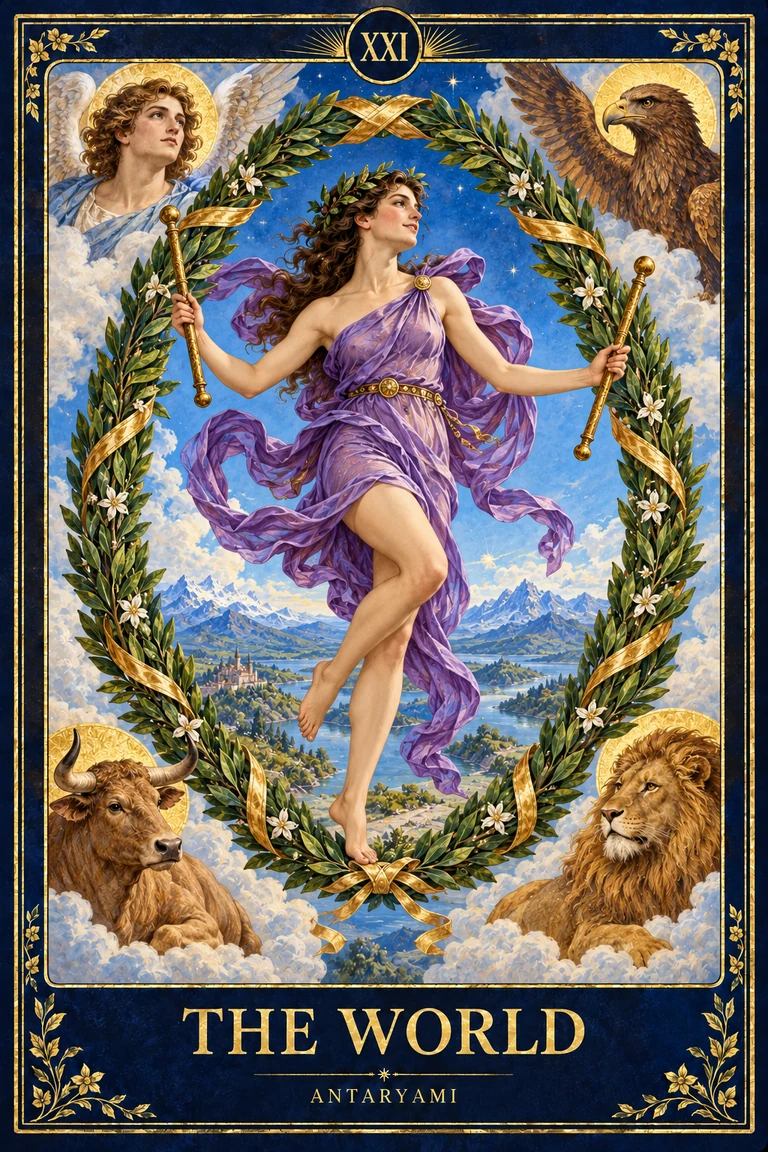
Antaryami's original World portrait places a central figure, draped in violet, within a leafy wreath and surrounded by four corner beings. The figure appears active rather than fixed like a statue. As our contemporary visual reading, the wreath can frame a completed whole while the movement suggests that completion is not the end of participation in life. The image does not certify an attained spiritual rank. It can simply help you consider how the parts of a process have come together and what can now be acknowledged.
Waite presents The World as the final message of the Major Trumps and discusses completion through an explicitly cosmic and mystical framework. His account concerns divine vision and a restored world, rather than a straightforward checklist for finishing ordinary work. Our guide therefore identifies everyday completion and integration as contemporary reflective applications. The historical source supplies context, not evidence that a reader has achieved a perfect state. Studying a card's original explanation can enrich its meaning without requiring every metaphysical statement to be asserted as a fact about your life.
The corner figures echo a visual arrangement encountered elsewhere in the deck, including Wheel of Fortune. The similarity can invite comparison between changing conditions and a sense of an integrated whole. It does not mean the cards have the same function. A completed project may have developed through many changes, but recognising its result is a different question from adapting to its next turn. Look at the composition first, then choose a question relevant to your actual situation instead of assuming that every repeated symbol carries one fixed message in every card.
Sources: Waite: The World as the final Major Trumps message and its mystical completion framework
Upright: recognise the result, the learning and the people who helped
An upright World reflection may fit a completed task or a transition that has reached a stable form. Before immediately selecting the next goal, record what has actually been accomplished. What can now be done that could not be done before? Which lesson changed the process? Who contributed? These questions make completion more substantial than a brief feeling of relief. The card does not create the achievement, but it can prompt a fuller acknowledgment of it, especially when you are accustomed to treating finished work as instantly irrelevant.
Consider finishing a course. The certificate may be one result, but the learning also includes techniques you can apply, questions you now understand and areas that still require practice. A World-themed reflection can integrate those outcomes instead of assuming that a finished course means complete expertise. Celebrate the defined achievement honestly. You have completed the course, not mastered every possible use of the subject. That distinction allows pride without exaggeration and helps you choose what to practise next from a clearer account of what you actually know.
Acknowledgment may also involve the people who supported the process. A useful thank-you names the contribution rather than treating help as background scenery to your success. If the work belongs to a group, give credit in a way that reflects the actual roles. The World image can prompt attention to the whole, including less visible labour. It does not determine how credit should be distributed. The group still needs fairness and accurate information. Completion feels more trustworthy when the story of the result includes the people and conditions that made it possible.
Reversed: identify the real loose end, or the moving standard that prevents closure
Reversed World interpretations often concern incomplete closure, a delayed endpoint or difficulty recognising what has been achieved. The useful question is what remains unfinished. A missing handover, an unfulfilled promise and an aesthetic preference are not equivalent. The first two may be obligations; the third may or may not matter to the purpose. List the remaining items and compare them with the original standard. The card can frame the review, but it cannot tell you that a deliverable is complete without examining what was actually required.
Suppose a report is finished but nobody has received it. The work is not fully delivered merely because the document exists. A reversed reflection could highlight the final communication or access step. In another situation, the report has been delivered and accepted, but you keep revising a sentence because you cannot tolerate any imperfection. Then the problem may be a standard that keeps moving. These examples need different responses. One requires completion of an obligation; the other may require a reasonable limit on revision rather than another round of polishing.
A delayed ending can also reflect an external dependency. You may be waiting for confirmation that only another person can provide. Clarify the status and your remaining responsibility rather than assuming the delay means personal failure. Some processes cannot be completed alone. The reversed card does not establish that you are blocked by a spiritual deficiency. It can help you separate your part from the part outside your control, then decide whether a follow-up, a documented pause or appropriate escalation is needed in the actual circumstances.
Relationships: a completed phase does not decide the whole connection
In relationship reflection, The World may concern a phase that has reached completion: a shared project, a period of living together or a significant change in how people relate. It does not automatically predict marriage, breakup or permanent fulfilment. Ask which phase is complete and what the participants actually want next. A relationship can continue in a new form, or a particular arrangement can end while respect remains. The card cannot make those choices or guarantee that both people understand the transition in the same way.
For example, friends may finish a course that provided their regular meeting place. The shared phase is complete; the friendship's next form is still a choice. A clear invitation can show whether both want to maintain contact. You do not need to interpret the loss of the old routine as proof that the connection was unreal. Nor should a positive card be used to insist that the bond must continue forever. Meaningful experiences can be finite, and continuation requires the actual willingness of the people involved rather than a symbolic promise of wholeness.
Where a shared commitment has been fulfilled, take time to recognise it together if that is wanted. You might review what worked, thank each other or agree on which responsibilities remain. This can prevent completion from feeling like an abrupt disappearance. Yet there is no required ritual, and a person may prefer a quiet ending. Respect the form that suits the circumstances. The World can support acknowledgment without turning closure into a demand for a final emotional performance or implying that another person owes you the exact ending you imagined.
Work: finished means usable, delivered and consistent with the agreed purpose
A World-themed work question can examine whether the result is actually ready for the people who need it. A design may look complete while missing instructions. A process may exist while nobody knows who owns it. A file may be final while inaccessible to its intended reader. Define completion in terms of use and agreed obligations, not only the creator's sense that the main effort is over. The card can prompt that broader view, but professional checks and the actual brief determine whether the result meets its requirements.
Integration also concerns preserving lessons after delivery. Record a useful method, a recurring problem or a decision that would matter in the next project. The review need not become a long ceremony. A concise account can prevent the same confusion from being rediscovered later. Recognise what is transferable and what depended on this project's specific conditions. The World does not imply that one completed success provides a universal formula. It can help you gather the learning while remaining open to a different approach when the next context changes.
Financial and career interpretations need the same scope discipline. The card cannot guarantee payment, profit, graduation, promotion or successful travel. Check actual records, requirements and terms. If a payment has not been confirmed, a favourable card does not make it paid. If a qualification has formal conditions, symbolic completion does not fulfil them. You may find the image encouraging while continuing the necessary paperwork. The difference protects both your practical interests and the honesty of the reading: recognition is meaningful when it corresponds to something real.
The World, The Fool and Judgement mark different questions, not compulsory life stages
The World is numbered XXI in this deck, while The Fool is numbered 0. That arrangement can inspire a symbolic discussion of completion and beginnings, but it does not require your life to follow a fixed cycle. A new project may begin before an old one is finished, and an ending may leave a period without a replacement. The images can enrich your vocabulary while actual circumstances determine the sequence. You do not have to rush into a new adventure simply because you have recognised a completed chapter.
The Fool can frame beginning under uncertainty; The World can frame an integrated result. Their contrast is useful when you ask what kind of information you now have. At the beginning, you may need a small test and a clear boundary. At completion, you may need acknowledgment, delivery and retained learning. Neither stage establishes superiority over the other. Beginners can act thoughtfully, and experienced people can make mistakes. A card's place in the numbered sequence is not a score for the reader's maturity or a ranking of spiritual development.
Judgement offers another distinction. It can frame recognising a lesson and choosing a response, whereas The World can frame a defined completion and its integration. A review may reveal work still to do; a completed process may also deserve review. The two questions support each other without becoming identical. Use them to clarify whether the present task is to change something based on learning or to acknowledge that an agreed purpose has been met. That precision is more useful than a general instruction to embrace a new chapter whenever a late Major Arcana card appears.
An Antaryami completion exercise: define the endpoint before adding the next goal
When The World appears in Antaryami, preserve its orientation and spread position and choose a question with a clear scope. You might explore which final obligation remains or what learning should be carried forward after a completed project. Avoid asking the app to certify that your life is perfect or guarantee the fulfilment of a wish. A contextual explanation should keep completion symbolic until the actual facts support it. Current product pages describe availability and access; a card guide does not establish that an account has unlocked a feature or received a result.
Write the purpose of one task in a sentence, then compare its present result with that purpose. Name any remaining obligation, the people who need the result and the useful learning you want to retain. If the task is genuinely complete, allow an acknowledgment before choosing the next goal. If it is not, identify the smallest appropriate final step rather than reopening everything. This exercise gives completion a practical shape. It does not depend on feeling permanently satisfied, and it does not require the card to decide whether your effort deserves recognition.
Temior Technologies Pvt Ltd presents this AI-assisted Antaryami Journal article under Nitish Raj Walia's byline with our previously made original World artwork. Let the wreath frame a real achievement rather than an impossible standard. You can finish a chapter, recognise its imperfections and still value the whole of what was done. The next question will arrive in its own time. For now, completion can mean that something has met its purpose, its obligations have been respected and its lessons are available to accompany whatever you choose to undertake next.
Find a defined endpoint rather than a flawless one
The main work is done, but I am not sure it is complete
Compare the result with its agreed purpose, delivery requirements and remaining obligations. A final handover may matter more than further polishing. The World can frame integration, but the actual brief and usability checks establish whether the work is finished.
Every time I finish, I add another requirement
Ask whether the added requirement fixes a real problem or moves the standard beyond the original purpose. You can acknowledge a satisfactory result without declaring it perfect. Completion does not need to become a verdict that your entire life is resolved.
Astrological interpretations are for reflection, not a diagnosis, a guaranteed prediction or a substitute for professional advice. Journal guides are prepared with AI assistance; they are educational content, not individual consultations.


