 Antaryami
Tarot card meanings
Three of Cups tarot card: friendship grows through participation, not only invitations
There are moments when joy becomes easier to recognise because someone else is there to share it. A friend's good news, a reunion or a small gathering can make the week feel less solitary. The Three of Cups gives that shared feeling a bright scene. In this Antaryami guide, Nitish Raj Walia explores community without pretending every invitation produces belonging. The card asks how people participate, whose voice is included and whether celebration leaves room for real differences. It does not predict a party, expose gossip or confirm that a relationship contains a third person. Its useful question is what kind of connection the group is actually making together.
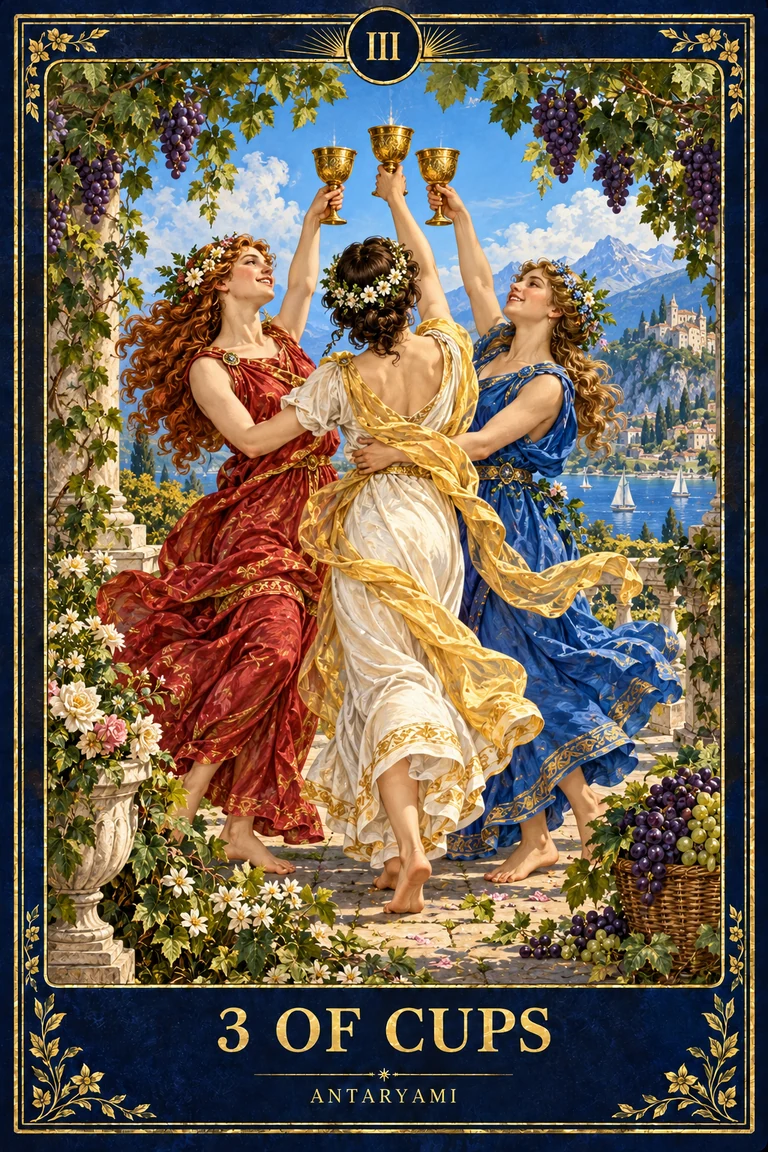
Three of Cups meaning: a group becomes meaningful through how people take part
Contemporary Three of Cups readings commonly emphasise friendship, community, shared joy, support and celebration. The image contains more than one relationship, which makes it useful for examining how a group feels to its participants. Being invited is one stage; feeling able to contribute is another. A person may attend every gathering and still remain unheard. The card can prompt a question about participation rather than assuming that the presence of several smiling people establishes a genuinely welcoming community.
Suppose a creative group meets regularly, but only two members decide the activities. Others may enjoy the occasion while also wanting a chance to shape it. A Three of Cups reflection could ask how ideas are invited and whether newcomers understand the informal rules. A simple rotation of responsibilities or a clear space for suggestions may make the group more participatory. That is an ordinary arrangement, not a mystical change in collective energy. The value comes from the people having a more real place in what they share.
Support also needs boundaries. Friends can celebrate one another without being available for every request or agreeing on every opinion. A community becomes more durable when these differences can be expressed without immediate exclusion. The card's joy should not become a requirement to remain cheerful at all times. Ask whether people can bring an ordinary difficult day as well as good news. A group that allows honest participation may offer more meaningful belonging than one whose togetherness depends on everyone performing the same mood.
Three raised cups: celebration has a recognisable historical scene
Antaryami's original Three of Cups shows three figures raising their vessels in a colourful garden. The cups meet in the centre, while the figures remain distinct. That composition can inspire a useful question about shared experience: what are the people acknowledging together, and what does each bring? The image does not identify the members of your own group or reveal their private conversations. It gives a scene for reflection, not a social surveillance capability.
Waite describes figures in a garden holding up their cups in shared merriment, and his meanings include a fulfilled conclusion and celebration. His reversed account also contains achievement alongside excess, so it is not simply a historical declaration that friendship becomes isolation upside down. This guide develops community and social-boundary questions as contemporary applications. The Museum Tarot artwork is newly created, with its own setting and visual choices, rather than a reproduction of Pamela Colman Smith's original illustration.
The number three should not be treated as evidence of a romantic triangle or three specific people working against you. Context and actual behaviour are required for those claims. If the question concerns your friendships, ask what is observable: invitations, listening, shared responsibility and respect for privacy. A cheerful picture can prompt appreciation of those qualities without proving they exist in every group you belong to. Its symbolic richness is strongest when it helps you examine participation, not when it supplies a dramatic story the real relationships have not established.
Sources: Waite: Three of Cups garden, shared merriment and completion
Upright: make room for someone else’s good news
An upright Three of Cups reflection can encourage a simple act of friendship: receiving another person's achievement without immediately comparing it with your own position. You can be pleased for them while still having unfinished goals. Ask what the milestone means to them and how they would like to mark it. Not every occasion needs an elaborate event. A thoughtful message, a small meal or attentive listening may fit better than a public celebration they did not request.
For your own good news, consider who would enjoy sharing the moment and what invitation would be manageable. You do not need to wait for a spectacular achievement before involving people who care about you. At the same time, avoid turning the gathering into a demand for admiration. A shared celebration allows other people to participate in their own way. Some may be excited but unavailable; others may prefer a quieter acknowledgement. Their different response does not automatically invalidate the friendship.
The upright theme can also prompt renewed participation after a busy period. You might contact a group you value, offer to help with a small task or suggest an activity that does not require everyone to spend heavily. Community grows through repeated, ordinary exchanges. The card does not guarantee a warm reception, but it can encourage a clear and respectful invitation. Choose a contribution that fits your capacity, so returning to the group becomes a genuine connection rather than another promise you feel obliged to maintain beyond your available time.
Reversed: notice exclusion, excess or an invitation that costs too much
A reversed Three of Cups can prompt reflection on social pressure, exclusion, excessive participation or a group whose expectations no longer fit. Begin with the actual concern. You may be attending too many events, feeling unable to decline or noticing that your contribution is consistently overlooked. Those patterns deserve different responses. The card cannot determine that someone is gossiping or that the whole group is false. Ask what happened, what was agreed and what change would make participation more honest.
Imagine a friendship circle where every gathering requires spending beyond your comfort. You might suggest a simpler activity or explain your limit. A welcoming group should be able to hear that without treating it as rejection. Conversely, if you have withdrawn from every invitation because you assume you will not belong, a small, manageable return may provide better information. The reversed theme can help you examine the pattern, but it should not shame you into socialising when privacy or rest is what you actually need.
Excess can also concern the way an occasion is organised. A celebration may become so elaborate that people spend more effort performing enjoyment than experiencing it. Simplify the plan around what matters most. Waite's historical reversed account leaves room for achievement as well as excess, which is another reason not to force a negative verdict. The useful modern question is whether the shared experience remains voluntary, proportionate and genuinely connected to the people involved. A quieter gathering may express the same friendship more clearly than an impressive but exhausting event.
Relationships: friendship is not a lesser form of connection
The Three of Cups can be useful in a relationship reading because it brings community into view. A romantic partnership does not have to supply every kind of support, interest and social experience. Friends and creative groups may hold parts of life that remain meaningful in their own right. Ask whether the relationship allows those connections without possessiveness. The card does not prove that a partner is jealous or unfaithful; it can simply prompt a conversation about how each person maintains a wider social world.
For someone single, the image can invite appreciation of existing friendship rather than treating social life as a waiting room for romance. You may want a partner and still recognise the value of people already present. A practical reflection could be identifying one connection you have neglected and making a clear invitation to reconnect. Leave room for their circumstances and response. Friendship is not restored by declaring that the card predicts a reunion; it develops through actual participation and the willingness of the people involved.
Do not turn three figures into a verdict about a third party in a romantic relationship. If you have a real concern, discuss the relevant behaviour and agreements or seek appropriate support. The picture provides no private evidence. Likewise, a group celebration should not pressure someone to disclose personal news before they are ready. Respect confidentiality and ask before sharing images or stories. The Three's most constructive relational theme is a network of connection in which people can celebrate, contribute and keep the boundaries that make participation safe and voluntary.
Work: a supportive group should share more than the photograph
A Three of Cups workplace reflection can ask how a team recognises shared effort. An event may be enjoyable, but the deeper question is whether people understand their contribution and can participate in shaping the work. Clear credit, useful feedback and fair responsibilities matter beyond the celebration. A group photograph cannot establish a healthy team culture. The card can prompt attention to the ordinary exchanges that make cooperation feel real, including whether someone can raise a concern without spoiling the approved mood.
For a creative community, think about access. Are newcomers given enough information to join? Does the group rely on expensive equipment, insider language or informal expectations nobody explains? A small change in instructions or format may make participation easier. That is not a guarantee that every community can serve everyone, but it makes the boundaries clearer. A welcoming group can state who the activity is for and what it requires, rather than inviting broadly and leaving people to discover hidden conditions after they arrive.
Commercial networking should remain honest too. A friendly conversation does not establish a partnership, testimonial or endorsement. Ask before using another person's name or image to promote your work. Tarot cannot validate a business relationship or predict the value of a network. The practical question is what kind of exchange is actually available. A group becomes useful when people understand the purpose, terms and freedom involved, not when social warmth is converted into an obligation to buy, recommend or publicly approve something they have not evaluated.
Three of Cups versus Four of Wands and Two of Cups
The Three of Cups foregrounds friendship and shared participation among a group. The Four of Wands often highlights a milestone or welcoming setting, while the Two of Cups foregrounds a mutual exchange between two participants. These distinctions can help you ask the right question. Is the issue the group dynamic, the occasion being organised or a particular relationship within it? One gathering may involve all three, but the cards do not need to collapse into a generic prediction of happiness.
Imagine a reunion. The Three's lens may ask whether people feel included and able to contribute. The Four's lens may ask what the occasion recognises and how it is arranged. The Two's lens may ask about a meaningful conversation with one person. Each offers a different scale of reflection. None establishes that the reunion will happen or that every participant will feel the same way. The comparison helps you design a more thoughtful experience from actual preferences and circumstances rather than assuming a cheerful card has settled them.
Another misconception is that a community card requires constant sociability. Some people connect through small groups, shared work or occasional quiet meetings. Those forms are not less legitimate because they look different from the image. Ask what kind of participation fits your life and the people you care about. The Three becomes more inclusive when its joy is interpreted as a quality of connection rather than a compulsory style. You can value friendship without making every weekend public, crowded or available for another celebration.
An Antaryami community question: where can I contribute and belong?
For an Antaryami tarot draw, try what would make this group connection more genuine. The named position can narrow the Three's role: a resource may be support, while a challenge may be social pressure or uneven participation. The inspected walkthrough allows optional questions and reversals, but it does not monitor conversations or identify hidden gossip. Keep the reading connected to the exchanges you can observe and the respectful invitation you can actually make, with other people's privacy and freedom remaining intact.
Create a community note in your own journal. Name one group or friendship you value, one contribution you can offer and one boundary that helps you participate sustainably. Then choose a small action: send a specific invitation, thank someone or ask how a newcomer could join. Afterward, notice whether the exchange felt more open and what you learned about the group's actual preferences. The exercise is not a popularity measure. It helps you shape participation around real people rather than around an ideal picture of togetherness.
Explore Antaryami's tarot product guides and current app availability to see whether this reflective approach suits you. Nitish Raj Walia's Journal for Temior Technologies Pvt Ltd pairs individual artwork with practical explanations, making discovery an invitation to understand rather than a demand to believe. The Three of Cups leaves a useful final thought for a growing brand too: community is built through genuine participation, clear information and respect for the people who arrive. A following is more valuable when it comes from a worthwhile experience than from the appearance of a crowd.
Make one connection more participatory
I attend the group but rarely feel included in its choices
Ask how suggestions are invited and offer one manageable contribution. A welcoming group can make its process clearer, rather than assuming attendance alone proves that every participant feels they belong.
Social plans keep exceeding my time or budget
State a practical limit and suggest a simpler alternative where appropriate. Friendship can remain warm while the form of participation changes to something you can genuinely sustain.
Astrological interpretations are for reflection, not a diagnosis, a guaranteed prediction or a substitute for professional advice. Journal guides are prepared with AI assistance; they are educational content, not individual consultations.


