Antaryami
Tarot reading workshop
Two of Swords and Seven of Cups: missing information or too many options?
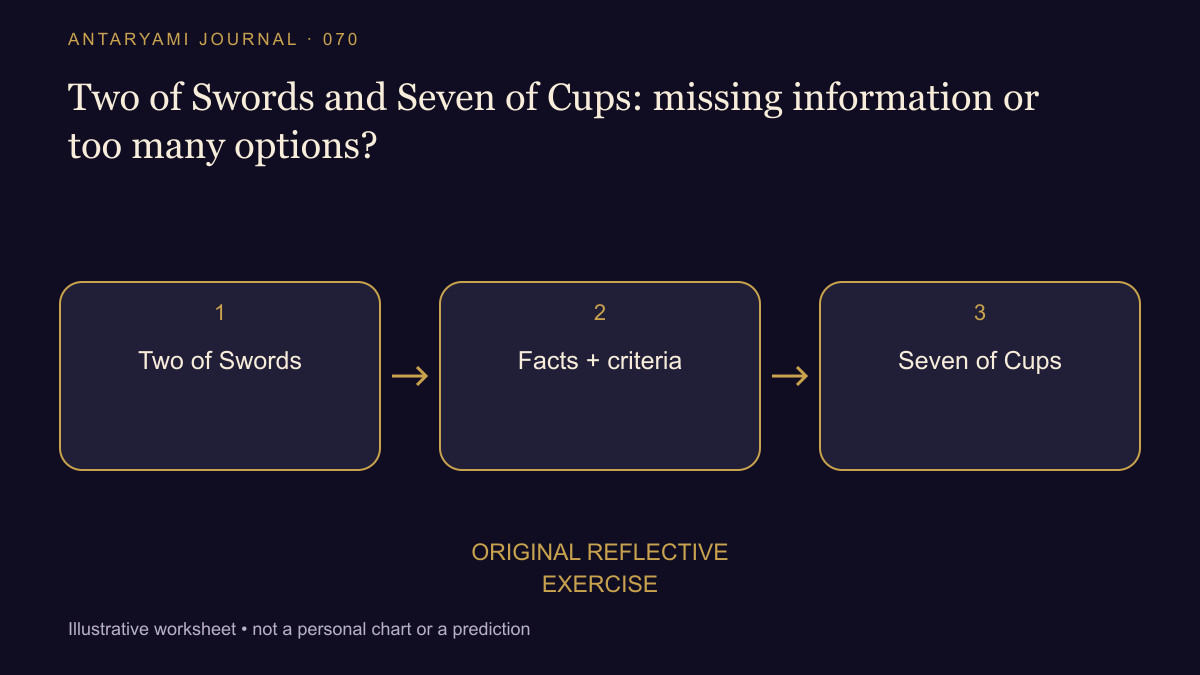
Being unable to decide can mean that crucial information is missing, that the options have not been made comparable, or simply that there are too many possibilities. Those are different problems. This original Two-of-Swords-and-Seven-of-Cups exercise uses two prompts to separate them. It does not diagnose indecision or imply that the cards know which choice is correct.
Ask what fact would change the decision
Imagine a fictional person choosing a weekend course. One option has not confirmed its dates; another lists several attractive topics without explaining the actual timetable. Use the Two of Swords position here to identify information that is genuinely necessary. Availability, total cost and accessibility may matter more than an appealing description.
Write one question for the provider that could alter the decision. If the answer is unknown, mark it unknown. Do not replace the missing detail with an intuitive claim that the provider is hiding something. The reading cannot verify an unpublished schedule or another person's motives.
Reduce options using declared criteria
Use the Seven of Cups position to examine the number and comparability of the options. Pick two or three practical criteria before ranking anything: dates, a maximum affordable cost and the specific skill to be taught. Remove options that fail a non-negotiable requirement rather than repeatedly imagining every possible outcome.
Make sure the criteria are the person's own. A reader should not introduce a more expensive option because it supposedly matches the spread, or describe hesitation as a reason to purchase urgently. An attractive symbolic narrative does not change the person's resources or establish the quality of a course.
Set a proportionate decision point
Choose a date to review the provider's reply and the narrowed list. If essential information remains unavailable, deciding not to book can be a legitimate outcome. A deadline set by a seller is not automatically a reason to abandon ordinary checks. Avoid inventing urgency where the actual situation allows time.
Save the known facts, the unanswered question and the selected criteria separately from the card interpretation. After deciding, record what the eventual experience showed, including shortcomings that the reading did not anticipate. Historical card references offer context, while this exercise supplies a contemporary decision structure. Its purpose is to make uncertainty manageable, not to transform a picture into private knowledge or guarantee that narrowing the list will produce the best possible future.
For a written comparison, retain the unanswered factual question beside each option. An empty field should stay empty until the provider supplies the information; an imagined answer is not a completed check.
Astrological interpretations are for reflection, not a diagnosis, a guaranteed prediction or a substitute for professional advice. Journal guides are prepared with AI assistance; they are educational content, not individual consultations.