Antaryami
Chart essentials
A first look at your Bhacakra
The first time you see a birth chart, it can feel like everyone else already knows the language. Start smaller. You do not need to understand every symbol to begin looking with care.
Before the meaning, check the details
Your birth date, time and birthplace are the starting information for your chart. Before exploring any interpretation, check that you are viewing the intended profile and that its details match the information you meant to enter.
A public illustration is different. It can help you recognise the instrument, but its placements do not describe you. The examples on this website are for exploration; your personal journey begins with your own saved profile.
Give yourself permission to begin as a beginner. An unfamiliar wheel can make the subject appear more complicated than the first question really is. You are not being asked to interpret every relationship at once. Before exploring, identify whether the screen shows an educational example or a personal chart. An example is there to help you learn the instrument. A personal view needs the correct saved profile and birth inputs. That distinction is more important than recognising every symbol on the ring.
For a personal view, read the name and check the birth record context before accepting the accompanying text. If the account contains several people, the selected profile should determine the entire personal experience, not merely the heading. Similar names, shared family details or a familiar paragraph do not establish ownership. The chart, placement list and interpretation must refer to the same person. If they do not, stop and describe the mismatch rather than trying to make the reading fit.
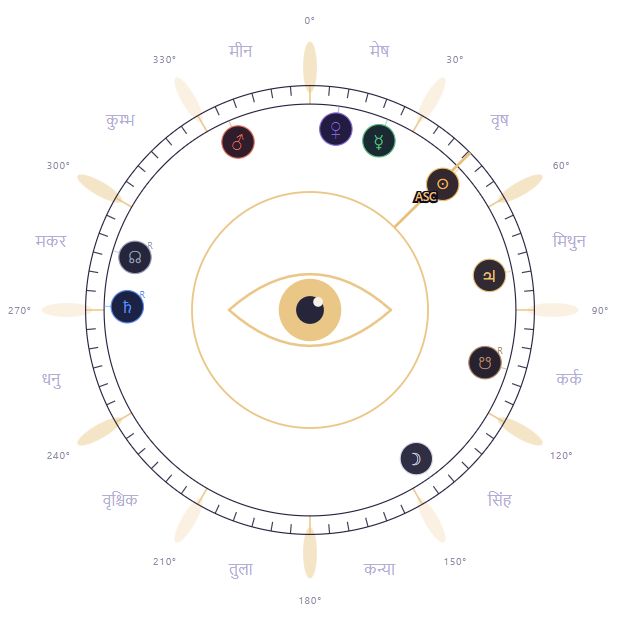
It can help to think of the first visit as learning a new map. You begin by finding the legend and the reference point, not by memorising every street. The same habit works here. Read how the view labels signs, planets and the Ascendant. If a small marker is unclear, use its named explanation rather than guessing from the colour or shape. Good orientation makes the later meaning easier to follow.
Take one marker at a time
The Bhacakra brings the chart into a circular view. The outer ring provides a frame of reference for the zodiac, while individual markers show positions within that frame. Start with one marker and read the explanation alongside it.
Resist the urge to turn a single symbol into a complete description of yourself. A chart is a collection of relationships, not a scorecard. It is fine to have a question, to need another explanation, or to leave something for a later visit.
Choose one object that you can identify by name, such as the Moon. Find it in the wheel, then locate the corresponding placement in the table or explanation. You are checking that you understand what the display represents. The visual arrangement may shift markers slightly to avoid overlap, so the drawn spacing should not be treated as a ruler for measuring an exact angular separation. The underlying values, with their labels, are the reference for that question.
Once you find the object, read its sign and house as different pieces of information. A sign name does not answer the same question as a house label. Nor is a motion marker a second planet. It is normal to need a little time with the legend. If the explanation introduces another term, ask what that term contributes to this placement before following the next link. A small sequence of clear questions is easier to retain than a flood of definitions.
You can repeat the exercise with a second marker and then stop. That is already progress: you have connected a symbol, a named value and an explanation. There is no requirement to turn the whole wheel into a single story about yourself on the first visit. A diagram can remain partly unfamiliar while still becoming approachable. Learning the instrument is a real outcome, even when you have not reached an interpretation that feels personally significant.
A position is not a prediction
There are two different steps here: calculating a position and interpreting it. A calculation depends on the supplied details and the selected method. An interpretation belongs to an astrological tradition; it does not establish that a particular event must happen.
The public Antaryami instrument example uses Antaryami Traditional. When comparing it with another chart, compare the inputs and method as well as the picture. An illustration or a different calculation convention is not a like-for-like comparison with your own result.
The explanation beside a marker has a different role from the marker's position. A position is calculated under stated inputs and conventions. The traditional meaning of that position is interpretive. This means a sentence can invite reflection without becoming a demonstrated prediction. If it mentions a theme such as communication or responsibility, ask which experience you want to consider. Do not assume that a precise degree value gives every accompanying sentence the same kind of precision.
Antaryami has licensed Swiss Ephemeris for astronomical calculations. That fact belongs to the calculation foundation, not to a claim that all interpretations are proven. The actual engine used by a particular chart surface must be verified and disclosed separately. A public fictional instrument is not a live private chart, even when it uses the same visual language. Keep the display context visible when moving between the website tour and any personal account experience.
If you compare the Bhacakra with another chart format, compare the same person and method. A diamond diagram and a wheel can arrange equivalent information differently. Conversely, two similar wheels can use different conventions. The shape alone cannot settle the comparison. Choose a named object and inspect its relevant values before deciding that the pictures disagree. That gives you a question a technical explanation can actually address.
Make the first visit a small one
- Check the selected profile and its birth details.
- Choose one marker and read its explanation in context.
- Ask what feels relevant to your lived experience, and what does not.
- Leave with a question to reflect on, rather than a label to live under.
You can explore a fictional example on the website before sharing any birth details. Return when you are curious. There is no requirement to understand the whole chart in one sitting.
At the end of the visit, choose one thing you can now explain in ordinary language. Perhaps you understand what a marker represents, or why the example is not your own chart. You do not need a dramatic insight. Write a question for a later visit if there is something you want to explore further. A useful stopping point is when the information has become clearer, not when you have exhausted every possible interpretation.
If you find the topic emotionally charged, let the chart remain a prompt rather than a verdict. A description that does not fit your experience can be left aside. A consequential choice needs the facts of the situation and appropriate support, not just another symbolic explanation. The instrument should create room for curiosity, not make you feel that every decision must wait for a planetary answer.
Nitish Raj Walia's Antaryami Journal is written to make these first steps less intimidating. Explore at your own pace, thank yourself for checking the basics and return when a question genuinely interests you. The Bhacakra is a way into a traditional framework. It is not a test you must pass, a label you must live under or a reason to give away your judgement. One well-understood marker is a good beginning.
Astrological interpretations are for reflection, not a diagnosis, a guaranteed prediction or a substitute for professional advice. Journal guides are prepared with AI assistance; they are educational content, not individual consultations.