Antaryami
Chart essentials
Moon sign vs Sun sign vs rising sign: what is different?
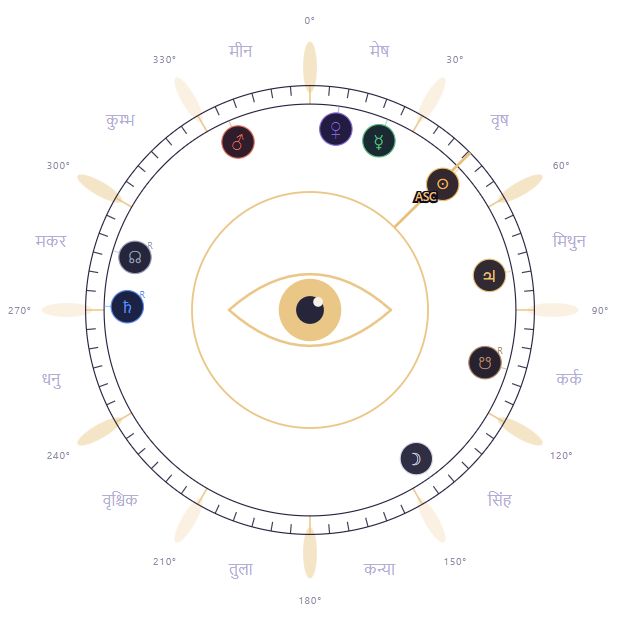
Your Sun sign, Moon sign and rising sign describe different positions in an astrological chart. They do not have to match. The rising sign is also called the Ascendant or Lagna; it is not another name for the Moon sign.

Three labels, three reference points
The Sun sign locates the Sun within the chosen zodiac. The Moon sign does the same for the Moon. The rising sign identifies the zodiac sign rising at the eastern horizon for the birth moment and location. Knowing one of these labels does not allow you to infer the other two, even when a popular description sounds familiar.
You may have known one zodiac sign for years, then opened a birth chart and met two unfamiliar ones. That can feel as if somebody has changed the answer halfway through the conversation. They have not necessarily changed anything. A birthday-based Sun-sign label was only one piece of the chart. The Moon and the Ascendant answer different positional questions, so their sign names need not match the one you already knew. The first task is to identify which label each screen is showing.
Try making three separate lines in a notebook: Sun, Moon and Ascendant. Beside each, write the sign displayed by the same calculation. Do not begin with a paragraph about personality. Begin with the labels themselves. If the interface uses "Lagna" or "rising," place it on the Ascendant line. If it says "Rashi," check the surrounding explanation rather than assuming every service uses that word in precisely the same way. Clear naming saves a surprising amount of confusion before interpretation begins.
The distinction becomes especially useful when somebody asks, "What is your sign?" In a casual conversation they may mean the Sun sign. In another context they may be discussing the Moon sign. You can ask which one they mean without making the exchange complicated. The same word can be used as shorthand for different things. What matters is that you and the person explaining the chart are pointing to the same reference, not that you choose one label to represent every part of yourself.
Why the birth time matters
The Ascendant needs a reliable time and place. The Moon can also cross a sign boundary during a birth date, so a date alone may not settle its sign. Even a Sun placement near a boundary needs careful calculation. Do not substitute personality preferences for missing birth information or choose a time because you prefer a particular result.
Now consider a birth date for which the Moon moves across a sign boundary. Two people born on that date need not receive the same Moon sign. That does not mean their personalities must oppose each other; it means a date-only shortcut may not settle the placement. The exact timing of the boundary needs calculation within the chosen zodiac convention. Do not replace that calculation with an assumption based on the time of day, a social-media table or which description seems more flattering.
For the Ascendant, the local birth time and location are central to the calculation. A vague remembered time should remain visibly vague. If you test several possible times, label those results as alternatives rather than selecting the chart you like best. A useful comparison asks which values remain stable across the uncertainty window and which do not. That is an investigation of the inputs, not a personality quiz designed to recover a missing clock reading.
Even apparently precise data deserve a brief review. Was the date entered in the intended format? Is the city correct? Has someone already converted the local time before entering it into a form that expects local time? You do not have to become a time-zone specialist, but you should know what the original record said. Keeping the original information separate from any conversion makes it easier to resolve a disagreement later without repeatedly rewriting the saved profile.
Why two websites may disagree
Check whether both services use the same zodiac. A sidereal chart and a tropical chart need not give the same sign labels. Also compare local time, date format and city selection. A disagreement is a reason to inspect the inputs and conventions, not immediate evidence that one website has discovered your true personality and the other has failed.
When two services show different signs, compare like with like. A sidereal Moon sign and a tropical Moon sign are not automatically contradictory answers to the same configured calculation. Nor is a house number another version of a sign name. Copy the object name, zodiac convention and relevant method beside the result. Once those are aligned, you can investigate an actual discrepancy instead of comparing two screenshots that quietly answer different questions.
This is also where impressive technical branding needs a careful reading. Antaryami uses Swiss Ephemeris as part of its astronomical calculation foundation, but naming an engine is not enough to explain every result. Inputs, time handling and calculation settings still matter. An engine computes positions; the application selects conventions and presents them. The traditional meaning attached to a placement is another layer again. Good explanations let you see those layers instead of blending them into one promise of absolute certainty.
If a label changes when you switch language, the underlying placement should not change merely because the wording does. If a label changes when you switch profiles, it may correctly reflect another person. These two situations need different checks. First confirm whose chart is open, then inspect the method. In a shared account, treating the profile name as decoration is a mistake: it is the boundary that tells you which person the entire personal reading should concern.
A useful way to read the three together
Treat the three placements as different traditional perspectives, not competing identities. Write down each placement with its calculation settings and one question it raises. Check descriptions against lived examples, including examples that do not fit. On a shared family account, confirm the profile again before opening a personal interpretation; similar names are not enough to identify the correct chart.
Once the values are checked, you can approach the traditional descriptions with a little more freedom. Rather than deciding which of the three signs is the "real you," ask what each explanation invites you to consider. A communication theme might lead to a question about how you express needs. An emotional theme might prompt a note about how you respond under pressure. These are possibilities for reflection, not measurements that establish your character.
Try discussing one example with someone who knows you well, provided you are comfortable doing so. Ask whether the observation fits a specific situation, not whether they agree with a label. They may notice a pattern you missed, or offer a counterexample. Leave room for that disagreement. A conversation becomes richer when the chart is a starting point rather than an authority that everyone must accept before speaking.
You can also decide that a description does not help today. There is no obligation to find a profound connection in every line. With Antaryami, the useful outcome is understanding what you are reading and retaining your own judgement. Keep the three reference points distinct, keep the selected profile correct, and take one worthwhile question away. You are a whole person, not an exercise in getting three sign descriptions to agree.
Astrological interpretations are for reflection, not a diagnosis, a guaranteed prediction or a substitute for professional advice. Journal guides are prepared with AI assistance; they are educational content, not individual consultations.