 Antaryami
Tarot card meanings
Ace of Swords tarot card: make the question clear before you call the answer certain
A tangled situation sometimes changes after one precise sentence. You identify the actual problem, ask the question everyone has avoided or realise that two people have been using the same word differently. The Ace of Swords gives that clarifying moment a memorable image. This Antaryami guide by Nitish Raj Walia explores a sharp idea without confusing it with an infallible answer. A clear question is a beginning: it makes evidence easier to examine and conversation easier to conduct. It does not prove that your first conclusion is right. The sword's useful edge is the distinction it helps you make, while its responsibility lies in what happens when you bring that distinction into someone else's life.
Ace of Swords meaning: clarity starts by separating the questions
In contemporary tarot, the Ace of Swords is often associated with a fresh understanding, clear language, discernment or the beginning of a more direct approach. Swords commonly provide a vocabulary for thought, communication and conflict. The Ace concentrates that vocabulary into a point of entry. Something previously vague can become specific enough to inspect. This is an interpretive theme, not evidence that a card has delivered objective truth or that a sudden thought deserves more trust than the facts available to support it.
Imagine a project described as not working. That phrase could mean a missed deadline, an unclear audience, an unreliable tool or disagreement about the purpose. Each possibility requires a different response. An Ace of Swords reflection might help you replace the broad complaint with a precise question: which part is failing, for whom and according to what expectation? The sharper wording does not solve the project by itself. It identifies where investigation can begin, allowing the next conversation to concern something people can actually observe.
Clarity can also reveal that you have been trying to answer several questions at once. Whether you enjoy an opportunity, can afford its cost and have time to pursue it are related but distinct matters. Write them separately. A compelling answer to one does not automatically settle the others. The card's most useful beginning is a distinction that reduces confusion without pretending uncertainty has disappeared. A clear mind can remain uncertain, provided it knows what is uncertain and what information would make the situation easier to understand.
The crowned blade: a strong idea also carries responsibility
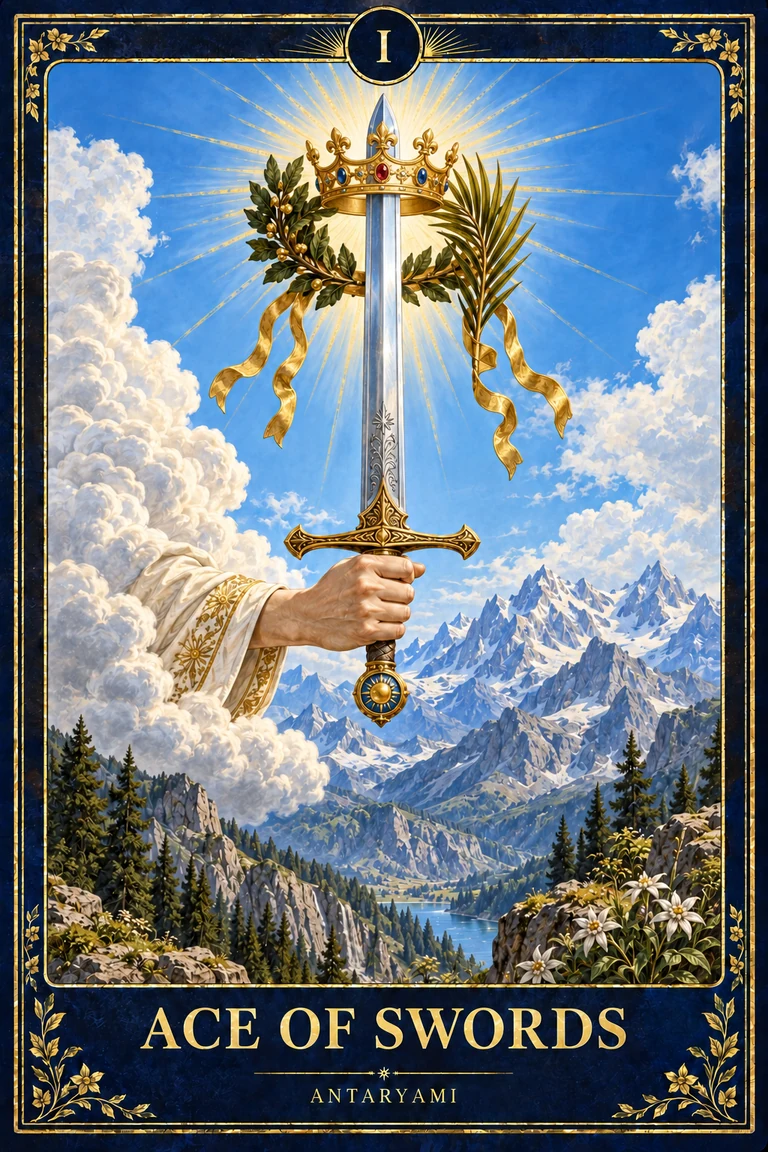
Antaryami's original Ace of Swords shows an upright blade held from a cloud, passing through a crown above an open mountain landscape. The composition draws your attention to an edge and a visible point. That can suggest precision, authority or the force with which an idea is expressed. Our Museum Tarot image is a new illustration inspired by recognisable motifs, not a historical facsimile. Its landscape and ornament should be enjoyed as artistic choices rather than assigned meanings that an original source has not established.
Waite describes a cloud-held sword with a crown around its point and emphasises force and triumph in his historical account. That differs from treating clarity as the card's sole timeless meaning. This guide's question-led approach is contemporary, informed by the image but not presented as a literal restatement of every old divinatory association. Historical lists include extreme claims and inconsistent alternatives; those do not become evidence about a person's health, relationships or future simply because they appear in an influential book.
The sword offers another useful distinction: precision and harshness are not identical. A sentence can be accurate without being humiliating. A claim can sound decisive while remaining unsupported. Consider whether your language makes the issue more understandable or merely makes your position harder to challenge. The crown does not certify authority. In an actual exchange, authority must come from the relevant role, evidence and accountability. A beautiful symbol can remind you to examine those things rather than serving as a substitute for them.
Sources: Waite: Ace of Swords crowned blade and the force of its historical meanings
Upright: say exactly what you know and what you still need
An upright Ace of Swords can prompt a direct, proportionate conversation. State the observation, the question it raises and the information you need. If a delivery has not arrived, ask about its actual status rather than announcing that the whole arrangement is unreliable. If a message is unclear, request the missing detail instead of filling it with an assumption. The useful edge is specific enough to obtain a meaningful answer, while leaving the other person room to provide information you did not already have.
For a personal decision, make the criteria explicit before comparing options. Perhaps the choice must fit a certain time commitment, cost and purpose. Write those conditions down. An appealing option may satisfy one beautifully while failing another that matters more. Clear criteria help you see that trade-off without turning the decision into a referendum on your confidence. The card can support a disciplined question, but it cannot select the objectively best path or know how an uncertain opportunity will unfold after you choose it.
In writing, the same theme may involve replacing a vague promise with an understandable statement. What does the reader receive? What remains unavailable? What should they compare before taking the next step? A precise explanation can be persuasive because it gives curiosity something real to inspect. Upright clarity is most useful when it increases the reader's freedom to understand and decide. It is less useful when a polished sentence creates certainty by leaving out the limits that would make the claim accurate.
Reversed: when a sharp statement outruns its evidence
A reversed Ace of Swords can prompt reflection on confusion, premature certainty, an unclear argument or language used more forcefully than the facts justify. Start by checking the claim rather than interpreting the reversal as a verdict about your intelligence. What supports the conclusion? Which terms are undefined? Have you mistaken a feeling of insight for verification? These questions can improve an actual decision. The card itself does not establish that someone is lying, that a plan is doomed or that you have missed a hidden truth.
Suppose a striking online statement feels immediately convincing. Before sharing it, identify the source, the context and whether the evidence says what the headline implies. A memorable explanation may still omit an important qualification. You do not need to become cynical about every idea; you need a way to distinguish interest from endorsement. The reversed theme can help you hold that small pause, allowing a useful question to remain open long enough that confidence is shaped by information rather than by the sentence's dramatic effect.
Another version is knowing what you mean but communicating it in a form the listener cannot follow. Try a concrete example, separate the main point from its exceptions and ask what remains unclear. Precision is a relationship between an explanation and the matter it explains, not a performance of complexity. Waite's reversed account is not simply the modern keyword confusion, so this article labels that reading as contemporary. The practical goal is to make the reasoning inspectable, whether the needed change is better evidence, clearer language or a less absolute conclusion.
Relationships: directness can create room for understanding
In relationship reflection, the Ace of Swords can invite an honest conversation about a specific need or misunderstanding. Begin with what happened and how it affected you, rather than claiming to know the other person's motive. The card cannot confirm infidelity, reveal secret feelings or prove that a difficult truth is about to be exposed. A useful question concerns the exchange you can actually have: what needs to be said clearly, what needs to be asked and which assumptions should remain assumptions until the person responds.
Imagine two friends disagreeing about a cancelled plan. One sees it as an ordinary change; the other feels that repeated cancellations have made the arrangement difficult to rely on. A clear conversation could separate the latest event from the pattern and ask what each person can realistically commit to. The distinction reduces the chance that a practical issue becomes a global judgment about the friendship. It does not guarantee agreement, but it makes disagreement easier to understand and a possible new arrangement easier to describe.
Directness should also respect timing and consent. Not every important conversation belongs in a public setting or at the moment you first feel ready to speak. Ask for an appropriate time and keep the topic proportionate. A sharp statement does not become kinder merely because it is true, and kindness does not require concealing the matter indefinitely. The card's contemporary invitation is to give the issue a clear form that another person can meet, while remaining willing to hear an answer different from the one you hoped the conversation would produce.
Work: a clear brief prevents different people from solving different problems
An Ace of Swords workplace reflection can help at the beginning of a brief, proposal or difficult review. Define the intended result and the standard by which it will be assessed. Words such as premium, fast or simple can mean different things to different people. Add examples and practical constraints. A shared definition makes collaboration more efficient because participants can notice differences before investing effort in incompatible directions. The card offers a prompt for that definition, not a substitute for the relevant expertise or a guarantee that the project will succeed.
For a product page, clarity includes separating a demonstration from a customer's actual result. A fictional sample can show the interface, but its output should not be presented as proof of a prediction's accuracy. Likewise, an astronomical engine label should describe the calculation scope rather than guarantee every interpretation attached to it. A well-formed claim helps the visitor understand what is being shown and which question the tool can address. Its precision becomes part of the experience, allowing beauty and substance to support each other.
Consequential financial, legal or health decisions need appropriate evidence and qualified advice. A symbolic reading cannot verify a contract, establish a diagnosis or forecast a return. Keep that distinction in view without turning every ordinary creative question into a high-stakes matter. If the task is choosing a clearer heading or asking about a deadline, a simple practical response may be enough. The Ace theme becomes professionally useful when it helps identify the right kind of question and the right standard of evidence for answering it.
Ace of Swords versus Justice and Two of Swords
The Ace of Swords often foregrounds a clarifying beginning. Justice foregrounds standards, fairness and accountability within a larger framework. The Two of Swords foregrounds a balanced or suspended position between competing considerations. These interpretations overlap but ask different questions. Are you defining the issue, evaluating it against a standard or pausing because the options remain difficult to distinguish? The answer comes from the situation. A card's place in the deck does not determine which stage your actual decision has reached.
Suppose you are comparing two ways to run a workshop. An Ace lens might help define what the workshop must accomplish. A Justice lens might ask whether its terms are clear and fair to everyone involved. A Two lens might examine what remains unresolved between the alternatives and whether a bounded pause would obtain useful information. None proves which choice will attract more participants. The comparison helps you see which work is still needed, so a sudden insight does not pretend to complete an evaluation that has not yet happened.
Another misconception is that the sword must mean conflict. Thought and language can also clarify, teach or reconcile. Conversely, a calm explanation can still carry an unfair assumption. Read the symbol through its actual use rather than a single dramatic keyword. The Ace can invite an argument worth examining, a question worth sharpening or a statement worth revising. Its usefulness lies in the distinction it makes available, not in a promise that clarity always arrives comfortably or that every clear-sounding conclusion deserves to be believed.
Try an Antaryami clarity sheet: observation, interpretation and the unanswered question
For an Antaryami tarot draw, ask which distinction would make this situation easier to understand. The Ace's named spread position may frame a resource of direct language or a challenge of unsupported certainty. The inspected tarot walkthrough supports optional questions and reversals; it does not authenticate a thought or reveal concealed facts. Use the reading to improve your own inquiry. If the matter concerns another person's intentions, a medical question or a consequential commitment, obtain the relevant real-world information rather than treating the card as the missing evidence.
In your own notebook, make a clarity sheet with three lines: what you observed, what you interpreted and what remains unanswered. Keep the first two separate even when the interpretation feels persuasive. Rewrite the last line as a question someone could reasonably investigate. After you obtain an answer, note whether it changed the original interpretation. This exercise does not demonstrate predictive accuracy. It turns the card's visual precision into a practice that can be checked through the quality of your questions and the information they make available.
Look through Antaryami's tarot walkthrough and current app page to see how that questioning approach fits the product before choosing access. Nitish Raj Walia's Journal for Temior Technologies Pvt Ltd gives the original artwork a substantial companion: recognisable symbolism, historical context and examples that bring the idea into ordinary conversation. The Ace of Swords is a fitting doorway for curious readers. Let the image catch your eye, let the explanation sharpen the question and let the actual product details guide whether you wish to take the exploration further.
Make the question sharper than the assumption
A situation feels wrong but I cannot name the actual problem
Separate the broad complaint into observable parts: timing, purpose, reliability or communication. Choose the part you can investigate so the next conversation asks something a person can meaningfully answer.
An explanation sounds decisive but I have not checked its basis
Identify the evidence, the missing context and any terms that remain undefined. Interest can justify looking closer without requiring you to endorse the claim before that work is done.
Astrological interpretations are for reflection, not a diagnosis, a guaranteed prediction or a substitute for professional advice. Journal guides are prepared with AI assistance; they are educational content, not individual consultations.


