 Antaryami
Tarot card meanings
Two of Swords tarot card: give a difficult choice a useful pause, not an endless waiting room
Not choosing can feel like keeping every possibility safe. For a while, that may be useful: you need information, a quieter conversation or enough distance to understand what matters. Then the pause can start doing something different. It keeps the options suspended while the situation moves on without you. The Two of Swords gives that tension a still, carefully balanced picture. In this Antaryami guide, Nitish Raj Walia explores how to make a difficult pause purposeful. The card does not prove that you are indecisive or tell you which option to select. It asks what the pause is protecting, what it is costing and what would make a real next step possible.
Two of Swords meaning: balance and stalemate can look similar
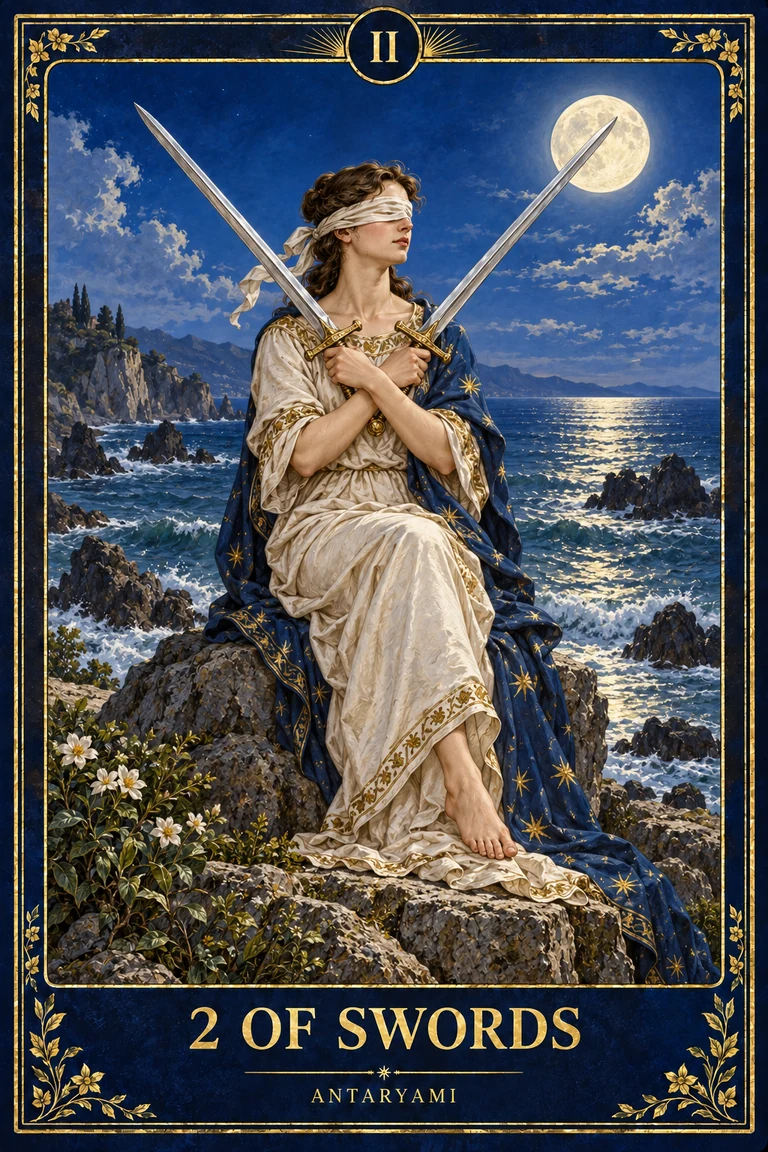
Contemporary Two of Swords readings often emphasise a difficult choice, competing considerations, guarded balance or a temporary stalemate. The seated figure holds two blades in a symmetrical arrangement, making suspension part of the scene. Yet suspension is not automatically a failure. You may need to prevent a rushed decision while you clarify the terms. The useful question is whether the pause serves an identifiable purpose. A tarot interpretation cannot establish that either option is secretly right or that remaining still is necessarily wiser than moving.
Imagine two possible schedules for a shared project. Each works well for one person and less well for another. Choosing immediately may overlook information about availability or workload. A bounded pause could gather that information and allow the group to compare the actual trade-offs. An endless pause, however, leaves everyone unable to prepare. The Two lens can help you distinguish a useful interval from a decision that has no route toward resolution, without treating every delay as weakness or every quick answer as courage.
Balance may also mean acknowledging that two values matter even when they cannot both be fully satisfied. You might want flexibility and predictability, privacy and support, or independence and collaboration. Naming the tension can be more useful than searching for an option with no cost at all. The card's stillness offers space to see the competing needs clearly. The next step is not always selecting one against the other; sometimes it is designing a smaller arrangement that honours enough of each to be workable.
The blindfold and crossed blades: what is being held outside the decision?
Antaryami's original Two of Swords presents a blindfolded figure beside water, with the blades crossed beneath a bright moon. The composition looks composed and guarded at once. Ask what information is inside the decision and what has been kept outside it. The blindfold can become a prompt about limited visibility or deliberate exclusion, but it should not be used to accuse someone of refusing reality. Our scene is original Museum Tarot art, and the artistic moon does not supply an astronomical date, a transit or an auspicious deadline.
Waite's historical account describes a balance of swords and includes concord, courage and qualified harmony. That is broader than the familiar modern keyword indecision. This guide treats stalemate and competing priorities as contemporary reading choices rather than pretending they exhaust the old source. Its historical reversed list is accusatory; those descriptions are not evidence that someone involved in your decision is disloyal or deceptive. A tradition can supply imagery worth considering without turning its vocabulary into a verdict about a real person's conduct.
The water behind the figure may prompt attention to feelings not yet included in a practical comparison. That does not mean emotion should automatically decide the matter. It means a decision can become incomplete when an important preference is treated as irrelevant because it is difficult to quantify. Bring the preference into the discussion in an understandable form. The picture becomes useful when it helps you identify missing considerations, not when its blindfold and blades are interpreted as proof that someone knows less than you or is deliberately obstructing your preferred answer.
Sources: Waite: Two of Swords balance, courage and qualified harmony
Upright: give the pause a purpose and a point of return
An upright Two of Swords can support a pause that is clear enough to be useful. State what you need to learn and when you will return to the decision. Perhaps you are comparing availability, asking about a condition or checking whether a commitment fits your actual capacity. A pause with an answerable question differs from waiting until every uncertainty disappears. Most ordinary choices retain some uncertainty. The card can prompt you to decide which missing information is important enough to obtain before acting.
For a shared decision, make the pause understandable to the people affected. If you need a day to consider a proposal, say so and explain what you are considering. That prevents silence from being interpreted as agreement or rejection. It also allows the other person to state their own timing needs. A useful interval should not quietly require everyone else to remain suspended indefinitely. The upright theme can support respectful pacing, where deliberation has a shape rather than becoming an unexplained withdrawal from the exchange.
When comparing options, write the strongest reason for each before arguing against either. You may discover that the disagreement concerns a value rather than a factual claim. If so, more information alone may not resolve it. Discuss which value matters most in the present situation and whether a reversible trial is possible. The Two does not promise a perfect compromise. It can help you treat competing considerations seriously enough that the eventual choice is understandable, even to someone whose preferred option was not selected.
Reversed: when waiting no longer changes what you know
A reversed Two of Swords may prompt reflection on a stalemate becoming costly, an imbalance revealed or a decision made under pressure because the earlier pause had no structure. Ask what has changed during the delay. Have you obtained useful information, or repeated the same comparison without learning anything? The card cannot declare that you must choose immediately. It can help you inspect whether the way you are waiting still serves the situation, and what consequence follows if the decision remains unanswered.
Suppose you keep postponing a small booking because you want certainty that everyone will enjoy the event. That certainty is unavailable. What you can check is the date, accessibility, cost and whether the participants want to attend. Once those conditions are clear, repeating the same imagined outcomes may not add anything useful. The reversed theme can prompt a distinction between information you can obtain and reassurance no option can provide. That distinction may make a proportionate decision possible without pretending it carries no risk or disappointment.
Another version is ignoring a preference until it erupts as a refusal. If you have been appearing neutral while one condition matters strongly, bring it into the discussion earlier and more clearly. A balanced presentation is not always an honest representation of your position. The goal is not to become forceful for its own sake. It is to give the decision the information it actually needs, including your limits. Contemporary reversal meanings vary, so the practical reading here concerns the usefulness of the pause rather than an automatic negative prediction.
Relationships: time to think should not leave someone guessing indefinitely
In relationship reflection, the Two of Swords can frame a conversation suspended between needs, preferences or incompatible expectations. The card cannot read a partner's mind, establish a secret attachment or predict whether a relationship will end. Focus on the matter people can discuss. What has been asked? What answer is still pending? Is more information needed, or is someone finding it difficult to express a preference? A clear question can respect uncertainty while preventing silence from being interpreted as an answer it was never intended to give.
Consider deciding where to spend a holiday. One person values time with family; the other needs a quieter break. Treat both preferences as real rather than assuming one is the generous choice and the other is selfish. You may divide the time, choose a shorter visit or discover that the year's constraints make compromise limited. The Two lens encourages an honest comparison, not a promise that every disagreement can be harmonised. A workable choice becomes easier to explain when the needs have been heard before the options are selected.
If a conversation feels unsafe or coercive, do not use a tarot exercise to push yourself into a confrontation or an agreement. Seek appropriate support and make decisions through the actual circumstances. In ordinary disagreements, a communicated pause can be considerate when it has a point of return. The card's stillness should not become permission to keep another person indefinitely waiting. Thoughtful pacing gives both people enough clarity to decide how they wish to participate, including the possibility that their needs cannot be met by the same arrangement.
Two of Swords versus Two of Wands and The Hanged Man
The Two of Swords often foregrounds a suspended balance between competing considerations. The Two of Wands often foregrounds planning and a view toward possibilities beyond the present arrangement. The Hanged Man often foregrounds a changed perspective or a deliberate suspension of the usual approach. These lenses can clarify why a pause exists. Are you comparing unresolved needs, surveying a possible direction or trying to see the matter differently? Their resemblance does not make them interchangeable instructions to wait or move.
Suppose you are considering a new project. A Two of Wands lens may help you identify the direction and scope worth exploring. A Two of Swords lens may reveal a conflict between the project and another important commitment. A Hanged Man lens may prompt you to question whether the project must take its original form at all. The comparison does not guarantee that a redesigned option will solve everything. It makes the inquiry more precise, allowing different kinds of hesitation to receive a response appropriate to what is actually unresolved.
A common misconception is that a reversed Two means the decision has been made and must therefore be accepted. Reversals vary by method, and a card does not supply consent or validate a commitment. Read the position, question and actual circumstances together. You may decide, defer, revise the options or obtain more information. The value is not obedience to a keyword. It is a better account of why the choice is difficult and what would make the next step both understandable and proportionate.
Explore a decision-pause note in Antaryami: purpose, information and return
For an Antaryami tarot draw, ask what would make this pause useful rather than indefinite. The Two's named position may frame balance as a resource or suspension as a challenge. Check whether reversals are enabled in the inspected walkthrough before assigning a reversed theme. The interface can organise a reflective question; it cannot determine which alternative is safest or reveal another person's unspoken preference. Keep the decision attached to the people involved and the relevant evidence, with the card serving as a prompt for a clearer comparison.
In your own journal, write a decision-pause note with the two options, the most important criterion for each and the information still needed. Add a point of return: when or after which event you will reconsider. If no obtainable information is missing, name the preference or uncertainty you are finding difficult to accept. A small reversible step may be appropriate for an ordinary low-stakes choice, while other matters need expert input. This exercise is not a decision score; it gives the pause an explicit purpose you can later examine.
Visit Antaryami's tarot walkthrough to inspect the reading flow, then check current app availability and access details at your own pace. Nitish Raj Walia's Journal for Temior Technologies Pvt Ltd pairs the original Two of Swords illustration with enough context to move beyond a one-word meaning. That is the invitation of the experience centre: an arresting image can begin your curiosity, and a detailed explanation can help you understand whether the product's reflective style is useful to you. You need not rush a purchase to enjoy looking deeper.
Give the pause a reason to end
I am waiting for certainty that neither option can provide
Separate the conditions you can verify from the outcome you cannot guarantee. Once the important information is available, compare the actual trade-offs rather than asking either choice to remove all uncertainty.
Our discussion keeps returning to the same two alternatives
Check whether you are using the same criteria. One person may be discussing cost while another is discussing flexibility; naming that difference can be more useful than repeating the comparison.
Astrological interpretations are for reflection, not a diagnosis, a guaranteed prediction or a substitute for professional advice. Journal guides are prepared with AI assistance; they are educational content, not individual consultations.


