 Antaryami
Tarot card meanings
Ace of Wands tarot card: give a promising idea its first real experiment
You know that moment when an idea makes you sit up a little straighter? A name for a project arrives, a conversation awakens your interest, or you suddenly want to make something instead of only thinking about it. The Ace of Wands gives that first spark a picture. It is not the finished project and certainly not a certificate that the project will succeed. In this Antaryami guide, Nitish Raj Walia turns the card's creative energy into a useful question: what small experiment would let this possibility meet the real world? Start there, before the excitement becomes another abandoned note.
Ace of Wands meaning: potential needs somewhere to land
In contemporary tarot, the Ace of Wands commonly represents creative initiative, enthusiasm, an opening or the impulse to begin. Wands are often read through the vocabulary of action and desire. The Ace concentrates that vocabulary into a starting point: something feels worth attempting, even though its shape is unfinished. Think of a seed rather than a harvest. The image offers permission to investigate an idea, not an instruction to make an irreversible commitment before you understand the practical consequences.
Suppose you keep imagining a small weekend workshop. You like teaching, friends have asked for help, and the idea feels lively. Your first experiment could be a single session with a clearly stated topic and a few willing participants. That would reveal much more than repeatedly imagining a large business. What do people need? Which explanation works? How much preparation is required? The card's theme becomes valuable when excitement produces a question that experience can actually answer.
Potential also comes with selection. You may have six appealing ideas but enough attention to test only one. Choosing does not mean the other ideas are worthless; it means the current experiment needs a manageable boundary. Write the purpose, the smallest useful version and what you will observe. An Ace reading can help you move from vague inspiration to that first outline. It cannot tell you which opportunity is secretly destined for you, and it does not make ordinary planning less necessary.
The sprouting wand: a beginning pictured as something alive
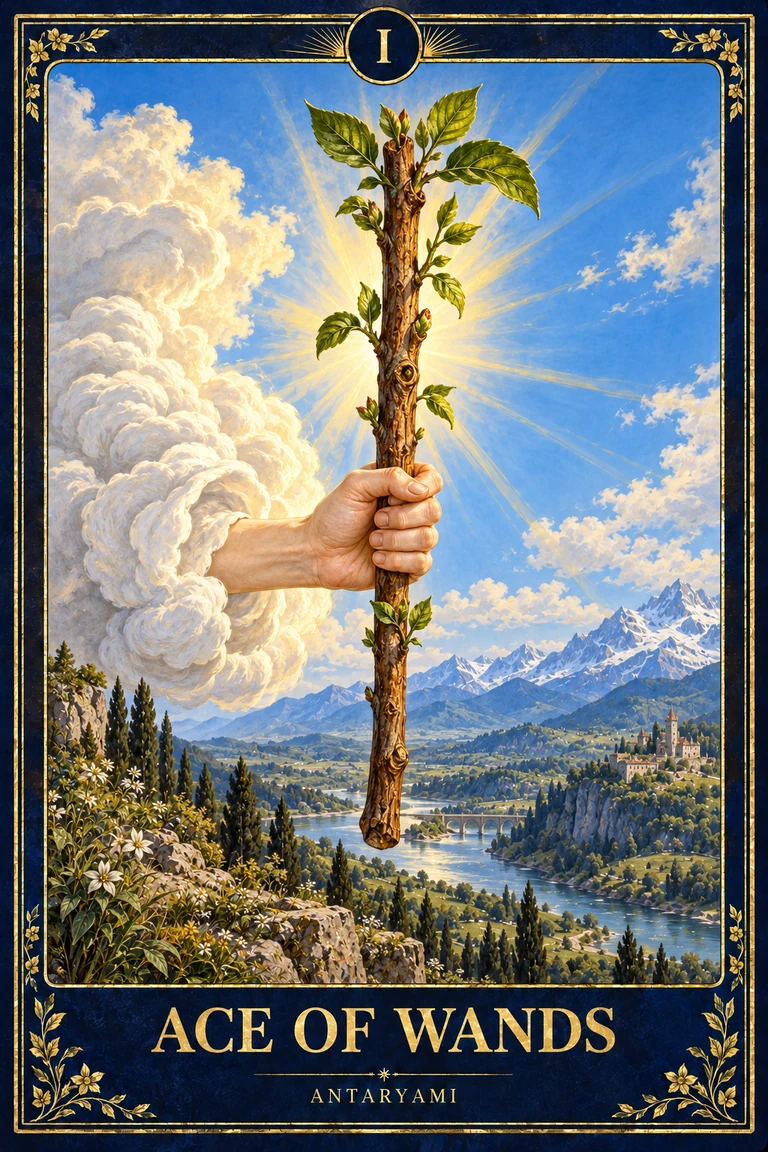
Antaryami's original illustration places a hand among clouds, holding a staff with visible new growth. Below it, the landscape remains open and distant. Your eye meets the wand first, then discovers how much territory lies beyond it. That composition fits the experience of an early idea: the impulse is close enough to notice, while the route ahead is still uncertain. A useful visual question is what this new growth would need if you decided to care for it.
Waite's historical account describes a cloud-emerging hand grasping a stout wand and associates the card with creation, invention and enterprise. His list also contains meanings belonging to the language and assumptions of his period. This guide uses that primary source to identify a tradition, while its experiment-based approach is a modern educational interpretation. Our branded artwork is original rather than a copy of Pamela Colman Smith's card, so its landscape and decorative details should not be presented as exact historical evidence.
Notice the difference between a symbol of life and a claim about biology. New leaves can suggest development in a project or practice, but they do not establish fertility, pregnancy or health. Likewise, a wand is not a computed astrological placement. Tarot can sit beside other Antaryami instruments without being confused with them. Naming the method lets you enjoy the visual richness while keeping the question honest: this picture can help you consider how to begin, not measure an unseen result.
Sources: Waite: Ace of Wands imagery and historical meanings
Upright: make the beginning small enough to happen
An upright Ace of Wands reflection can be especially useful when motivation is present but the first step is too large. A person who wants to learn photography might think they need an expensive camera, a complete course and a perfect travel destination before taking a meaningful picture. A smaller beginning would be an afternoon studying light with the camera already available. The point is not to settle forever for less; it is to remove conditions that prevent any genuine learning from starting.
For a creative collaboration, the first experiment might be a sample rather than an announcement. Two musicians could make a short recording together before promising a full album. A designer and a writer could build one page before planning an entire publication. Such experiments allow both people to discover their working rhythm. Enthusiasm deserves that opportunity to become specific. It is easier to assess an actual attempt than a beautifully described intention that nobody has yet put under ordinary pressure.
Choose an observation that matches the experiment. If you are testing whether you enjoy a practice, notice your willingness to return after the novelty fades. If you are testing a service idea, ask participants what was useful and what remained confusing. Do not declare success simply because the card appeared and you felt excited. A constructive upright reading leaves you with something modest to do, something sensible to notice and enough freedom to revise the idea without feeling that you have betrayed your destiny.
Reversed: is the spark blocked, borrowed or simply not yours?
A reversed Ace of Wands can be read as stalled initiative, an unsuitable opening, fading interest or energy that has nowhere practical to go. Those possibilities are not interchangeable. You might genuinely want to begin but lack time; you might have adopted someone else's ambition; or you might discover that the idea appealed more in conversation than in practice. The orientation cannot determine the cause. Start by asking what happens when you imagine the smallest real version of the proposed activity.
If even that version feels heavy, consider whether the project belongs to you. Perhaps you said you wanted to run a channel because everyone around you was doing so, while what you actually enjoy is private drawing. Letting go of a borrowed goal can free useful attention. Conversely, if the small version feels inviting but your schedule has no space, the problem may be a missing condition rather than absent motivation. Protecting one realistic hour could answer that question better than collecting motivational slogans.
Sometimes the reversed theme is an invitation to wait without abandoning the idea. Materials may be unavailable or an existing obligation may need completion first. Give the pause a review date and a clear reason, so it does not become indefinite postponement disguised as preparation. Waite's older reversed vocabulary is considerably starker than many modern readings; we do not convert it into a prediction of personal disaster. Here the card asks you to investigate a blocked beginning with proportion, not to fear that every delay carries a hidden punishment.
Relationships: chemistry is an opening, not the whole connection
In a relationship question, the Ace of Wands may frame attraction, liveliness or a renewed wish to connect. A conversation that feels energising can be worth exploring. Yet chemistry does not tell you whether two people share expectations, respect boundaries or want the same relationship. An appealing first encounter is a beginning with unanswered questions. Let the card encourage curiosity without allowing the excitement to write an entire future on behalf of someone who has not agreed to it.
A practical example is suggesting one activity you would both enjoy instead of interpreting every message for evidence of permanence. Notice whether interest is reciprocal and whether each person can comfortably say yes or no. In an established relationship, the theme may suggest changing a stale routine: cooking something unfamiliar, visiting a place you have discussed or making room for a playful conversation. The gesture works because it is welcome and followed through, not because the image has magically restored closeness.
Attraction also has ordinary limits. A card cannot supply consent, reveal someone's private desire or justify pursuing a person who has declined. Nor should it be used to rank your existing relationship against an imagined exciting alternative. Ask what kind of connection you are actually seeking and what evidence of mutual interest exists. The Ace is strongest here as a reminder that vitality can invite participation. Whether the invitation becomes a meaningful relationship depends on the people, their choices and the care they bring beyond that initial spark.
Work and money: test the idea before paying for its costume
The Ace of Wands often attracts business language because a new venture feels like a natural match for creative initiative. There is a useful question in that association: can you demonstrate the value of the idea before spending heavily on how it looks? A person opening a small service may be tempted to buy elaborate branding, tools and advertising immediately. An early conversation with potential customers could instead reveal whether the service solves a problem they actually have and can describe.
Separate enthusiasm from financial evidence. Write the costs you know, the costs you have not researched and the income assumptions that remain untested. A tarot prompt can help you organise these questions, but it cannot assess investment risk or promise revenue. Avoid treating the card as permission to borrow, resign or sign a contract without appropriate information. The creative beginning and the commercial commitment are different stages. You can explore the first while remaining careful about the second.
At work, the theme need not mean starting your own company. It could mean offering a small improvement to an existing process, volunteering to test a new format or returning to a skill you enjoy. Make the proposal concrete enough for another person to evaluate. Explain the problem, the experiment and the time required. A lively idea becomes easier to support when it is accompanied by a realistic request. That is a more useful form of initiative than insisting that inspiration should exempt you from constraints everyone else must manage.
Ace of Wands versus The Fool and Page of Wands
These three cards can all evoke beginnings, but their pictures give different questions. The Ace of Wands focuses on the opening itself: an impulse, opportunity or creative possibility. The Fool introduces a character approaching unfamiliar territory, so modern readings often examine openness and the responsibility of stepping forward. The Page of Wands introduces a learner studying a staff, which can emphasise curiosity, practice and the first attempt to understand what interests them. The overlap is useful; treating them as identical is not.
Imagine a person who wants to learn pottery. The Ace might frame the moment they feel drawn to making something with their hands. The Fool could frame entering a first class without knowing whether they will be good at it. The Page might frame examining the tools, asking basic questions and becoming a beginner deliberately. None of these is a compulsory sequence or a forecast of what must happen next. They are different lenses for the same situation, and a spread position should determine which lens is relevant.
Another common question asks whether the Ace means an immediate yes. This guide does not turn card orientation into an automatic decision rule. If your question concerns a purchase, commitment or another person's willingness, obtain the relevant facts directly. You can instead ask what conditions would make a beginning responsible. That preserves the appealing energy of the card while avoiding a false shortcut. A promising start is more useful when it can survive contact with information, practical limits and the possibility that another route might suit you better.
Explore the spark in Antaryami, then carry one experiment outside the screen
Antaryami's tarot walkthrough distinguishes the daily card from an interactive shuffled draw, with optional questions and named spread positions. For the Ace of Wands, a focused question could be what is the smallest worthwhile beginning available to me. If you use a larger spread, read the position before interpreting the card: a resource may highlight enthusiasm, while an obstacle may raise the problem of scattered initiative. Optional reversals offer another angle, not an additional measurement of how likely your idea is to succeed.
Try a first-spark note on paper or in your own notes app. Record the idea in one plain sentence, then describe a version you can attempt without a major purchase or another person's unconfirmed commitment. Add one thing you would learn from the attempt. After doing it, write what surprised you and what deserves the next step. This exercise makes the reading useful even if the original plan changes. You are not collecting evidence that the card knew your future; you are giving an unfinished possibility a fair, limited trial.
Visit the Antaryami app page to check current release and access information, and explore the tarot product guides before choosing a plan. Nitish Raj Walia's card series for Temior Technologies Pvt Ltd is designed to make the experience understandable before you buy, with distinctive artwork and practical explanations rather than a promise of effortless transformation. Let this Ace leave you with an appealing but grounded invitation: make something small, learn from the making, and decide the next step from what you genuinely discover.
Give the spark a testable shape
I have an idea but keep waiting for perfect conditions
Describe a low-cost version you could attempt with what is available. Choose one observation that would help you understand the idea better, rather than demanding that the first attempt prove your entire future.
I feel excited about several directions at once
Select one experiment for a limited period and keep the other ideas in a separate list. Enthusiasm becomes more informative when one direction receives enough attention to reveal what doing it actually involves.
Astrological interpretations are for reflection, not a diagnosis, a guaranteed prediction or a substitute for professional advice. Journal guides are prepared with AI assistance; they are educational content, not individual consultations.


