 Antaryami
Tarot card meanings
Two of Wands tarot card: choose a direction without pretending you control the world
You have an idea, but now two possible futures are competing for your attention. One route feels familiar and manageable; the other is interesting enough to make you restless. The Two of Wands stands on that threshold, looking beyond an established place while holding a small world in its hand. This Antaryami article by Nitish Raj Walia explores planning without turning it into endless rehearsal. The aim is not to discover a secretly correct destiny. It is to choose a direction with enough information, a sensible first commitment and an honest account of what remains outside your control.
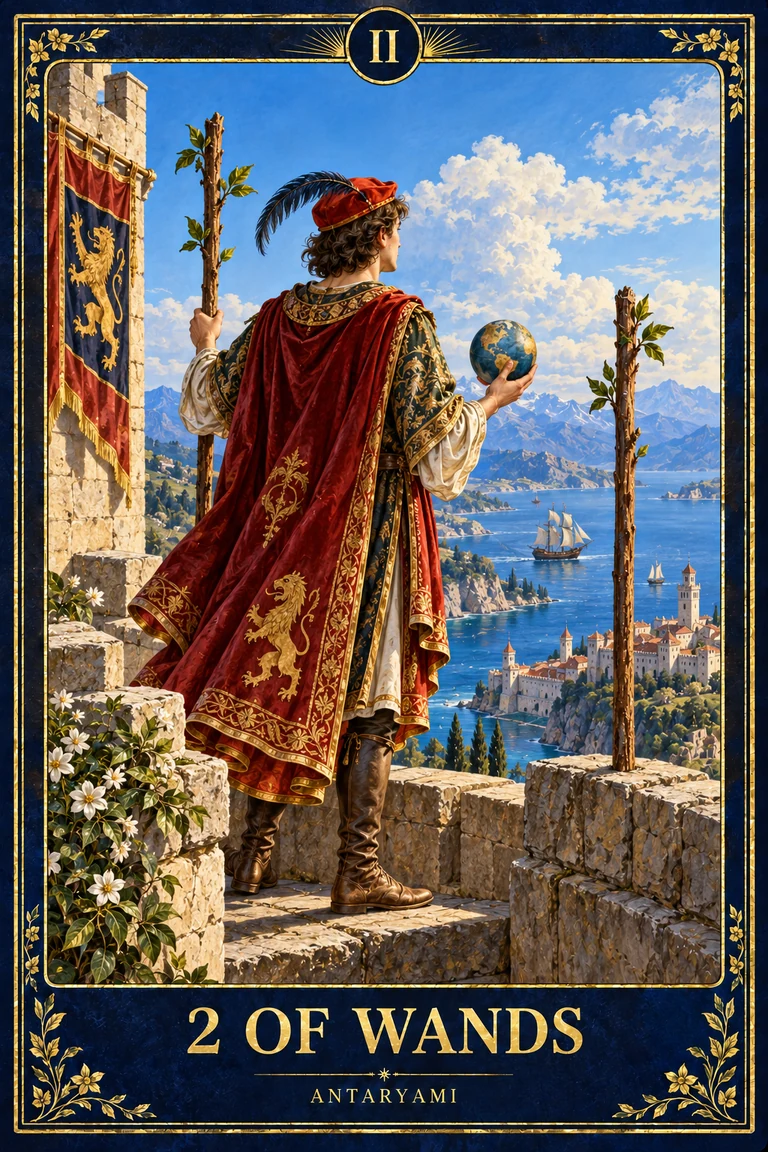
Two of Wands meaning: interest becomes a choice
Contemporary interpretations often connect the Two of Wands with planning, future direction and the decision to look beyond a current arrangement. Where the Ace introduces a spark, this card asks what you intend to do with it. The useful question is no longer simply whether something interests you. It is whether you are prepared to organise time, information and resources around one direction. Planning has value when it makes a choice clearer, not when it supplies an attractive substitute for choosing.
Consider someone deciding between improving a current service and creating a different one. Both possibilities may have merit, but each requires different work. A Two of Wands reflection could ask what success would look like for each route, what can be tested and which commitments cannot easily be reversed. This is a more precise conversation than deciding that the exciting option is automatically brave and the familiar option automatically fearful. Sometimes staying is a deliberate expansion of skill rather than a refusal to grow.
The card can also reveal the scale of your imagination. You may be planning a large future while having only a small amount of information about the next stage. That mismatch is not necessarily a reason to abandon the ambition. It is a reason to identify the next unanswered question. Speak to someone with relevant experience, examine the actual requirements or make a limited trial. A symbolic horizon becomes useful when it leads to a concrete inquiry instead of asking you to admire possibilities indefinitely.
The globe, two staffs and high viewpoint: reach is not ownership
Our original Two of Wands places a red-robed figure above a seascape, with two upright staffs and a globe held in one hand. The elevated viewpoint makes the world appear available for inspection. Yet a small globe is a representation, not the world itself. That distinction is an excellent planning question: which parts of your future exist only as a tidy model, and which have been checked against the people, costs and conditions you will actually encounter?
Waite describes a figure looking from a battlement over sea and shore, holding a globe with one staff nearby and another fixed. His divinatory account is unusually divided, associating the card with both worldly grandeur and difficult emotions. The familiar modern emphasis on planning is therefore not a word-for-word continuation of a single historical definition. This guide names its contemporary lens while acknowledging the primary source. Antaryami's artwork interprets the recognisable composition in its own visual language rather than presenting a historical facsimile.
A wider view can help, but distance also hides detail. From above, a route may look simple while the ground contains obstacles you have not considered. Think about a move to another city: the photographs, map and projected budget are useful representations, but they do not establish how you will feel living there or whether a job offer is secure. The picture asks you to combine perspective with verification. Holding a model of the world should make your questions sharper, not make you feel entitled to command everything it depicts.
Sources: Waite: Two of Wands composition and contrasting historical meanings
Upright: choose the question that your next step must answer
An upright Two of Wands reading can help when you have reached the limit of thinking alone. Perhaps you are considering a course but cannot decide whether it fits your goals. Instead of repeatedly comparing the same promotional descriptions, identify the missing information. You might need a sample class, a conversation with a former student or a clearer explanation of the workload. A useful plan moves toward the source of that information rather than rearranging uncertainty into a prettier spreadsheet.
After research, decide what counts as enough information for a provisional choice. Complete certainty is rarely available, and demanding it can become a way to avoid responsibility. You can define a limited commitment: try the course's introductory stage, take a short visit before moving, or build a sample before changing your service. The boundary makes action less theatrical. You are not announcing that one path will suit you forever; you are choosing a reasonable next stage and a point at which to reassess it.
Planning also involves what you will not do. If your selected direction needs three evenings each week, something else may need to leave the schedule. Name that trade-off rather than assuming motivation will manufacture extra time. The upright theme can support ambition with discipline: a clear question, an information source, a first commitment and a review point. That combination leaves room for discovery while protecting you from the illusion that imagining two futures means you can live both without cost.
Reversed: distinguish fear from a plan that genuinely does not fit
A modern reversed Two of Wands interpretation may explore indecision, restricted options, reluctance to leave familiar conditions or a plan built without enough preparation. The first task is to avoid calling every hesitation fear. You may be noticing a real constraint: caring responsibilities, an inaccessible cost or a promise made to someone else. Those details deserve respect. A card should not pressure you to demonstrate courage by ignoring the conditions that make a proposed move unsuitable right now.
Conversely, you might have enough information but keep reopening the same decision because commitment feels uncomfortable. Look for a pattern in your process. Are you learning something new each time you research, or only looking for reassurance that no disappointment is possible? A small reversible experiment can help separate those states. If the experiment itself feels unacceptable, examine why. There may be a practical reason, a preference you have not admitted or simply a direction you do not want as much as you thought.
The reversed theme can also challenge overplanning. A detailed timetable is not a guarantee that the people involved will cooperate or that every dependency will arrive on time. Ask which assumption would disrupt the plan if it proved false, and create a reasonable alternative where possible. Do not treat a contingency as evidence of pessimism. Planning becomes stronger when it acknowledges uncertainty explicitly. The aim is a direction you can navigate, not a diagram that collapses as soon as life behaves differently from your preferred version.
Relationships: a shared future needs two actual voices
In relationship reflection, the Two of Wands can raise the question of direction: are both people discussing the same kind of future? One may imagine travel and change while the other wants stability in a particular place. Neither preference is automatically superior. The difficulty begins when an unspoken preference is treated as a shared agreement. The card offers a useful prompt to talk about plans before relying on them, not a way to discover what another person secretly intends.
A couple could each describe the next year in ordinary terms: where they expect to live, which responsibilities matter and what they would like to try. Compare the overlap and the differences. Some choices may be flexible, while others are important enough to name clearly. This conversation can be warm and practical at the same time. It does not need to become an interrogation about permanent commitment. The point is to stop mistaking a pleasant general conversation for consent to a specific life change.
For someone dating, the horizon imagery may invite you to consider your own direction before reshaping it around a new person. You can remain open while keeping commitments that matter to you. A promising connection should allow appropriate questions about availability and expectations. Tarot cannot tell you whether someone will move, marry or return from abroad. Ask what can be discussed directly, notice how the person responds and leave room for a genuine difference of preference rather than turning uncertainty into a romantic prediction.
Career and resources: read the terms beneath the exciting prospect
A career choice often arrives wrapped in a compelling story: a bigger role, an international opportunity or a chance to become independent. The Two of Wands can help you look underneath that story. What are the actual duties? Which hours are expected? Is the location requirement clear? Which costs fall on you? A wider ambition does not become less meaningful when you ask detailed questions. In fact, accurate terms let you decide whether the opportunity can support the life you are imagining.
Suppose you are weighing an established position against a new venture. Do not reduce the choice to security versus passion. The established role may offer valuable development, and the new venture may include routine work you have not considered. List the ordinary week each option would require, not only its best possible outcome. Include your existing responsibilities and financial limits. The card can support the comparison, but specialist questions about contracts, taxes or investment belong with relevant documents and qualified advice.
Be especially careful when a decision deadline is used to prevent verification. A legitimate opportunity may have time limits, but urgency does not make unsupported claims true. Ask what can be confirmed before you commit, and avoid paying because a reading seemed to endorse the offer. The useful commercial lesson of this card is direction with informed consent: understand what you are joining, what you will provide and what the other party has actually promised. A far horizon is inviting; clear terms determine whether the first step toward it is sensible.
Two of Wands versus Three of Wands: choosing is not the same as watching progress
The Two of Wands often frames the planning threshold, while the Three of Wands is commonly read through outward movement, cooperation and observing something already sent into the world. The distinction can be practical. If you have not yet selected a direction, the Two asks about alternatives and commitment. If your work has been shared and now depends on feedback or delivery, the Three asks about what is arriving, what needs adjustment and whom you need to coordinate with.
Imagine preparing a workshop again. Comparing possible topics and deciding which audience to serve fits the Two's question. Sending the invitation, receiving enquiries and organising participation fits the Three's question. Neither guarantees attendance. The pictures help identify the stage of the process, so your next action is not confused with a later one. You may not need more strategic planning when the real task is answering an enquiry, and you may not need public promotion when the idea itself remains undecided.
Another misconception is that the globe predicts overseas travel. It can certainly inspire a travel-related reflection if that is your question, but the image does not determine a destination, visa outcome or timetable. Verify those matters through the appropriate authorities and actual plans. The card's broader theme is reach: considering something beyond your present arrangement. That could be a local collaboration, a new skill or a different way of organising your time. Keeping the interpretation open to context makes it more useful than reducing a rich composition to one literal forecast.
Use Antaryami to clarify a direction, not to outsource the decision
A focused Antaryami tarot question for this card might be which part of my plan needs clearer information. In a spread, an obstacle position can highlight indecision or an unsupported assumption; a resource position may highlight your ability to take a wider view. Read the position alongside your circumstances. The inspected app walkthrough offers face-down selection and reveal, with optional reversals and questions, so you can approach the reading as a deliberate pause rather than repeatedly drawing until a preferred answer appears.
For a direction note, divide a page into two options. Under each, write the ordinary work involved, one attraction, one cost and one fact still missing. Then choose the information-gathering action that could most change your comparison. Set a reasonable point to decide or reassess. This is not a scoring system that mathematically proves the right life choice. It is a way to make your reasoning visible, so another conversation or new piece of evidence can improve it instead of disappearing into a vague feeling.
Explore Antaryami's tarot walkthrough and current app availability before selecting access. Temior Technologies Pvt Ltd presents these guides with Nitish Raj Walia's byline so you can understand the instruments, their differences and their limits in advance. A good product invitation should give you clarity, not create pressure through an invented prediction. Let the Two of Wands offer a satisfying next step: choose what you need to learn, gather it from the right source and make a direction that you can explain in your own words.
Make the next decision more concrete
Two possible routes keep competing in my mind
Compare an ordinary week on each route, including its cost and responsibilities. Identify the missing fact that could change your preference and obtain it before opening another round of abstract speculation.
My plan looks complete but rests on assumptions
Name the dependency most likely to change the timetable, such as another person's agreement or an unconfirmed cost. A useful plan includes a way to respond when that assumption is not fulfilled.
Astrological interpretations are for reflection, not a diagnosis, a guaranteed prediction or a substitute for professional advice. Journal guides are prepared with AI assistance; they are educational content, not individual consultations.


