 Antaryami
App walkthroughs
Where should you begin in Antaryami? An Explore tour for the question you actually have
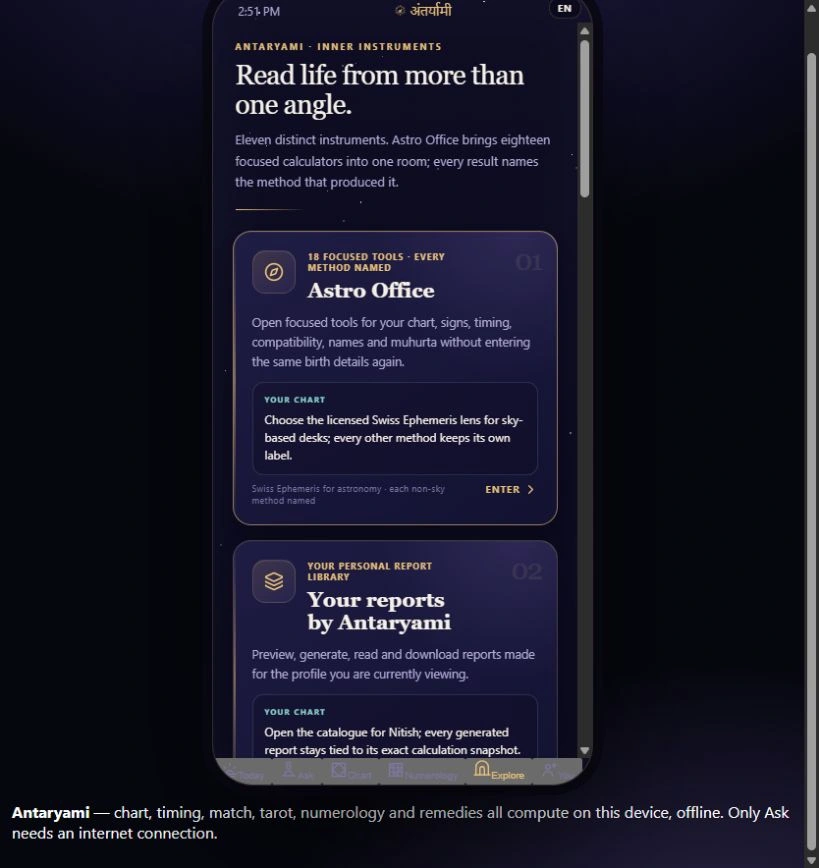
Perhaps you arrived with a simple question and found a whole collection of instruments. That can be exciting, but it can also make a first visit feel larger than it needs to be. The Antaryami Explore screen is a map, not an examination you must finish. This guide by Nitish Raj Walia helps you choose one room for one purpose, using a real app-source preview from Temior Technologies Pvt Ltd. The selected adult profile is fictional. You can learn how the collection is organised without giving anyone private birth details or assuming that every displayed feature is already available through a public app-store release.
The question comes before the instrument
Describe what you want in ordinary language before choosing a tool. Learning what a chart compartment means is different from comparing two numerology methods. Looking up a traditional festival rule is different again from reflecting on a tarot image. The screen gives these activities separate names because their inputs and explanations are not interchangeable. An instrument becomes easier to understand when you know what you came to inspect, rather than asking every room to produce a complete verdict about your life.
Try finishing the sentence, "I would like to understand..." with something specific. You might write "the difference between a sign and a house" or "why two name-number systems give different results." That is enough for a useful visit. You do not need to begin with a frightening prediction or an enormous question about your entire future. Smaller intentions make the product more navigable and leave you able to tell whether a particular explanation has helped. Curiosity is a sufficient reason to open an instrument.
Chart instruments and Astro Office serve different reading habits
The chart views are useful when you want to inspect the whole frame and select a planet or house. North Indian, South Indian, Bhacakra and Planetary Map organise shared chart information in different visual arrangements. Astro Office is more task-oriented: its focused desks name questions such as Moon sign, ascendant, planetary positions and numerology arithmetic. The distinction is not superior engine versus inferior engine. It is the difference between examining a map and entering a room devoted to one labelled question.
Read the method and access state on the desk before interpreting its result. In the inspected preview, sky-based Astro Office desks request a Swiss Ephemeris calculation; other desks retain separate traditional or arithmetic labels. An unavailable calculation is not a result of zero, an unlucky sign or a personal restriction imposed by the stars. It is a product state that needs to be understood as such. A helpful walkthrough must show that boundary rather than pretending that every attractive tile has already produced a verified personal reading.
Timing and Muhurta ask related, but different, questions
Timing places several kinds of chronology beside one another: the day's panchanga, moving-planet information and a profile's Vimshottari period structure. Muhurta expands the calendar work into festivals, beginnings and closed windows. The first screen helps you notice which kind of time information you are reading. The second lets you inspect a selected event and the rules behind a shortlist. Neither establishes the outcome of an appointment merely because its date is presented elegantly.
Suppose a household is preparing to move. The Muhurta beginning category can be a traditional preference alongside practical constraints such as key collection, transport and everyone's availability. The Timing period ladder is not a replacement for that event calendar, and a city-level festival card is not a description of each family member's chart. Choosing the right room avoids an easy confusion: calling every date on a screen "my lucky time" when the dates were produced for different purposes and with different reference points.
Numerology and tarot deserve their own method vocabulary
A name-and-date numerology view is not a planetary longitude calculation. Western Pythagorean roles, traditional Driver and Conductor numbers, and a Chaldean name value need their own input and reduction rules. Tarot adds another distinction: a symbolic card image and a shuffled spread are not birth-chart placements. Keeping these methods named helps you enjoy their different forms of reflection without building a false chain in which a card, a number and a planet supposedly prove one another correct.
If you prefer words and images to dense diagrams, one of these rooms may be a comfortable starting point. That preference does not make the method more accurate for your future, nor does it say anything about your intelligence or seriousness. Ask what the screen actually used: a name, a birth date, the selected profile, a daily selection rule or a shuffled eligible deck. The answer makes the experience understandable. You can then decide which explanation interests you without having to pretend that every tradition speaks the same technical language.
Make your first tour deliberately short
- Choose a chart, calendar, number or card question before selecting a room.
- Identify the input and method shown on that screen.
- Distinguish a ready result from a calculation that still requires access or loading.
- Leave with one explanation you understand rather than a collection of dramatic labels.
Choose one room, examine one labelled result and leave with one question you can explain to someone else. For example, a first chart visit could end when you understand why the same planet appears in a different place in two layouts. A first numerology visit could end when you identify which number came from the day alone and which came from the complete date. These are real learning outcomes. You have not failed to use the app fully because you stopped before opening every available instrument.
The same approach makes a return visit more intentional. Write a brief note about what you understood and what remains uncertain, using your own notebook if you prefer. Do not store someone else's sensitive details merely to practise navigation. The fictional public examples already provide a way to learn the interface. If you later choose personal access, inspect the current plan, profile allowance, availability and checkout disclosures separately. Touring a room does not create a payment, an active entitlement or consent to unrelated data processing.
Let interest lead the next step, not pressure
The website introduces the Antaryami collection; the personal app is intended for deeper exploration with a selected saved profile. Visit the app page for current release and download information, and the plan page for the actual terms of access. An interface screenshot demonstrates a screen, not a store listing or a promise that a purchased feature can be used immediately. That distinction protects your expectations while letting the museum-like public experience remain inviting and informative.
There is no obligation to turn a pleasant tour into a subscription. You may simply learn the vocabulary and return when the official app is available. Nitish Raj Walia's Antaryami Journal is designed to make the product understandable through specific examples, not to claim that symbolism removes uncertainty from life. Start in the room closest to your question. Stay while the explanation is useful. The best next move may be another instrument, a practical conversation, or closing the screen with something new to think about.
Which room fits your first question?
I want to understand a house or planet.
Begin with a chart instrument and one selected placement. Keep the profile and method fixed before comparing layouts.
I want to choose a traditional date for a beginning.
Inspect Muhurta with the event type, city and rule in view. Keep practical readiness separate from the symbolic shortlist.
Astrological interpretations are for reflection, not a diagnosis, a guaranteed prediction or a substitute for professional advice. Journal guides are prepared with AI assistance; they are educational content, not individual consultations.


