Antaryami
App walkthroughs
Inside Antaryami's Bhacakra: learn the circular chart one marker at a time
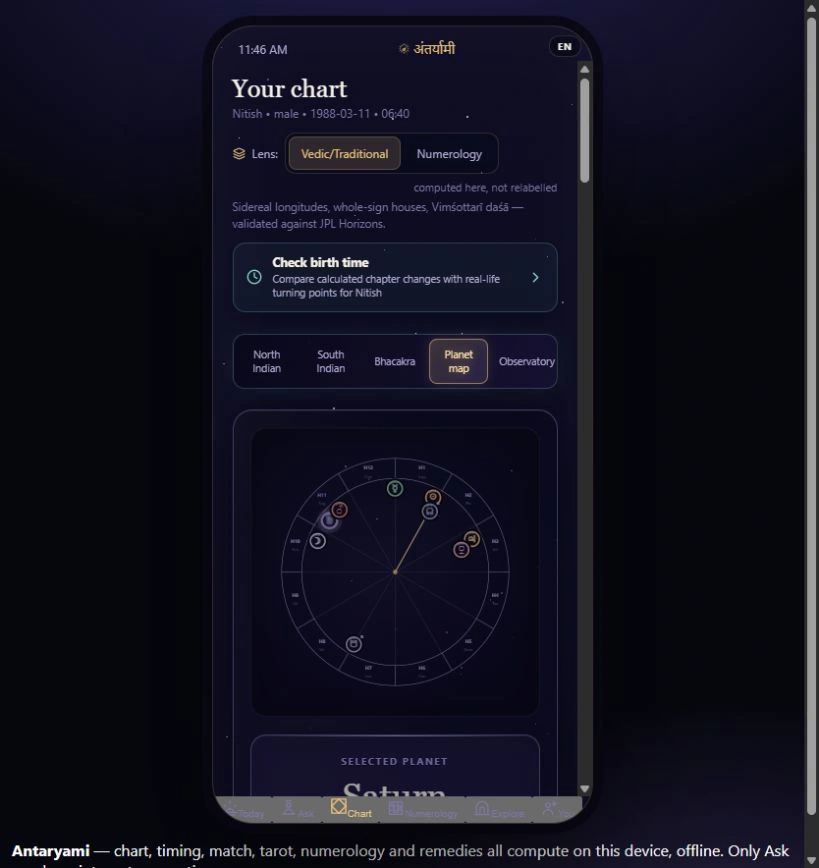
The Bhacakra invites you to look around rather than read down a list. Its circular form can make relationships between placements feel visible, but it can also tempt a new reader to treat every bright detail as equally urgent. Antaryami pairs the instrument with a selected-planet explanation so that the experience has a clear point of attention. In this walkthrough, Nitish Raj Walia begins with one marker and builds a small, repeatable learning routine around it. The real app screenshot uses a fictional adult profile. Its beauty is part of the product experience; its values remain an example, not evidence about the person reading this article or proof that the future can be known from a wheel.

Understand the circular frame before chasing every symbol
A circle is useful for showing positions around a shared reference. In the Bhacakra, the zodiac frame and planet markers let you inspect the selected chart as a whole. The app also identifies the profile and calculation convention beneath the instrument. Those labels belong to the learning experience because a wheel without context is easy to misunderstand. Start by recognising where the drawing comes from and which person it represents. You can admire the visual craftsmanship without assuming that every artistic detail is an additional calculated fact.
This is particularly important with animation. A rotating decorative layer or a changing highlight does not mean that the natal positions are continuously changing with the current time. A birth chart describes its supplied birth moment under its chosen method. Current transits, if shown elsewhere, describe another moment and must be identified as such. Before calling a moving screen a live sky, inspect its labels. The Bhacakra is an instrument for viewing the active chart, not permission to merge a natal calculation and today's positions into one unnamed picture.
Give one marker a name, a placement and a question
Select a planet you can recognise, then read its full name beside the chart. Establish the sign, degree and house from the written placement instead of estimating them from the marker's apparent size or glow. The selected explanation offers a practical meaning, a profile connection and balanced expressions of the traditional symbolism. This sequence turns a potentially overwhelming image into a conversation with a manageable subject. You are learning what one item means before adding more items to the discussion.
For example, choosing Saturn can lead to a question about responsibility or sustained effort. That does not mean a ringed marker proves that your life will be difficult. Ask which commitment you are actually carrying, which part belongs to you, and what support is available. The useful reflection comes from relating the vocabulary to a situation you can describe. If you cannot name any relevant situation, leave the interpretation as something you are learning about the tradition. There is no need to manufacture a crisis so that a planet card feels personally important.
Nearby markers are a reason to inspect degrees, not to guess a story
When several bodies occupy a small part of a chart, their markers can appear close together. A renderer may spread labels or markers enough to keep them selectable. The explanatory placement remains the place to read the calculated value. Visual spacing is not a substitute for angular separation. If you want to understand whether two bodies are near each other, inspect their written positions or the dedicated relationship information rather than judging how many pixels separate two icons on a phone.
The distinction protects you from a common mistake: assuming that a visually crowded section necessarily describes an overcrowded or troubled life. The drawing has to solve a screen-layout problem; traditional interpretation has a different task. A prominent cluster can be an interesting place to begin a lesson, but it does not establish a personality diagnosis or a guaranteed event. Keep the question narrow enough to answer. Which bodies are shown? What are their labelled positions? Which connection does the selected explanation actually discuss, and which connection have you only imagined from the picture?
Let the wheel organise curiosity without taking over judgement
A beautiful instrument can feel authoritative because it combines precision-looking marks with evocative language. It is worth separating the two kinds of authority. A chart position can be checked against its inputs and calculation method. A traditional interpretation remains a symbolic claim that must not outrank medical care, financial evidence, consent or someone else's account of their experience. Antaryami's explanatory flow is most useful when it makes that separation easier to see, not when the visual finish makes you forget to ask about it.
You can enjoy the wheel without agreeing with every meaning attached to it. Notice what helps you articulate a question and what feels too general or unfamiliar. Try to remember both responses, rather than saving only the sentence that sounded uncannily accurate. That balanced record is a better foundation for a thoughtful practice. It keeps a reflective tool from becoming a machine for finding confirmation everywhere. Your lived experience is not an obstacle to the reading; it is the context in which the reading either becomes useful or does not.
Build a visit that ends with understanding instead of more tabs
- Read the profile and method beneath the wheel before selecting a marker.
- Use the written placement to identify the selected body, not its animation or apparent prominence.
- Read both the constructive expression and the caution in the explanation.
- Translate one useful idea into a question you can discuss without requiring anyone else to believe in astrology.
A focused visit has a beginning and an end. Begin with a small topic, such as how you organise an obligation. Read one planet's placement and its everyday explanation. Open the traditional-context disclosure only if you want the additional background. Then put the phone down and describe the topic in your own words. If the explanation helps, name a realistic action that does not depend on the chart being correct. If it does not help, record the question you still have instead of opening every other instrument to force an answer.
The objective is not to finish the Bhacakra. It is to become a little more fluent in one part of it. On a later visit, you can inspect another marker or compare a familiar placement with the North Indian view. Because the same active chart sits behind those views, the comparison can teach representation rather than introduce another supposed verdict. A learning routine becomes sustainable when it leaves you with enough space for the ordinary task that brought you to the instrument in the first place.
A public wheel is an invitation, not personal access
The fictional instrument exhibit on the website is available for inspection without publishing your birth record. It helps you see whether this style of explanation is appealing before you prepare a personal profile or choose a plan. The pictured app screen demonstrates the current source preview, not a verified store download or an active membership. Official download links must be supplied before the website can offer them. Keep that availability distinction in mind when a polished exhibit makes you eager to continue.
For Nitish Raj Walia and Temior Technologies Pvt Ltd, the Antaryami Journal can explain the product by showing the work rather than inventing an outcome. The Bhacakra's distinctive circular presentation is one part of that work. Its value to a learner may be that an intimidating chart becomes something you can approach patiently. Explore it, compare it and ask what you still do not understand. The most worthwhile result of a first visit may be a clearer question, which is a modest outcome but a much stronger foundation than a dramatic label you do not know how to evaluate.
Choose a Bhacakra learning task
Understand a bright marker
Select it and read its name and placement. Brightness identifies attention in the interface; it is not an independently measured ranking of importance in your life.
Understand two close markers
Inspect their written degrees. Renderer spacing keeps controls readable and must not be mistaken for exact angular separation.
Astrological interpretations are for reflection, not a diagnosis, a guaranteed prediction or a substitute for professional advice. Journal guides are prepared with AI assistance; they are educational content, not individual consultations.