Antaryami
App walkthroughs
The South Indian chart in Antaryami: a steady sign map for a curious mind
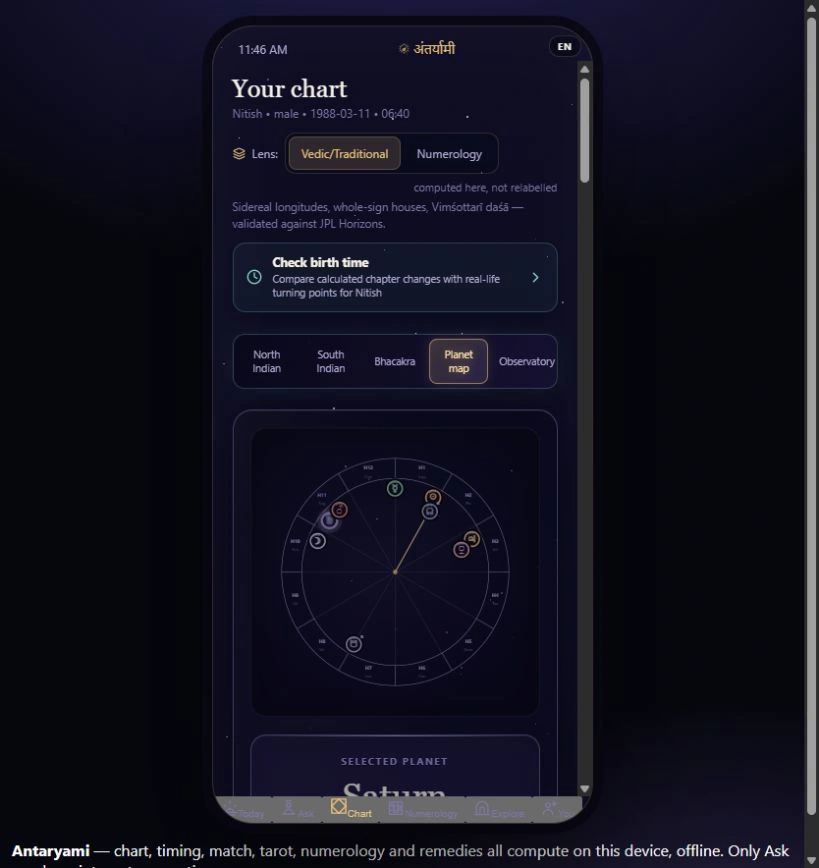
Sometimes understanding arrives when the information stays put. The South Indian chart gives a beginner a steady sign-oriented arrangement, which can feel easier to revisit than a diagram whose numbers seem to move. In Antaryami, it is one of several ways to view the selected profile's calculated chart. It is not a competing biography or a second opinion generated by changing the drawing. This guide by Nitish Raj Walia follows the real app preview and explains what to inspect, how to locate houses relative to the reference, and why a familiar visual pattern must not become a shortcut around reading the labels. The person shown here is fictional, so the screenshot teaches the instrument rather than revealing anyone's private record.

What stays fixed in a sign-oriented layout
The South Indian arrangement keeps the zodiac signs in a familiar perimeter pattern. Once you recognise that pattern, you can look for a sign without rebuilding the diagram in your head every time. The houses are then understood relative to the chart's reference, including the ascendant when the calculation supports it. This is the important difference from a house-oriented North Indian chart. Both can carry the same placements, but each makes a different part of the information visually stable for the reader.
You do not need to memorise the full perimeter on your first visit. Find the sign of one selected planet and compare the visible label with its compartment. Notice how the app names the placement beside the drawing. A label is a better starting point than guessing from a remembered picture found elsewhere. Different chart renderers may use abbreviations, glyphs or language variants, so apparent familiarity can be misleading. Learn the arrangement through a few explicit matches before relying on your visual memory to do all the work.
Locate a house from the reference, not from the edge of the phone
A house number is not simply the position of a box on the display. In a whole-sign interpretation, the reference sign defines the first house and the sequence continues through the zodiac signs. A planet in the same sign as that reference belongs to the first whole-sign house; a planet in the next sign belongs to the second, and so on. This describes the convention used in the app's instrument explanations. It should not be silently substituted for every house system someone might use in another astrology product.
If birth time is uncertain, the reference deserves extra attention. Do not infer a confidently timed ascendant just because the chart has neat borders. The calculation or profile uncertainty note is more important than the visual confidence of the drawing. A Moon-referenced fallback is not the same thing as a verified ascendant. When comparing charts, establish what the reference actually is before asking why a house placement differs. That distinction allows an attractive instrument to remain honest about what the supplied information can and cannot support.
Switch layouts without changing the question you are asking
A useful comparison begins by holding the person's details and calculation method steady. Open the North Indian view, select one planet, and read its sign and house. Then switch to South Indian and inspect that same planet. The location on the screen changes because the arrangement changes. The underlying placement should not become a new result merely because you preferred a different drawing. This little exercise teaches the relationship between data and presentation much more effectively than collecting screenshots of unrelated charts.
If the labels do not seem to match, investigate ordinary causes first. Was another profile selected? Did the lens or calculation convention change? Are you comparing the same planet, or a label that resembles it? The app's instruments are intended to render one active chart rather than calculate an independent chart inside every view. A mismatch is therefore a reason to review the context or report a reproducible issue, not an invitation to invent two contradictory destinies. Write down the inputs and the visible labels so a support question can be checked.
An empty sign compartment is not an empty area of life
Some compartments may contain several planet markers while others contain none. That distribution is a feature of the chart, not a population map of your relationships, talents or opportunities. A box without a marker is not proof that its associated life topic is absent. Traditional reading can consider the house's sign, its ruler and received aspects. The app's house guidance deliberately includes those connections so that occupancy alone does not become the whole explanation. Read an empty house with the same patience you give a crowded one.
Crowding also has a visual consequence. Labels may sit close together, and a small phone screen can encourage you to mistake nearby symbols for one symbol. Select the planet to bring its full name and placement into the explanatory area. Do not decide that the largest or brightest marker must be the most influential factor in a person's life. Interface emphasis often identifies the current selection. It is there to make the screen understandable, not to rank the person's qualities or tell you which member of a family matters most.
Use the chart as a shared learning exercise, not a test of belief
- Find one sign label and confirm it against the selected planet explanation.
- Identify the chart reference before counting whole-sign houses.
- Switch to the other layout and check that the same placement remains the same placement.
- Describe which arrangement helped you learn; avoid ranking the two as rival truths.
You can learn this instrument with another adult without asking for their birth details. Use the fictional public example and ask each person to locate one labelled planet. Compare what each layout makes easier. One person may recognise houses quickly in the North Indian frame, while another finds the fixed signs more intuitive in the South Indian one. That difference is about reading preference. It does not make either person more spiritual, more rational or more suited to astrology. A good educational tool can welcome both reactions.
If you later discuss a personal chart together, agree on what may be shared. Do not turn a screenshot into a public caption about somebody else's personality without their permission. A chart can contain identifying information even when you crop away the full name. The considerate way to continue is to let the person choose their question and the audience for it. A learning conversation should make information more understandable, not remove someone's control over their record or encourage strangers to judge them from a compartment.
The benefit is orientation you can return to
The South Indian view can help you build a consistent visual vocabulary. Repetition becomes useful when you revisit the same labelled pattern and understand one more connection, not when you repeatedly ask the chart to settle a decision that needs real-world information. You might begin with signs today and read a house explanation on another visit. That pace is perfectly reasonable. The instrument does not need to become a daily obligation to justify your interest, and you do not need to remember every glyph before you can ask a worthwhile question.
Antaryami's experience centre lets you compare the instruments before deciding whether the personal app experience suits you. Check current access and download availability on the app and plan pages; the demonstrated interface is not proof of an active purchase entitlement. This AI-assisted guide by Nitish Raj Walia for Temior Technologies Pvt Ltd offers a way to understand the product without exaggerating what it knows about you. Let the stable map make the next explanation clearer. Keep your own circumstances, other people's consent and practical judgement outside any box that claims to contain them completely.
Which part needs a second look?
The same planet moved on screen
Compare its written sign and house, not its screen position. The North and South Indian arrangements stabilise different parts of the same chart.
There is no planet in a compartment
Read the house topic, sign ruler and wider connections. An empty box does not mean a missing part of a human life.
Astrological interpretations are for reflection, not a diagnosis, a guaranteed prediction or a substitute for professional advice. Journal guides are prepared with AI assistance; they are educational content, not individual consultations.