Antaryami
App walkthroughs
Your first North Indian chart in Antaryami: turn the diamonds into understandable questions
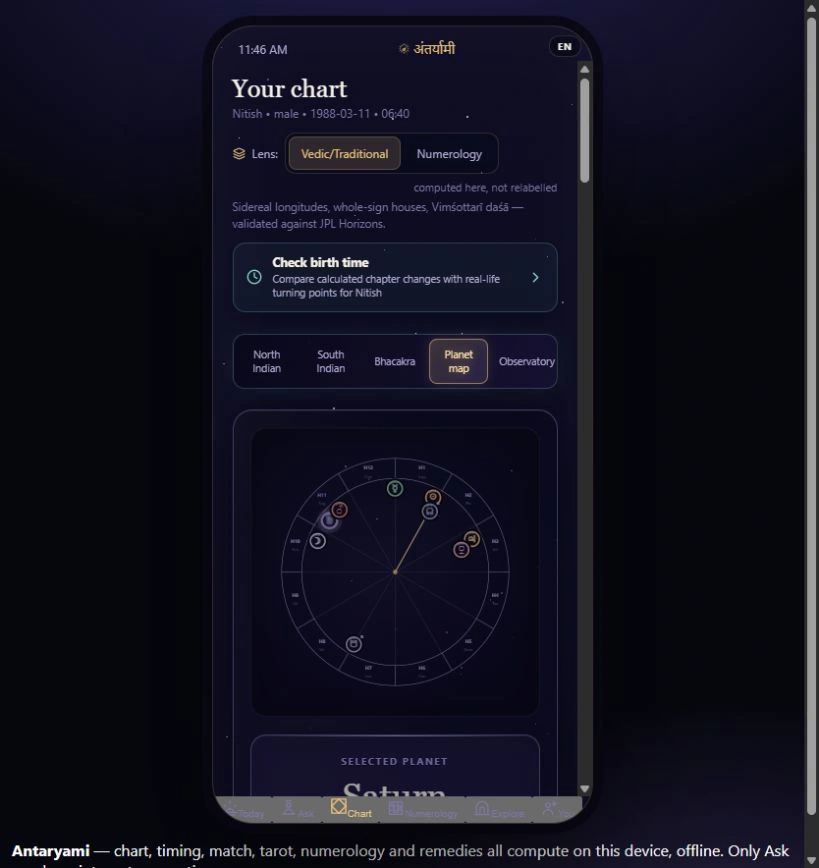
A North Indian birth chart can look like a secret written in diamonds. There are numbers, abbreviated names and compartments, yet very little about an ordinary day resembles that picture. Antaryami gives you a way into it: keep one person's profile selected, open the chart, and investigate one visible feature instead of trying to decode everything at once. This walkthrough by Nitish Raj Walia shows how the real app preview can support that learning. The screenshot contains fictional demonstration details, not the founder's birth record and not your own reading. We will work from the shape of the instrument toward useful questions, keeping its traditional meaning distinct from a prediction about your life.

Before the diagram, check whose information you are viewing
The profile line is part of the reading, not decoration above it. In the illustrated screen, Nitish is a fictional adult used to demonstrate the interface. A familiar first name does not prove that a chart belongs to the person you intended. Check the date and local birth time as well. When you later use a personal account, a family member's selected profile should never be mistaken for your own. That small pause prevents a surprisingly ordinary error: interpreting perfectly legible information for the wrong person.
The source app has a common chart object behind its instrument views. Moving from the North Indian layout to another instrument changes the presentation, not the identity of the selected person. If you suspect a mismatch, return to the profile information before searching for a symbolic explanation. Do not treat a changed screen as permission to revise someone else's details. The useful habit is simple: establish the person first, the calculation convention second, and the visual layout third. Those three checks have different jobs and should remain separate.
The diamonds organise houses, not twelve compulsory events
The North Indian layout is a house-oriented frame. Houses occupy their recognisable positions while sign identifiers tell you which zodiac signs are associated with them. This is why a number inside the diagram should not automatically be read as the house number. A beginner can easily confuse the two and then wonder why an explanation seems unrelated to the compartment. Read the instrument's selected-house or selected-planet label rather than inferring everything from where the number appears on your screen.
In traditional interpretation, houses organise areas of human experience: identity, resources, learning, home, relationships and other topics. They are not twelve scheduled events waiting to happen. An empty compartment does not mean that a person has no relationship, no career or no family life. The app's house explanation considers the associated sign and its ruler as well as occupants. That gives you a more complete reading question. You can ask what the house concerns and how several chart factors are connected without deciding that one symbol has settled the whole subject.
Selecting a planet makes the vocabulary less abstract
A planet name is often easier to learn in context than from a long glossary. Select a visible planet and read the explanation paired with it. The app's instrument flow distinguishes its placement from its everyday-life meaning, then offers a useful expression and something to watch for. This arrangement matters because the astronomical or calculated placement is not the same type of statement as a traditional interpretation. A degree can be checked against a method; a description of how you express a quality still needs your lived experience.
Suppose you choose Mercury while thinking about an unfinished conversation. The constructive question is not whether Mercury makes you a particular kind of person forever. Ask what you are trying to communicate, whether the other person has the same information, and which part of the message could be clearer. An interpretation can provide vocabulary for that reflection. It cannot tell you what another person secretly thinks, certify your memory or remove the need to listen. Use the selected-planet card to understand the tradition, then return to the actual conversation.
A placement is a combination, not a single-word diagnosis
The house, sign and planet answer different parts of a traditional reading. Think of the house as the topic being discussed, the sign as a style of expression, and the planet as a symbolic function in that topic. This analogy is a learning aid, not a scientific model of personality. It helps you avoid reducing a full placement to a word such as lucky, difficult or powerful. Those labels can obscure the actual explanation and encourage you to read a chart as a ranking of people.
When Antaryami shows a profile-specific placement, read the whole explanation before sharing a dramatic fragment. A sentence about responsibility may be followed by a qualification about support, context or uncertainty. Removing that context can turn an educational card into an alarming claim. It is also worth looking for situations in which the interpretation does not fit. You are not failing the reading by noticing an exception. You are bringing the evidence of your own life into a symbolic conversation, which is more useful than collecting only confirming examples.
Try a small chart-reading exercise, without making a major decision
- Confirm the selected person and read the calculation label before inspecting a placement.
- Choose one house topic and describe a real example in your own words.
- Read one associated planet explanation, including its qualifications and traditional context.
- Keep one useful question; leave any interpretation that does not match your experience unresolved.
Choose one ordinary subject that you can describe without a chart: perhaps how you prepare for a meeting or divide a household task. Write what is currently happening and what you would like to understand. Then read one relevant house explanation and one planet card. Compare their language with your actual situation. Keep the comparison specific enough that another person could understand it. A vague feeling that everything sounds true is less informative than an example of a behaviour you can recognise and discuss.
Finish by naming one question and one practical next step. You might ask for a clearer deadline, confirm an assumption or set aside time to practise a skill. Do not make a medical, financial or relationship commitment because a compartment looks favourable. The chart exercise is complete when it has improved a question, not when it has removed every uncertainty. You can also decide that a passage does not help today. Closing the app with that conclusion is a valid way to use a reflective tool.
Explore the exhibit first, then choose personal access deliberately
The Antaryami website is an experience centre: it lets you learn about instruments and inspect fictional examples before considering personal access. A public chart exhibit is not your personal Kundli, and a demonstration screen does not establish that every connected account, purchase or download service is available. Official app-store links are still awaiting publication in the website's current configuration. Use the availability shown on the app page rather than treating a picture of the interface as a live download promise.
If the North Indian instrument feels readable to you, that is a useful reason to explore further. Compare it with the South Indian layout while keeping the same profile and method. You may discover that a different arrangement makes the same information easier to understand. Nitish Raj Walia's Antaryami Journal, from Temior Technologies Pvt Ltd, is intended to support that kind of informed curiosity. The product should earn your attention through understandable work, not pressure to believe every interpretation. Start with the diagram you can read and the question that genuinely matters to you.
Your next chart question
I cannot tell signs from houses
Read the selected-house label first, then its sign and ruler. The North Indian frame keeps house positions recognisable; the sign number is a separate identifier.
One planet sounds like a verdict
Put the placement back beside the full explanation. Find one real-life example and one exception before deciding whether the symbolic language is useful.
Astrological interpretations are for reflection, not a diagnosis, a guaranteed prediction or a substitute for professional advice. Journal guides are prepared with AI assistance; they are educational content, not individual consultations.