 Antaryami
App walkthroughs
The Antaryami Observatory: see the chart, inspect the source, question the meaning
An observatory suggests looking carefully. That is a useful attitude to bring to Antaryami's Observatory instrument: not simply admiration for the dial, but attention to what it says was calculated and what the surrounding interpretation adds. The real app view displays the selected profile's chart and identifies the calculation source. This guide by Nitish Raj Walia explains how to read that distinction, how angular relationship lines differ from a life instruction, and what a beginner can reasonably learn from the display. The screenshot is a fictional adult example captured from the source app preview. It is not a telescope photograph, a current-sky observation or a personal chart generated for the visitor.
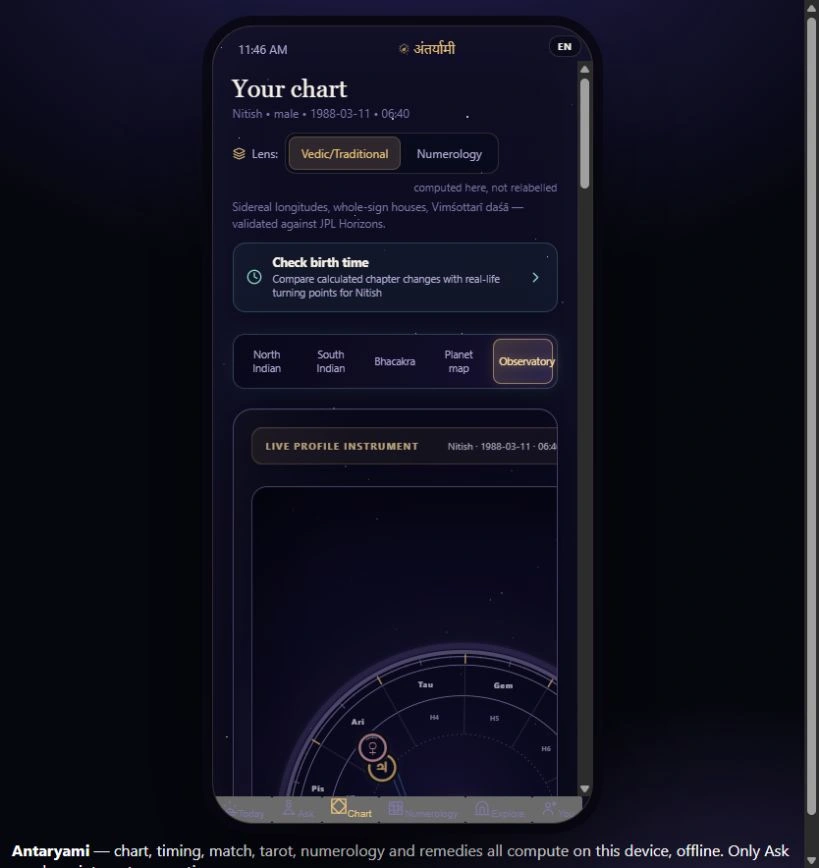
The calculation-source label is part of the result
The Observatory's source code chooses its provider label from the chart and calculation information, rather than treating every polished dial as Swiss Ephemeris output. That matters to a reader comparing instruments or services. Antaryami's Traditional calculation and its Swiss-signature pathway must retain their own labels. A provider name is not a decorative badge to apply whenever it sounds impressive. Read the label on the actual result you are examining, including its zodiac and house convention, before making a precision claim about it.
Swiss Ephemeris, from Astrodienst, supplies documented functions for astronomical position calculations. It does not certify that a traditional interpretation of those positions will predict someone's career, relationship or health. The distinction is especially important in a product experience that combines exact-looking coordinates with natural-language guidance. You may value a transparent source label because it makes the calculation easier to discuss and reproduce. That is a specific benefit; it is not a reason to treat every sentence near the label as an independently verified fact about a person.
A natal Observatory is not automatically a live view of today
The active chart supplies the bodies drawn in this Observatory. A natal chart is tied to the selected birth details, not continuously replaced by the current clock time because the instrument has animation or a luminous frame. Today's transits are a different context. A reader should be able to tell which moment a display represents. If you want to compare birth positions with another date, use a clearly identified comparison rather than treating every moving visual element as evidence that the plotted natal positions have advanced.
This also explains why an app screenshot cannot be used as a current astronomical observation. Its markers are chart symbols arranged for readability. The profile information, convention and source define their context. The view is not a photograph of how the planets would look through an eyepiece from the selected city. Appreciating that difference does not diminish the design. It tells you what kind of instrument you are learning from, which makes your questions more precise and prevents a striking image from being shared under an inaccurate caption.
Aspect lines describe selected angular relationships
An angular relationship begins with two positions and their separation around a circle. The app's Observatory component checks that separation against particular aspect angles with specified allowances, often called orbs in astrology. It then draws the eligible relationships. The lines therefore represent a rule-governed subset of possible pairs, not every imaginable connection between every body. A missing line does not mean two topics in your life can never interact. It may simply mean that the pair does not meet this renderer's selected angle-and-orb rule.
The colour and language attached to a relationship belong to the interpretive presentation. A mathematically measured separation is one claim; a statement that the relationship expresses tension or ease in a life is another. Do not collapse them into a single proof. If a line interests you, ask which two bodies it connects, what separation is reported and which rule names it. Then read any traditional explanation as a question to consider. A line cannot establish that you must abandon a plan or that another person is inherently unsuitable for you.
Read one body's placement without guessing from the dial
The body-selection controls provide written names and placement information. Use those labels instead of estimating a degree from the apparent distance between a marker and a tick. Renderers can adjust spacing to keep crowded markers readable. The text is the better place to identify a value, and the source context is the better place to explain how it was obtained. This is a small habit with a large benefit: it helps you separate what the instrument actually reports from what the image merely seems to suggest.
When the selected explanation moves into everyday meaning, keep its qualifications visible. You may find the vocabulary helpful for discussing responsibility, communication or priorities. That usefulness does not require you to claim that a calculated coordinate caused a particular behaviour. The practical question is whether the explanation helps you examine a real situation more clearly. If it does, write down what became clearer. If it does not, you can still have learned something about the calculation label and display convention without needing to call the entire visit a personal revelation.
Compare another calculator only after the methods match
- Identify the birth moment and calculation provider shown in the Observatory.
- Check the zodiac reference and house convention before comparing another service.
- Read written body values rather than measuring screenshot pixels.
- Describe one specific mismatch with its context; do not publish another person's record to prove a point.
Two services can disagree because they used different input details or conventions. Check the person, date, local time, birthplace, zodiac reference and house system before asking which provider is wrong. If an unknown or approximate time was used, record that as part of the comparison. A precise-looking screenshot does not repair uncertain information. You also need to compare the same type of value. A sidereal longitude is not identical to a tropical longitude, and an on-screen marker position is not a substitute for either written coordinate.
If you still find a mismatch, prepare a reproducible question rather than a dramatic accusation. Note the visible method labels and the specific body or house value you are comparing. Keep private birth details out of public comments and send only the necessary information through an appropriate support route. A transparent product should make that discussion possible. The purpose of comparing calculators is to understand or correct the result, not to collect whichever output makes the most comforting promise about a decision whose outcome no coordinate can guarantee.
The strongest product promise is an explanation you can inspect
The Antaryami experience centre can show you the Observatory's visual language with fictional data before you consider personal access. The app page should separately state whether the official download links and connected features are available. A source-preview screenshot proves that a view can be demonstrated in that preview; it does not prove that an account has received paid access, that a payment has settled or that every backend service is ready. Keep those operational facts separate from the instrument's appearance.
Nitish Raj Walia's AI-assisted guide for Temior Technologies Pvt Ltd invites you to enjoy the Observatory while asking better questions about it. Where did this value come from? Which moment does it represent? What method names the line? Which part is calculation and which part is interpretation? Those questions make an elegant product more understandable rather than less impressive. Leave with the habit of inspecting the source and context, then bring your real-world judgement to any meaning you choose to discuss. Clarity is something a product can demonstrate; certainty about your future is not.
Inspect before interpreting
Is this Swiss Ephemeris output?
Use the provider label attached to this calculation. Licensing and a provider logo do not establish that every displayed result used the Swiss pathway.
Does a line prove a life outcome?
No. First identify its bodies, angular rule and orb. Traditional meaning is a separate interpretive step, not scientific confirmation of a future event.
Astrological interpretations are for reflection, not a diagnosis, a guaranteed prediction or a substitute for professional advice. Journal guides are prepared with AI assistance; they are educational content, not individual consultations.


