 Antaryami
App walkthroughs
Antaryami's Planet map: connect a placement to a life area without labelling yourself
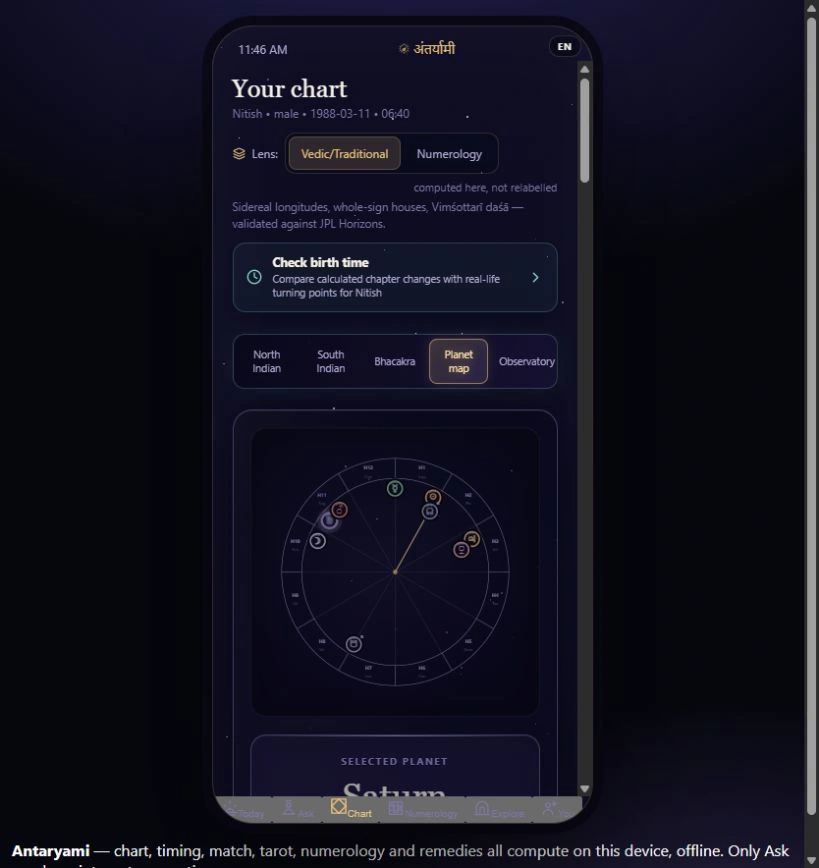
A planet name is an interesting fact to learn. A planet placed in a house raises a more personal question: which area of experience is this traditional explanation trying to describe? Antaryami's Planet map brings the two together visually and places a readable explanation beside the selection. This guide by Nitish Raj Walia shows how that design can help a beginner move from recognising symbols to asking more precise questions. The screen is captured from the real app preview with fictional data. We are not using it to diagnose the reader or to promise that a particular life event follows from a particular position. Its purpose is to make the instrument understandable before you decide what, if anything, you want from a personal reading.
The map draws the active chart; it does not create another person
The Planet map takes the chart already selected in the app and draws its bodies within a house-and-sign frame. Its source component does not run a separate astrology engine every time you select a marker. That is an important product distinction. The instrument is a way of seeing the same underlying result, with an emphasis on placements and their life-area context. If you move between it and another chart view, compare the labels for the same person rather than expecting a newly generated answer from every illustration.
This also makes a careful comparison possible. Pick a body in the North Indian chart and note its sign and house. Open the Planet map and check that body's written placement. The graphic will look different, yet the same chart context should remain intact. If it does not, review the profile and method before drawing conclusions. A visual discrepancy is a support question that can be reproduced; it is not evidence that a person has two incompatible identities depending on the button they pressed.
A house is a topic in the tradition, not an address inside a planet
The map's house labels refer to a traditional organisation of life topics. They do not mean that a planet physically occupies an earthly room or sends a measurable influence to that room. In the app's whole-sign explanations, the reference sign begins the first house and the following signs continue the sequence. Once that convention is clear, a placement can be read as a relationship between a symbolic planetary function and a topic. It is a structured interpretive language rather than a scientific map of an individual's circumstances.
Consider the difference between an occupation and a life topic. A career discussion may involve responsibility, communication, learning, resources and cooperation. There is no reason to reduce all of those considerations to one house label. A house can help focus a question, but your actual role is still shaped by training, opportunity, working conditions and other people. The map becomes more useful when it helps you articulate which part you want to discuss. It becomes less useful when its tidy sectors encourage you to ignore everything outside the sector.
Read the card as a sequence rather than a headline
The selected-planet explanation moves from everyday meaning to what the symbol does, then to the selected profile's placement. It also distinguishes a constructive expression from something worth watching. That balance makes the card more informative than a simple good-or-bad badge. Read the sequence before deciding what it means to you. A phrase about initiative, for instance, may need to be understood alongside a caution about rushing. The two statements are not competing verdicts; they offer different questions about how a quality could be expressed.
You can test the usefulness of the language against an ordinary example. Perhaps you volunteer for tasks quickly but later discover that the work was never defined. A reflection about initiative might help you ask for a clearer scope before agreeing. That action is sensible even without an astrological interpretation. It does not prove that the placement caused the behaviour. Keeping that distinction allows you to take something useful from the reading without converting a practical improvement into evidence for every larger claim a chart might be asked to make.
Look beyond the occupant when a house appears empty
An empty house is a common source of unnecessary alarm. In the app's house guidance, absence of a planet is explicitly distinguished from absence or weakness of the life area. The sign ruler and wider connections remain part of a traditional reading. If no marker sits in a sector, do not conclude that the person has no chance of experiencing the associated topic. Start with the topic itself and read the named sign and ruler. This turns an apparent blank into a question about connections rather than a statement of deficiency.
The opposite mistake is to overvalue a crowded sector. More visible markers do not automatically mean more success, more difficulty or more importance. Each marker has a role, and the interpretation depends on relationships between factors. A map makes the distribution easy to see, which is helpful for learning, but seeing more is not the same as knowing more. Ask what the explanation actually establishes under its method. If the language goes beyond that into a guaranteed outcome, keep your judgement and real-world evidence in charge.
Use the map to narrow a question you already recognise
- Write the everyday issue before choosing a planet or house.
- Read the placement and full explanation in the same selected profile.
- Identify one relevant example and one situation the interpretation does not explain.
- Choose an ordinary, reversible step that remains sensible outside astrology.
Before opening the instrument, name the real issue in a few ordinary words. You might want to understand why you avoid asking for help, how you organise a routine, or what makes a collaboration feel difficult. Do not include another person's private record in that question without their permission. Then read one relevant life-area explanation and one selected-planet card. Ask whether the vocabulary clarifies the issue or merely makes it sound grander. A useful explanation should make the next conversation more understandable, not harder to question.
Keep a note of any exception. If an interpretation describes caution and you often act impulsively, that contrast deserves attention rather than being explained away automatically. You could ask what situations produce each behaviour. That is a richer inquiry than forcing yourself into one label. Finish with a bounded next step: define a task, invite a conversation or collect information. Avoid trying to optimise every action around a chart. The map is an educational instrument you can return to, not a compulsory control panel for the decisions of your day.
Let understanding, not pressure, lead you to the next screen
The website's fictional exhibits let you inspect the Antaryami instruments before choosing personal access. They are suitable for learning the visual language, not for reading your own circumstances from someone else's demonstration data. The personal app experience also depends on verified availability and active access. A screenshot is not a purchase entitlement, and an unpublished app-store link must not be treated as available because the interface looks finished. Check the current app page before planning a download or payment.
This guide is part of the AI-assisted Antaryami Journal by Nitish Raj Walia, from Temior Technologies Pvt Ltd. Its invitation is specific: try the Planet map's way of organising a question and see whether it helps you understand the tradition. You do not need to surrender judgement to enjoy the instrument. A readable product should help you distinguish a topic, a placement, an interpretation and a personal decision. When those distinctions stay visible, the map can be a place to learn rather than a place to acquire a label you feel obliged to live under.
What would you like the map to clarify?
The life area of a placement
Read its whole-sign house label and the house topic, then bring one concrete situation to the explanation. A topic is not a guaranteed event.
A supposedly missing life area
A sector without a planet still has a sign and ruler in the traditional framework. Begin with those connections instead of an alarming conclusion.
Astrological interpretations are for reflection, not a diagnosis, a guaranteed prediction or a substitute for professional advice. Journal guides are prepared with AI assistance; they are educational content, not individual consultations.


