 Antaryami
Birth-record workshop
The birth date and the registration date are different facts
A document is issued on 2 November for an event recorded late on 30 October. Another page carries a later registration stamp. Which date belongs in a birth-date field? The answer depends on what each document label describes. This fictional record review separates the event from the paperwork about it, without offering legal advice about certificates or declaring which document must prevail in every jurisdiction.
Make a timeline with different kinds of events
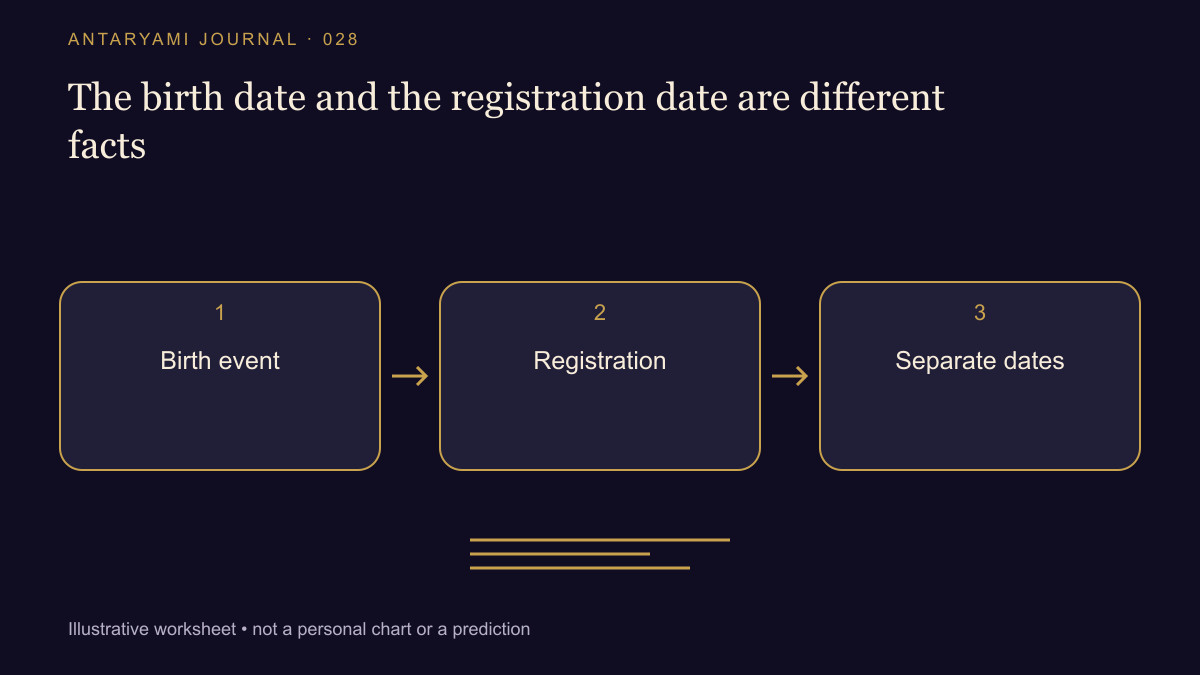
Begin with three separate lines: the stated birth event, its registration and the document's issue date. Add a source label to each. The dates can legitimately differ because they concern different actions. A later administrative date should not replace the event date simply because it is printed more prominently.
In the invented example, “birth: 30 October, 23:55” is one statement, “registered: 2 November” another, and “copy issued: 10 November” a third. These labels do not verify the record's authenticity, but they prevent a reader from treating three different fields as contradictory birth dates.
Preserve the document's actual wording
Transcribe the heading as well as the number. If a field is labelled date of issue, keep that label in the review note. Do not rename it date of birth during a spreadsheet import. An image crop that removes the heading can make a later reviewer unable to understand what was originally supplied.
If the language or layout is unclear, ask for a competent reading through an appropriate private process. Do not post a full identity document publicly to crowdsource an answer. A redacted explanation of the ambiguous field may be enough for preliminary guidance without exposing unnecessary personal information.
Separate authenticity from interpretation
This worksheet does not establish which source is legally authoritative, whether a document is genuine or how an official correction should be made. Those questions may require the issuing authority or qualified advice. Its narrower task is to identify what each visible date claims to describe.
Where two documents genuinely state different event dates, record the conflict rather than hiding one. Note whether either has been corrected or superseded according to reliable evidence. A chart application cannot resolve a documentary conflict merely by accepting one date into a valid input field.
Use the event record responsibly
For a personal calculation, select the event date supported by the appropriate record and keep any uncertainty attached. Avoid changing it to a registration or printing date to see which reading feels more familiar. If support is needed, explain the field-label issue with fictional details first. The useful result is a clear account of the evidence, not a confident chart built from the wrong administrative timestamp.
Astrological interpretations are for reflection, not a diagnosis, a guaranteed prediction or a substitute for professional advice. Journal guides are prepared with AI assistance; they are educational content, not individual consultations.