Antaryami
Birth-record workshop
Ten minutes either side: a birth-time sensitivity exercise
A chart category seems sensitive to a small time change. Instead of selecting a more convincing interpretation, try a controlled sensitivity exercise. Keep the source time and its uncertainty visible, then compare a small set of explicitly labelled candidate instants. The exercise can show what changes. It cannot identify the correct birth time without additional evidence.
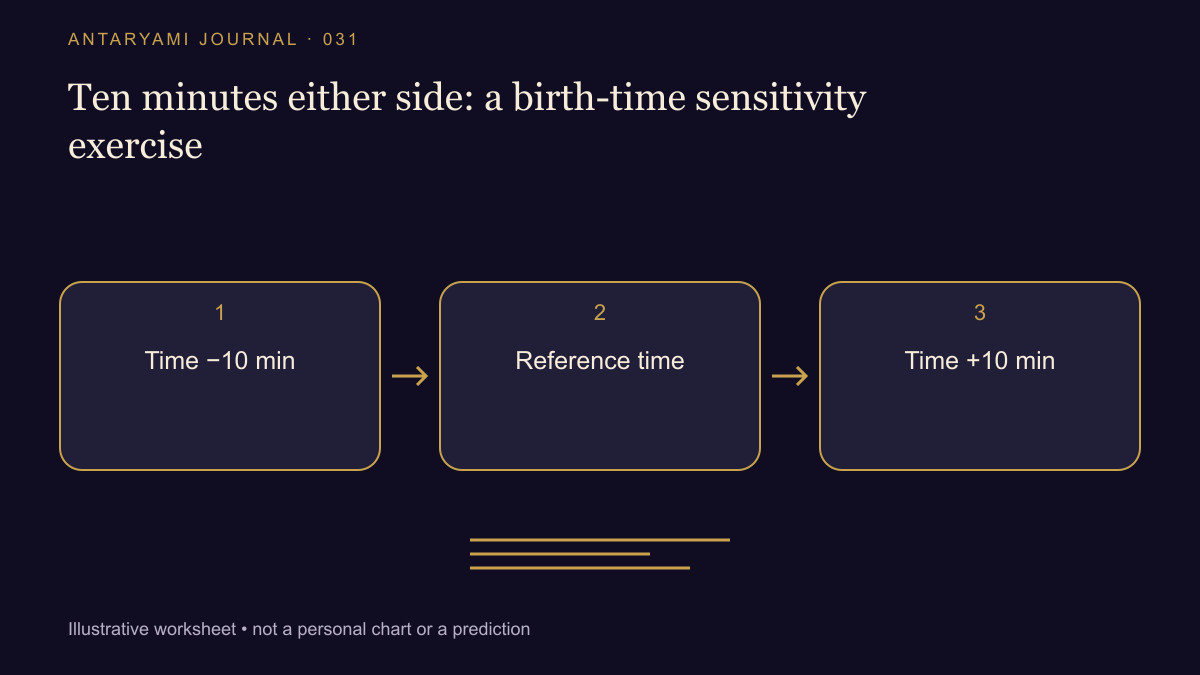
Choose an interval for a stated reason
Suppose a fictional record gives 08:00 with uncertainty of roughly ten minutes on either side. Use 07:50, 08:00 and 08:10 as an initial teaching set. The interval belongs to the invented record in this example; it is not a universal prescription for every uncertain birth time.
Hold the date, location, time-zone interpretation and calculation settings constant. Changing these while testing the time would introduce several possible causes for the difference. If the interval crosses a civil date or a clock-change boundary, handle that condition explicitly rather than treating the hour field as an isolated number.
Decide what you will compare
Choose a defined output: an angle, a house assignment or a particular classification. Record numeric values with enough precision to explain any label change. A diagram's colours or icon positions may change for layout reasons, so they are not always the best comparison fields.
Make a table with one row for each candidate. Add a column describing whether the selected category stayed stable or crossed a boundary. If a change appears between samples, a finer examination may help describe that transition. It still does not establish where within the uncertainty interval the real event occurred.
Keep stable and unstable results separate
One output can change while another remains stable over the tested range. Avoid responding with an all-or-nothing claim that every part of the chart is either precise or meaningless. The useful conclusion concerns the specific output and interval actually examined.
Also distinguish a range check from a full uncertainty analysis. Three samples can demonstrate a difference at those points; they do not prove the behaviour of every unsampled instant. If a rigorous boundary search is needed, use an appropriate documented calculation method and preserve its assumptions.
Write the conclusion before interpreting
A clear note might say, “The selected label differs between 07:50 and 08:10 under otherwise matched settings; the source does not resolve which candidate applies.” That statement is useful even without a firm personal reading. It keeps the calculation from pretending to repair the record. Any later interpretation should retain the uncertainty instead of presenting one candidate's story as a confirmed account of the person.
Astrological interpretations are for reflection, not a diagnosis, a guaranteed prediction or a substitute for professional advice. Journal guides are prepared with AI assistance; they are educational content, not individual consultations.