 Antaryami
Numerology workshop
29, 11 and 2: preserve the compound and reduced totals
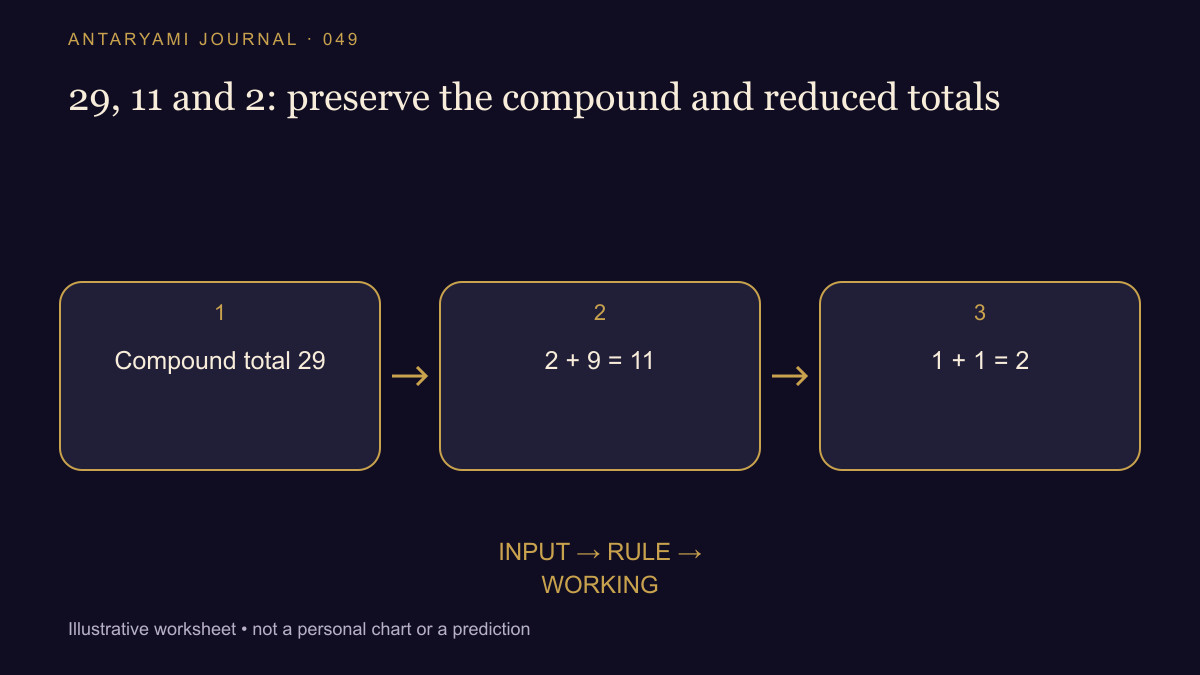
The notation 29/11/2 can describe successive stages of one calculation: an unreduced total of 29, a digit sum of 11 and an ordinary final reduction of 2. Without that explanation, three displayed numbers can look like separate findings. This exercise keeps the chain visible so that the arithmetic can be checked before anyone offers a symbolic interpretation.
Follow the chain without skipping a stage
Start with the stated total 29. Add its digits: 2 + 9 = 11. If the rule is ordinary reduction to a single digit, add again: 1 + 1 = 2. If the method retains 11 at that stage, the reported endpoint may instead be 11, ideally accompanied by the ordinary reduced form. The choice belongs in the method note.
A correct chain does not prove that 29 was the correct original total. For a letter-based calculation, keep the selected spelling, letter table and every value that produced 29. For a date-based calculation, retain the date components and their order. Otherwise the reduction can be flawless while the input or first addition is wrong.
Compare matching stages
Imagine one screenshot says 29/11 and another says 2. Before calling them contradictory, ask whether both began with the same input and whether the second always reduces. If so, they may simply display different stages. A screenshot that says 29 reduces directly to 3, however, needs an arithmetic correction under the declared ordinary rule.
Do not compare the compound total from one name method with a reduced component from another and describe them as competing answers. Label columns original sum, first digit sum and final ordinary digit. Add a separate field for any retained endpoint. That small structure makes it harder to lose track of what each number means.
Avoid turning a notation into a verdict
If a traditional interpretation attaches meaning to 29 or 11, present it as that tradition's interpretation, not a verified diagnosis or forecast. The reduction chain alone says nothing about whether a person will succeed in a relationship, career or investment. A practical reflection might ask what cooperation means in a current project, while the project's actual evidence remains central.
For sharing, use fictional inputs and include the complete rule beside the chain. If the input later changes and its sum is no longer 29, retire the old reading rather than carrying its symbolism into the new calculation. Keeping the compound and reduced totals together supports a clear explanation. It does not create extra evidence simply because several related numbers are visible on the page.
Astrological interpretations are for reflection, not a diagnosis, a guaranteed prediction or a substitute for professional advice. Journal guides are prepared with AI assistance; they are educational content, not individual consultations.