Antaryami
Birth-record workshop
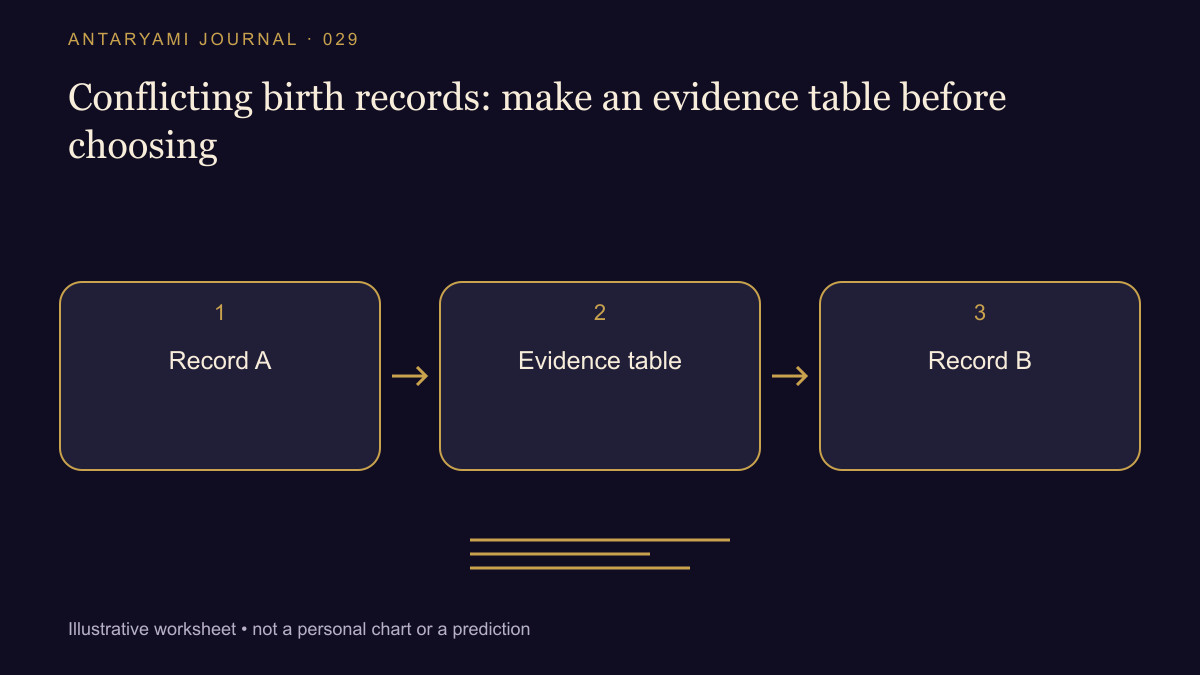
Conflicting birth records: make an evidence table before choosing
One family note says 06:20. A later transcription says 06:50. A relative remembers only early morning. It is possible to acknowledge all three without pretending that they carry equal detail or that an attractive chart interpretation can settle the disagreement. An evidence table makes the conflict visible and gives a record review a more disciplined starting point.
Give every statement a source
Create columns for the time as written, the source, when that source was made and any explanation attached to it. Distinguish a contemporaneous document from a later copy or memory. Do not automatically declare one category infallible; the table is a way to organise evidence, not a machine that certifies a winner.
In the fictional example, enter the two exact-looking times as separate claims. Enter early morning as an approximate recollection rather than translating it into a guessed minute. Keeping its original level of precision prevents a broad memory from being turned into false numerical support for one of the written values.
Look for a traceable transcription change
Check whether the later record copied the earlier one, whether a digit is unclear, or whether a correction is explicitly documented. Two matching copies are not necessarily two independent witnesses if both derive from the same original. A repeated value can be useful, but its provenance matters.
If a source cannot be inspected or its interpretation remains disputed, state that limit. Do not fill the gap with an assumption about what a hospital must always have done. The useful questions concern the actual record in front of you, not a general story about institutions or families.
Keep chart exploration separate
You can explore how calculations change under each candidate time, provided the outputs retain their candidate labels. That sensitivity exercise shows the consequences of an input choice. It does not determine which source statement is historically correct or turn a matching life story into documentary proof.
Avoid presenting a provisional chart as a confirmed correction. If a specialist proposes a rectified time, ask how that proposal is distinguished from the original record and what uncertainty remains. Different kinds of evidence should remain identifiable even when they are discussed together.
End with a clear record status
Possible conclusions include confirmed from a specified source, provisional pending clarification, or unresolved between stated alternatives. Those labels are more honest than silently selecting whichever minute produces the most persuasive reading. Share only the information necessary for private support. The aim is a record that can be understood and revisited, rather than a neat table whose certainty was created by deleting the disagreement.
Astrological interpretations are for reflection, not a diagnosis, a guaranteed prediction or a substitute for professional advice. Journal guides are prepared with AI assistance; they are educational content, not individual consultations.