Antaryami
Festival planning
Dussehra 2026: why Vijayadashami matters beyond Ravana Dahan
An effigy makes a striking photograph. It is much harder to photograph a decision to tell the truth, correct a mistake or use power responsibly. Dussehra brings these different scales together: a public spectacle can also open a private question about what victory should mean. Yet the festival cannot be reduced to one image or one regional programme. A visitor looking for Dussehra 2026 information needs to distinguish the general calendar date from a particular city's event notice, and the Rama narrative from other devotional settings. This Antaryami guide follows those distinctions. It offers a way to approach Vijayadashami through story, attention and ordinary conduct without inventing a universal ceremony or promising that a single auspicious day will repair everything in a person's life.
Dussehra 2026: a festival date is not every event booking
Incredible India's general Dussehra page lists Tuesday, 20 October 2026. That is a useful starting point for someone asking when the festival falls. It is not sufficient evidence for the exact start time of a procession, the availability of tickets or the opening hours of a particular ground. Those questions belong to the event organiser's current notice.
A revealing example is the Mysuru Dasara programme consulted on 13 October. It presents a local Vijayadashami finale under 21 October, whereas the general national festival page gives 20 October. This guide reports the difference rather than silently replacing one with the other. If travelling, verify the latest original programme and the particular event before paying for transport or accommodation. A city name added to a search result does not automatically resolve a programme discrepancy.
Imagine two relatives agreeing to meet for Dussehra. One has saved a national date; the other has a ticket for a locally scheduled performance. Both can be describing something real while still planning different evenings. Ask for the event name, venue, civil date and admission arrangement. Put those details in the shared message. Keep the source link alongside them so an update can be traced. This small distinction is more useful than insisting that every activity associated with a festival must fit inside one date printed on a generic graphic.
Sources: Incredible India: Dussehra traditions and its general 2026 listing; Mysuru Dasara: organiser programme; check the current event notice
What does Vijayadashami invite us to understand?
Vijayadashami is associated with victory on the tenth day in the festival vocabulary. Within relevant devotional accounts, that victory is understood through sacred narratives. Incredible India's overview connects the Rama and Ravana story with many Dussehra celebrations and also describes the conclusion of Durga Puja in Bengal. These are related festival contexts, not a licence to merge every narrative into a single invented episode.
When explaining a story to a new learner, name the setting first. Say that a particular performance is presenting the Rama narrative, or that a gathering belongs to a Durga Puja tradition. The learner then has somewhere to place the characters, symbols and actions they encounter. An introduction becomes confusing when it treats a regional example as the sole definition and assumes that everything else is an inaccurate version of it.
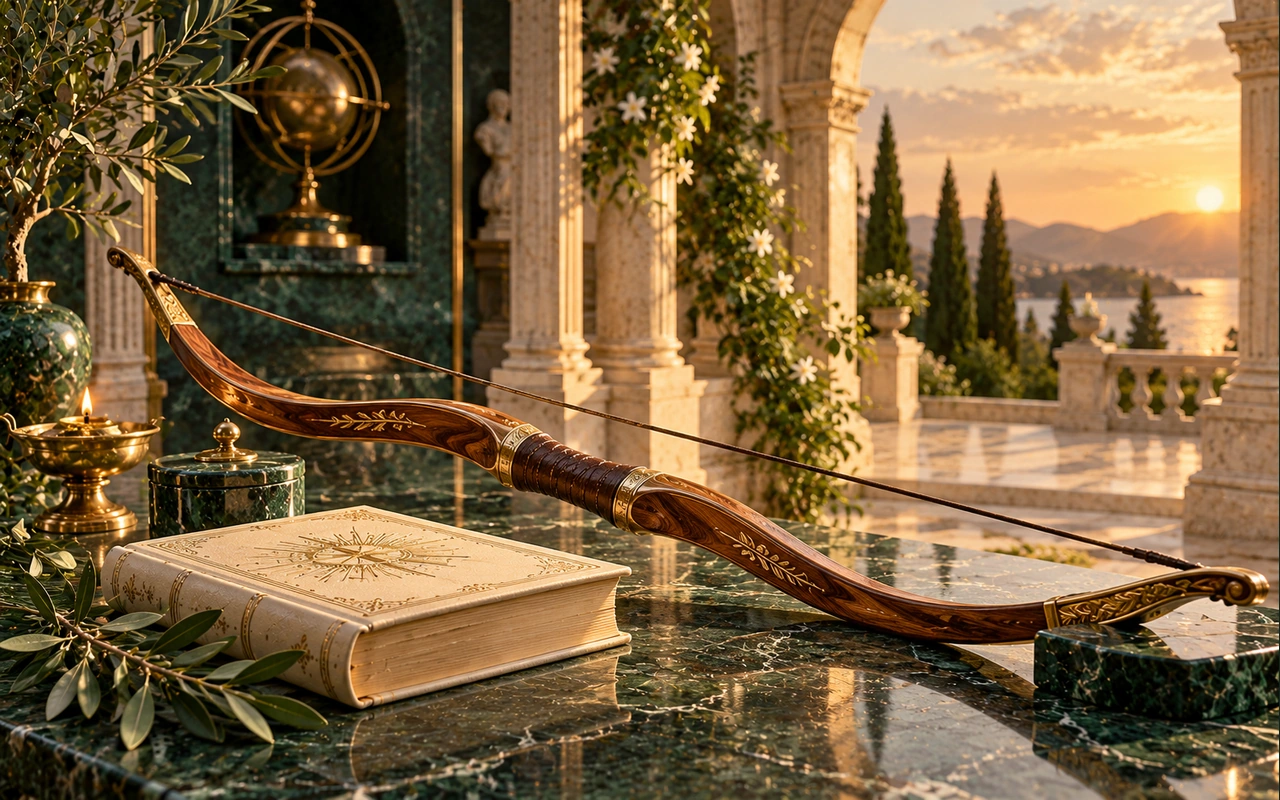
There is a further distinction between understanding a religious story and claiming it as a measured prediction. A narrative can carry ethical and devotional meaning without functioning as a forecast about a customer's future. A bow in our illustration points toward the subject of the story; it does not certify an ancient object or promise that the reader will defeat an enemy. Keep the symbolic language expressive, but let the labels do their work. Someone should be able to learn why an occasion matters without being pushed into a claim they cannot examine.
Sources: Incredible India: Dussehra traditions and its general 2026 listing
Watch a performance as a conversation with a story
Ramlila gives a story a body: voices, costumes, movement and an audience sharing time in one place. A useful way to approach a performance is to ask what decision is being shown in the scene you are watching. Which character is speaking? What commitment or conflict has brought that character here? This makes attendance more than waiting for the final spectacle, even if the viewer is unfamiliar with the full narrative.
You do not need to pretend to understand everything immediately. If a word or reference is unfamiliar, note it and ask a knowledgeable person afterwards. If attending with someone new to the tradition, offer a short explanation of the scene rather than an uninterrupted lecture over the performers. Listening is part of the visit. Let the programme's own language and presentation be heard before fitting it into a lesson you arrived expecting to find.
Consider a hypothetical scene in which a promise becomes inconvenient. A viewer might ask whether the difficulty changes the character's obligation, and how the performance presents the consequences. That is an interpretive question, not a claim that the same event will happen in the viewer's household. A good discussion can hold several observations together: admiration for the artistry, curiosity about the narrative and disagreement about a decision. The festival remains alive as a subject of learning when the audience is allowed to think as well as applaud.
Regional diversity changes what you should look for
Incredible India's account identifies different festival settings, including Kolkata, Mysuru, Kullu and Bastar. Its mention of this diversity is important, but a list of places is only the beginning of understanding. A reader should not conclude that each destination offers the same performance under a different skyline. The relevant community, organising institution and devotional focus need to be examined separately.
For a first visit, choose one programme to learn about properly. Read the organiser's description, identify which parts are open to visitors and ask about conduct at the venue. A public celebration may include devotional activity, civic arrangements and commercial stalls, each with its own expectations. Being able to purchase a ticket for one component does not mean that every space is available for unrestricted photography or entry.
The same principle helps a family describe its own observance online. A caption can say that this is the custom followed in our household or at the programme we attended. That wording shares an experience without claiming authority over everyone else's. Avoid presenting another region's practice as exotic decoration or an amusing deviation. A festival becomes richer when the explanation allows its communities to remain recognisable. Antaryami's journal uses named sources and settings for exactly this reason: a clear account should make difference intelligible instead of smoothing it away to fit a slogan.
Sources: Incredible India: Dussehra traditions and its general 2026 listing
A contemporary reflection on the tools you use
The Mysuru programme includes Ayudha Puja among its listed activities. That local entry does not supply a universal ritual sequence for this article. It does, however, open a useful learning question: what does respectful attention to tools mean in your own working life? A traditional practice and a contemporary reflection can be discussed together, provided the latter is not passed off as an ancient mandatory instruction.
Take a tool you use often: a notebook, a laptop, a musical instrument or a set of workshop implements. Ask what it helps you do and what responsibilities come with using it. A device can help you communicate accurately or spread a rumour quickly. A skilled instrument can produce careful work or conceal a shortcut. Respect for the object is incomplete if the person refuses to think about the action it enables.
One practical exercise is to identify a small neglected maintenance task and a small neglected ethical task. The first might be organising a backup. The second might be acknowledging somebody whose work was used without credit. These are suggestions from this guide, not a substitute for a family's worship. They give a person a concrete way to connect a festival reflection with the following working day. The result need not be dramatic to matter: a tool used more carefully and a responsibility handled more honestly are things other people can actually experience.
Sources: Mysuru Dasara: organiser programme; check the current event notice
Do not turn the story into a label for another person
The language of good overcoming evil can be powerful. It can also be misused when a person declares every opponent evil and treats disagreement as permission for humiliation. A more demanding reflection begins with one's own conduct. Where have I been careless with a fact? Which promise have I avoided discussing? What would a fair correction require from me rather than from somebody I dislike?
Suppose a colleague has made a mistake. A response focused on repair asks what happened, who was affected and how the work can be corrected. A response focused only on winning looks for a public defeat of the colleague. This example is not an interpretation of a specific scripture. It is an ordinary comparison that lets a reader test what kind of victory they are seeking in a real interaction.
Astrology and symbolic guidance should not be used to assign moral guilt to a person either. A difficult chart label, a tarot image or a planetary period does not establish that someone is dishonest or dangerous. If there is an actual problem, attend to behaviour and evidence. The festival can encourage self-examination, but it should not become a tool for declaring another person's worth from a symbolic category. Keeping that boundary allows the ethical language to remain serious. It asks more of the reader than a flattering promise that the universe is automatically taking their side.
Turn interest into a considerate visit
Before leaving home, confirm which activity you are attending and when admission begins. Keep a copy of the organiser's current notice rather than relying on a screenshot with no date or source. If travelling as a group, select a meeting point that everybody can identify and agree how to reconnect if the group separates. An enjoyable visit depends on these practical arrangements as well as on enthusiasm for the festival.
Think about the needs of the people accompanying you. A long evening in a crowded venue may be tiring for somebody who was comfortable at the start. Discuss the option of leaving earlier without presenting it as disrespect. Make food, transport and access decisions before the group is under pressure. Follow the venue's safety instructions, and do not treat a striking photograph as a reason to move closer to a restricted or hazardous area.
When posting afterwards, distinguish your observation from the programme's claims. You can say what you saw, what you learned and which question you want to explore further. Do not invent crowd statistics, historical dates or a personal miracle to make the caption sound important. A specific detail often tells a stronger story than an exaggerated superlative. It also respects the people who created the event: their work deserves to be described accurately, not used as a background for a claim the visitor brought from somewhere else.
Choose one action that can survive the celebration
The evening ends; the next morning still contains ordinary responsibilities. Before setting the festival aside, choose one action you can describe without spiritual inflation. Perhaps it is an apology that names the actual harm, a corrected message, a task shared more fairly or a commitment to read the story beyond the episode you already know. Write down what the action is and when you intend to do it.
Keep the scale realistic. A statement that you will become a completely different person can be difficult to evaluate and easy to abandon. A statement that you will correct an inaccurate claim with the people who received it has a clear next step. The festival has not guaranteed success; it has offered a moment in which you can examine what you want to do differently. Follow-through belongs to your choices and circumstances.
Continue with Antaryami's calendar and instrument guides when you want to understand the language behind an observance or symbolic system. Read the method and availability labels before considering app access, and ask for the context behind a confident claim. Dussehra can be approached through a national festival date, a regional programme, a sacred narrative and a personal reflection without confusing those layers. The most useful conclusion is a clearer eye: for the story you are hearing, for the community hosting you and for the kind of victory you are willing to practise when there is no audience watching.
Separate the date, story and decision
Does a national festival date confirm a local procession booking?
No. Check the named organiser programme, venue and latest admission notice. A local programme may use a different schedule.
Is a practical reflection in this guide an ancient ritual rule?
No. The contemporary exercises are labelled suggestions. Ritual instructions belong to a named tradition and responsible organiser.
Astrological interpretations are for reflection, not a diagnosis, a guaranteed prediction or a substitute for professional advice. Journal guides are prepared with AI assistance; they are educational content, not individual consultations.