Antaryami
Festival planning
Sharad Purnima 2026: meaning, Moon traditions and common misconceptions
A full Moon can make a familiar courtyard feel unfamiliar. Objects that looked ordinary in the afternoon acquire a different outline, and a person may find themselves looking up for longer than they intended. Sharad Purnima brings that attention into a devotional season. The beauty is real as an experience; the claims made about it still need careful labels. A festival story, the calculated full-Moon phase and a statement about a food's health effects are not the same kind of knowledge. This Antaryami guide explains the distinction without flattening the occasion into either a shopping list or a dismissal. You will find the 2026 Chandigarh calendar context, an example from a named religious institution and practical questions for enjoying an evening without mistaking a symbolic image for scientific evidence.
Sharad Purnima 2026: why the label beside the date matters
The Chandigarh monthly calendar consulted on 13 October 2026 lists Sharad Purnima and Kojagara Puja on Sunday, 25 October, and lists Ashwina Purnima on Monday, 26 October. The distinction deserves to remain visible. An observance selected for an evening and a lunar-day label selected for another calendar purpose need not be interchangeable. If you are attending a gathering, obtain the host's actual civil date and programme rather than selecting whichever search result has the larger headline.
A tithi is a lunar calendar division, not a promise that every activity lasts from midnight to midnight. The relevant observance rule can care about a particular part of the day or night. To understand a date discrepancy, ask which event is being named and which location and convention the calendar uses. Without those details, two different labels can look like an error even when they are answering different questions.
Use a simple planning note with separate fields: occasion, place, selected evening and source checked. Do not shorten it to a bare number if you intend to forward it to someone abroad. A local family gathering also has practical arrival and serving times that are not supplied by the lunar label. Keeping these distinctions allows you to enjoy the evening with less confusion. This article preserves the dated provider listing; it does not claim that its Chandigarh example decides every temple's programme or every regional family's observance.
Sources: Drik Panchang: Chandigarh monthly calendar, checked 13 October 2026
One festival, more than one devotional emphasis
The BAPS Swaminarayan Sanstha explanation connects Sharad Purnima with Kojagari themes, Krishna's devotional narrative and the birth observance of Gunatitanand Swami within its own tradition. It also describes a milk-and-rice offering. This is a useful institutional example because the reader can identify whose religious account is being presented. It is not a universal instruction to reproduce every detail in every household.
The important question for a visitor is not merely what people eat. Ask what the gathering is remembering and how the host understands its symbols. A story about devotion may be central in one setting, while another assembly gives particular attention to an institutional birth commemoration. Understanding this difference keeps you from arriving with a single generic explanation and overlooking the purpose of the event in front of you.
An institutional account can also contain claims of different kinds. A description of a rite, a theological belief and a statement about health should not receive the same label simply because they appear on one page. This guide uses the page to identify devotional context, not to endorse a physiological benefit. Respectful learning includes this ability to separate categories. You can listen carefully to a sacred narrative while still asking for appropriate evidence before treating something as medicine. The distinction protects the meaning of the tradition from being reduced to a supposed clinical result.
Sources: BAPS Swaminarayan Sanstha: its Sharad Purnima festival explanation
The Moon shines by reflection, not by producing its own lamp
NASA explains moonlight as reflected sunlight. The Moon's bright appearance should therefore not be confused with a light source burning on its surface. Its visible shape changes as our view of the illuminated part changes. In the full-Moon phase, most of the sunlit face is directed toward the Earth-facing view; the familiar round appearance is a matter of geometry rather than a separate object switching on.
Try an ordinary demonstration with a ball and a lamp in a room. Keep the lamp fixed, move the ball around a viewing position and notice how the lit portion visible to the observer changes. This is a simplified model, not a scale reproduction of the Earth-Moon system. Its purpose is to help you notice the relationship between illumination and viewpoint. It also shows why a photograph of a bright disc does not explain everything about the phase.
The demonstration invites a useful habit: distinguish what you observe from the explanation you attach to it. You may see a bright Moon above a courtyard and feel that the evening is special. That experience does not by itself measure a medicinal substance, prove an effect on a meal or establish a personal astrological outcome. Astronomy describes illumination. Devotional interpretation describes significance. Letting both retain their own questions gives a richer understanding than forcing one vocabulary to answer every question that arises under the sky.
Sources: NASA: why the Moon shines and what its surface reflects
A full-Moon phase and Purnima are connected, not identical labels
Purnima belongs to a traditional calendar vocabulary. Full Moon also has an astronomical meaning. The terms are closely connected, but a civil date chosen for an observance and an instant in a phase calculation answer different questions. A person asking when to attend a temple event needs a programme; a person asking about the Moon's illumination needs the relevant astronomical description. Confusion grows when a website presents both as one unlabeled time.
NASA describes a repeating phase cycle of about 29.5 days. That does not mean an observance can be scheduled by adding thirty days to the last family photograph. Nor does an almost-round appearance decide the precise boundary of a tithi. A learner can appreciate the regularity of the cycle while recognising that the calendar uses defined calculations and conventions to select its labels.
When comparing sources, write down what each source actually supplies. One may identify the festival evening for Chandigarh; another may show a phase diagram; a third may announce a local devotional assembly. Do not rank them solely by how precise their numbers look. Precision is useful only when it belongs to the right question. Antaryami's instrument guides encourage the same approach to chart labels: understand the method before interpreting the result, and do not assume that two similar-looking displays are making the same claim. A clear distinction is often more educational than a longer list of unexplained times.
Sources: NASA: lunar phases and their astronomical explanation
An offering does not suspend ordinary food safety
A bowl of a traditional sweet can carry affection, hospitality and devotional meaning. None of those meanings removes the ordinary requirements of handling perishable food. If your household associates an offering with moonlight, ask how the symbolic practice can be observed while keeping food safely stored and served. Do not use a belief about the evening to justify leaving a milk-based dish unrefrigerated overnight.
The FDA's consumer guidance says perishable foods should be refrigerated promptly, with a two-hour limit at room temperature and a shorter one-hour limit in heat above 32 degrees Celsius. This is food-safety guidance, not a statement about the religious meaning of an offering. Follow appropriate handling instructions for the actual ingredients and conditions, and seek qualified guidance where needed. A cool-looking evening or an attractive photograph is not a measurement of safe food temperature.
For a gathering, decide beforehand who prepares the dish, how it is stored and when portions are served. Explain ingredients so guests can make their own choices. You can also keep the devotional display and the serving arrangement distinct where your responsible tradition-bearer considers that appropriate. This article does not redesign a rite or promise that one arrangement suits every household. It asks organisers to avoid a false choice between respect and care. Guests should not be pressured to eat something questionable as proof that they honour the occasion.
Moonlit beauty is not evidence of a health guarantee
An online caption may move quickly from a beautiful night to a claim that a particular food cures a condition or that the Moon's rays guarantee wellbeing. Pause at that transition. What was observed? What effect is being claimed? Is the claim a devotional belief, an anecdote or a conclusion from appropriate medical evidence? These questions are not answered by the image's sharpness or by the confidence of the narrator.
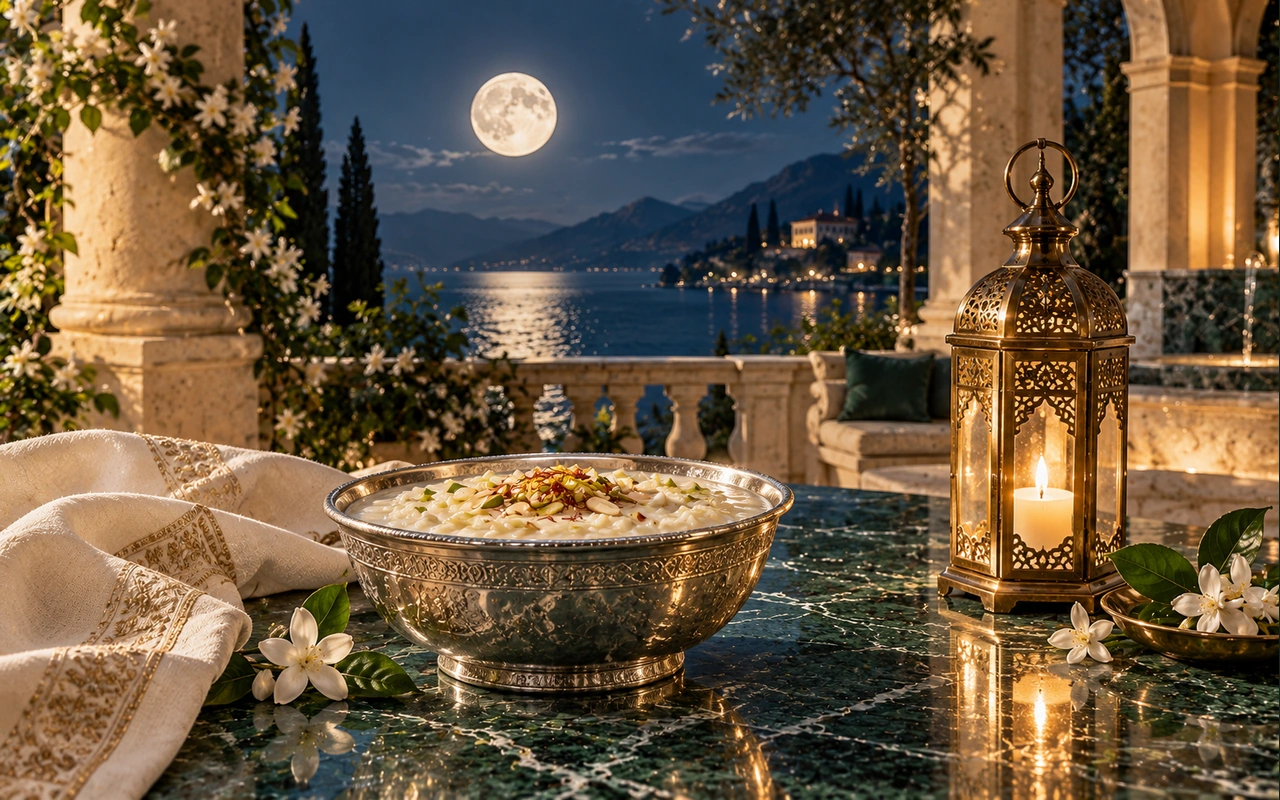
Consider a hypothetical post showing a silver bowl under a full Moon. The photograph can illustrate a household custom. It cannot, on its own, establish a change in the food's composition or demonstrate that a person should stop treatment. A story about somebody feeling better afterwards also leaves many other explanations unresolved. The responsible response is to keep the claim at the level its evidence supports, not to enlarge it into a universal instruction.
Use the same care when a seller connects the evening with a paid remedy. Ask for the exact service, its limitations and the basis of any promised outcome before spending money. Antaryami presents astronomical calculations separately from traditional and symbolic interpretations. Our conceptual cover is an illustration of an occasion, not evidence of healing rays or an authenticated ritual photograph. Readers should be able to enjoy the creative without being nudged toward a medical conclusion it cannot support. A meaningful festival does not need an unsupported cure attached to it to deserve attention.
Make an evening of looking, listening and recording
Choose a comfortable, permitted place from which to look at the sky. If you plan to use binoculars or a telescope, familiarise yourself with the equipment and its safe use beforehand. The evening should not depend on climbing somewhere unsuitable to obtain a photograph. A modest view from an accessible place can still lead to a satisfying observation.
Keep an observation note with the date, location, approximate time and conditions. Write what you actually saw: a bright disc, a cloud crossing it, a nearby rooftop blocking the horizon or a change in appearance as the Moon climbed. Do not fill a cloudy interval with details you expected to see. The value of the note is its honesty. If two people observe from different places, compare the conditions as well as the photographs.
Add a second, separately labelled reflection. Perhaps the gathering made you think about attention, gratitude or the difference between hurry and patience. That record describes your experience, not a measurement of the Moon causing your thoughts. Keeping the two notes side by side can be surprisingly helpful. It preserves the evening's personal meaning while teaching a basic research skill: observation and interpretation can inform each other without being treated as identical. For learners new to astrology, this is a practical foundation for asking better questions about any celestial display.
Let the festival make your questions clearer
After the evening, you may have three different kinds of notes: a local calendar choice, a description of a devotional gathering and an observation of the sky. Keep the source or context beside each. This is a more useful memory than a single claim that the night was powerful, because you can explain what you mean by that word and what you still want to learn.
Choose a next question suited to its source. Ask the organiser about the devotional sequence, consult a local calendar for a future observance and read an astronomy source for phase geometry. Bring health questions to qualified professionals rather than to a festival caption. The same person can be interested in all these subjects without requiring one authority to govern every part of them.
Antaryami's journal is a place to develop that literacy before making a personal purchase. Explore the Moon and calendar guides, compare method labels and check which app features are currently available. Sharad Purnima need not be explained through a conflict between wonder and accuracy. An evening can be beautiful, a tradition can be meaningful and a health claim can still require evidence. Once those distinctions are clear, you can look up with more curiosity and less pressure to believe everything attached to the image. That is a lasting benefit of learning the language behind the occasion.
Keep wonder and evidence in their right places
Does a moonlit photograph demonstrate that food has become medicinal?
No. It illustrates a setting or custom. A health claim requires suitable evidence and must not replace professional care or safe food handling.
Why retain both the Sharad Purnima and Purnima labels?
They can refer to different calendar purposes. The consulted Chandigarh listing gives the festival evening on 25 October and Ashwina Purnima on 26 October 2026.
Astrological interpretations are for reflection, not a diagnosis, a guaranteed prediction or a substitute for professional advice. Journal guides are prepared with AI assistance; they are educational content, not individual consultations.