 Antaryami
Tarot card meanings
Eight of Swords tarot card: name the real constraint before asking where movement is possible
A situation can feel narrow because it really is narrow. Time, money, rules, other people's decisions or safety concerns may restrict the options available. The Eight of Swords is often described as a mental prison, but that phrase can become unfair when it ignores actual constraints. In this Antaryami guide, Nitish Raj Walia begins somewhere more careful: name what limits the situation, then ask where information, assistance or a manageable change might create room. The card does not prove that your difficulty is imaginary or that you could simply walk away if you were more confident. Its useful question concerns agency within real conditions, not blame for conditions you did not choose.
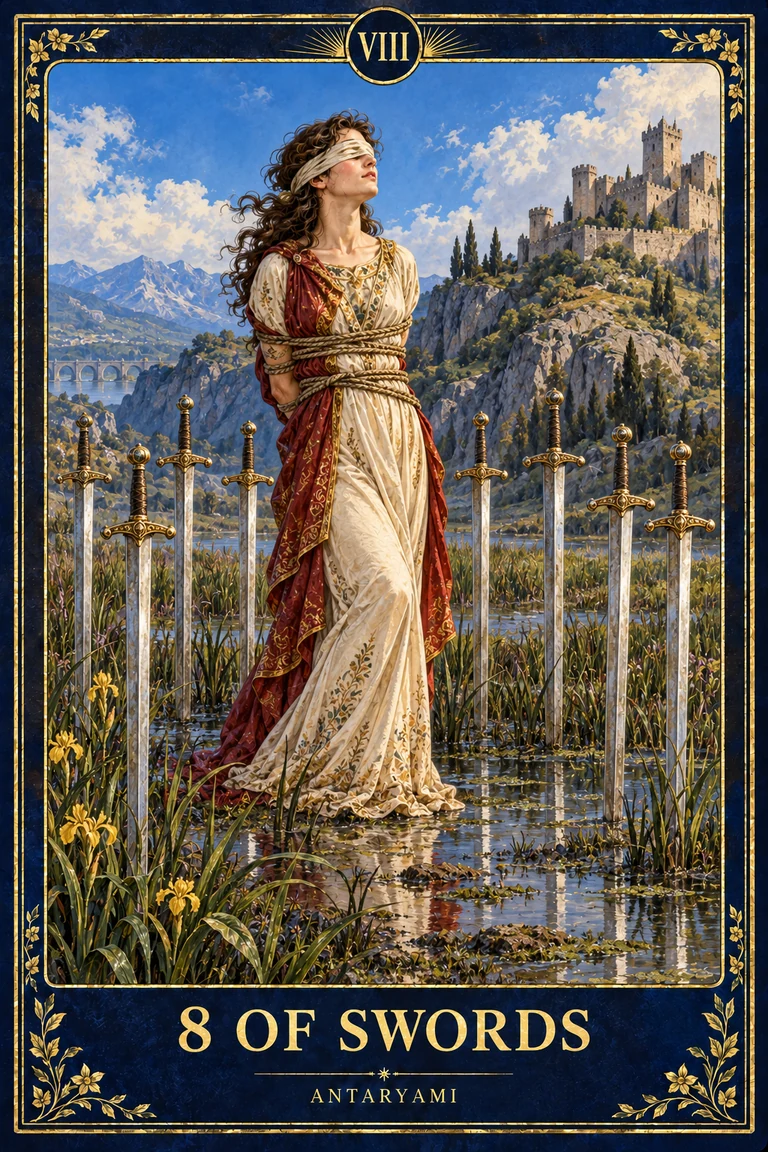
Eight of Swords meaning: restriction is a question to investigate, not a character flaw
Contemporary Eight of Swords interpretations often discuss feeling restricted, limited visibility, a belief that options are unavailable or the need to recognise a possible opening. Those themes require context. Some restrictions are assumptions; others are material conditions or decisions you cannot change alone. The card does not determine which kind you face. Begin by naming the constraint accurately. A useful reflection can examine where movement exists without pretending that confidence removes a rule, a resource limit or a genuine risk.
Imagine being unable to take on a new commitment because your schedule is already full. Calling that a limiting belief would overlook the actual time required. You may be able to revise the commitment, obtain help or choose a later date, but those are practical changes rather than proof that the restriction was never real. The Eight lens can prompt you to distinguish the fixed part from the part that may be adjustable. That distinction makes agency more realistic and the next question more answerable.
Limited information can narrow the situation as well. You may believe a process has only one route because you have not been told about an alternative. An appropriate inquiry could reveal another option, or confirm that the original limit is real. Both answers matter. The card's usefulness does not depend on discovering that everything was in your mind. It can support a more accurate account of the conditions, making it easier to identify which change, support or boundary is relevant and which promise would be unrealistic.
The blindfold and bindings: look carefully without minimising what restricts the figure
Antaryami's original Eight of Swords places a bound, blindfolded figure among upright blades in shallow water, with a castle beyond. The setting makes restriction visible rather than merely naming it. You can inspect the spaces between the swords, but do not turn those spaces into a claim that every real difficulty has an easy exit. Our Museum Tarot artwork is an original composition. Its physical details are not a map of a customer's situation or an assessment of the help and resources actually available to them.
Waite describes the image as a temporary restriction rather than an irretrievable one, while his historical meanings include severe difficulties. This article uses the question of agency and support as a contemporary lens without treating the source's divinatory claims as verified outcomes. Temporary in an illustration does not supply a timetable for an actual restriction. The card cannot establish that a legal, financial, medical or personal obstacle will resolve soon. Those matters need information and assistance appropriate to their real circumstances.
The blindfold can prompt a question about missing information, while the bindings can prompt attention to an actual limit. Keep those questions separate. Obtaining information may reveal options without removing the resources needed to use them. Conversely, practical help may change a constraint even when your understanding was already accurate. The scene becomes more humane when it lets several kinds of restriction be considered, rather than using one metaphor to explain every difficult situation or making the person depicted responsible for whatever prevents movement.
Sources: Waite: Eight of Swords bound figure and temporary restriction
Upright: distinguish fixed conditions from adjustable parts
An upright Eight of Swords can prompt a constraint map. List what is currently fixed, what may be changed with permission or help and what you do not yet know. That structure can make a narrow situation easier to understand without requiring an immediate solution. The card does not promise that an opening exists in every direction. It supports a question about the part you can investigate now, with the rest acknowledged rather than dismissed as negativity or a lack of willingness to try.
For an ordinary task, a manageable adjustment may be changing its scope. If you cannot complete a large project within the available time, perhaps a smaller useful version is possible. That does not mean the original deadline was imaginary. It means the task and constraint can be considered together. An upright reflection can help you ask what result remains worthwhile under the actual conditions. If no acceptable adjustment is available, declining or postponing may be an honest response rather than a failure to make the card's optimistic interpretation come true.
Support may change the picture. A colleague could explain a process, a qualified adviser could clarify a right or a trusted person could help with a practical responsibility. Choose assistance suited to the matter and avoid sharing private information unnecessarily. The Eight does not identify who is safe or competent to help. Its useful role is to make the need explicit enough that you can seek an appropriate resource, while retaining a realistic account of what the support can provide and which conditions may still remain unchanged.
Reversed: an opening still needs a workable way to use it
A reversed Eight of Swords may be read through recognising options, an altered restriction, an internalised limit or a situation still requiring support. Reversal methods differ, and the orientation does not prove that freedom has arrived. Ask what has actually changed. Has information become available? Has a rule been clarified? Is a practical resource now accessible? An opening becomes meaningful through those conditions. A card-based declaration that you are free can be misleading when the actual means of acting remain absent.
Suppose you learn that a process allows an alternative route. The next question is whether you can use it, what it requires and whether it fits your circumstances. You may need documents, time, permission or assistance. The reversed theme can support careful attention to that next step instead of celebrating possibility as though the work were already complete. Recognising an option is valuable, but it is not the same as having an available, suitable and safe route through it.
Another possibility is retaining a conclusion after the conditions have changed. Perhaps a previous refusal has made you assume that no future request will be considered. An appropriate new inquiry may test that assumption, but it should not override an existing boundary or require another person to reconsider contact they have declined. The useful distinction concerns current evidence. Ask which restriction still applies and which conclusion needs updating. A contemporary reversal lens can help with that review without blaming you for having responded cautiously to a difficulty that was once real.
Relationships: do not let a symbolic opening override a real boundary
In relationship reflection, the Eight of Swords can frame limited choices, uncertainty about expectations or a concern that cannot be resolved alone. It cannot establish that someone is controlling you, that you are imagining a problem or that leaving is safe. Those matters require context. Begin with actual conduct and the resources available. If the situation involves coercion or safety, seek appropriate real-world support rather than treating the card as permission to confront someone or as a guarantee that an exit will be easy.
For an ordinary shared decision, the constraint may be an expectation never discussed. You might assume that asking for a different arrangement would be unacceptable. A clear, proportionate request could reveal whether adjustment is possible. The other person may agree, decline or explain a limit you did not know. The Eight lens can help you formulate the question without predicting the response. A request is useful because it obtains information, not because a symbolic image has proved that the person must provide the option you hope exists.
Respect other people's boundaries as well. Their refusal is not a binding you are entitled to remove by becoming more persuasive. Agency includes their freedom to choose. The card's restricted figure should not become a reason to cast every limit as unfair or every obstacle as an invitation to push harder. A careful relationship reflection asks what is yours to request, what is yours to decide and what remains outside your control. That account can make the next step clearer while preserving the dignity and choices of everyone involved.
Work: practical constraints need practical responses
An Eight of Swords workplace reflection can help when a task is being described as blocked without enough detail to address the blockage. Identify whether the issue is access, capacity, authority, information or a technical dependency. Each requires a different response. More motivation will not grant a permission, and a new meeting may not resolve a missing file. The card can prompt a more precise account of the constraint, while the actual process and evidence determine what change is possible.
Imagine a website release waiting for approval. The relevant limit is not necessarily hesitation by the person preparing it. A defined authorisation may be required before a live write can occur. The appropriate response is to keep preparation complete, communicate the scope and retain the normal checks. Treating the requirement as something to bypass would make the process less responsible. The Eight theme can be useful precisely because it distinguishes a genuine boundary from an assumption, and recognises that some boundaries protect the people and systems involved.
Where the matter involves rights, payment, security or health, obtain the appropriate advice or verification. A symbolic interpretation cannot determine eligibility or authorise an action. In ordinary planning, a constraint map can support a smaller scope or a clearer request for help. The useful result is not endless optimism about hidden possibilities. It is an accurate enough account of the conditions that a team can identify the next legitimate step, including the possibility that a task must wait or cannot proceed under the current arrangement.
Eight of Swords versus Two of Swords and The Devil
The Eight of Swords often foregrounds perceived or actual restriction and limited visibility. By contrast, the Two can focus attention on a decision paused between competing considerations. The Devil often foregrounds attachment, an entrenched pattern or the question of what holds influence over a situation. These are different interpretive lenses, not diagnoses or levels of captivity. A difficult choice, a material constraint and a repeating habit may coexist, but each needs its own account rather than being collapsed into one dramatic explanation.
Suppose you cannot begin a project. A Two lens may ask whether two priorities remain unresolved. An Eight lens may ask whether you lack time, information or required access. A Devil lens may ask whether a repeated pattern is absorbing attention despite your stated purpose. The comparison can clarify which question belongs to the actual blockage. It cannot establish that your difficulty comes from a psychological condition or a hidden force. Real constraints should remain visible even when the symbolic vocabulary makes a broader story tempting.
Another misconception is that the Eight promises that all barriers are self-created. This guide rejects that shortcut. A useful reflective instrument can support agency without assigning blame for conditions beyond a person's control. Its strength lies in asking about what can be known, changed or supported now. If the answer is limited, that answer deserves respect. A realistic next step may be small, may require help or may be a boundary about what cannot be done, rather than a dramatic escape that makes the illustration feel resolved.
Try an Antaryami constraint map: fixed, adjustable and unknown
For an Antaryami tarot draw, ask which constraint needs a clearer description before I choose a response. The Eight's named position may frame a challenge of limited visibility or a resource of recognising where assistance is needed. The inspected walkthrough can organise a symbolic question and reversal choice; it does not assess your rights, safety or psychological state. Use the interpretation to improve your account of the actual conditions, with serious matters handled through relevant evidence and qualified support rather than through a promise that the swords can simply be stepped around.
In your own journal, create three columns: fixed conditions, potentially adjustable conditions and unknown information. Put the next appropriate inquiry beside each adjustable or unknown item. Avoid making another person's consent an adjustable condition you can control. After obtaining information, update the map rather than forcing the answer into your first reading. This exercise is not a measure of courage. It makes room for realistic agency by distinguishing what can be investigated from what must be acknowledged or supported before movement becomes possible.
Explore Antaryami's tarot walkthrough and current app availability to see whether this thoughtful style of reading suits your curiosity. Nitish Raj Walia's Journal for Temior Technologies Pvt Ltd pairs original card artwork with detailed explanations that do not need fear or blame to feel meaningful. The Eight of Swords invites a closer look precisely because its familiar image contains a difficult question. The experience centre gives you space to inspect that question, compare the instruments and choose access from verified product information rather than from a demand to prove that you can overcome every limit.
Describe the limit before choosing the response
A practical restriction is being dismissed as a lack of confidence
Name the actual condition, such as time, access or a required permission. Then ask which adjustment or support is legitimate; a realistic description can protect agency better than pretending the limit does not exist.
I have discovered an option but do not yet know how to use it
Check the resources, requirements and suitability of the route. Recognising an opening is useful information, while making it workable may still require assistance or a different scope.
Astrological interpretations are for reflection, not a diagnosis, a guaranteed prediction or a substitute for professional advice. Journal guides are prepared with AI assistance; they are educational content, not individual consultations.


