Antaryami
Chart essentials
Empty houses in a birth chart: what they do and do not mean
An empty house means the chart does not place one of the displayed planets in that house. It does not mean you will lack relationships, work, family or another area of life. Occupancy is a chart fact; a sweeping life verdict is something else.

Why empty spaces are normal
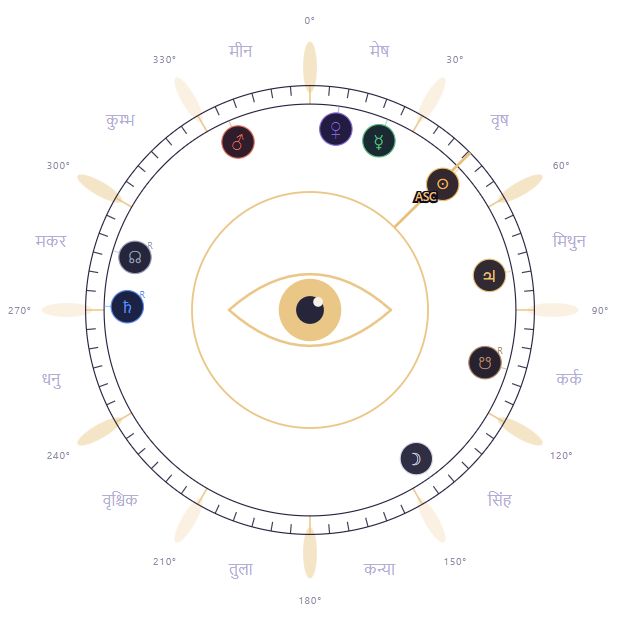
A chart has multiple houses and a limited set of displayed bodies. Some houses will therefore have no marker. You are looking at a distribution, not a checklist that needs every square filled. Also check which bodies a renderer includes before comparing apparent emptiness across services; a different display selection can change what you see without changing the birth data.
An empty-looking compartment can draw more attention than a crowded one. You may wonder whether the blank area means that something important is absent from your life. Before following that thought, return to what the display actually records: which of the selected objects appear in which houses. An unoccupied compartment is a feature of that distribution. It is not a personal assessment, an instruction or a statement that an experience is unavailable to you.
Think of a seating plan with more places than named attendees. An empty seat tells you that nobody in that displayed list occupies it. It does not tell you whether the room will ever be used, whether the event matters or what will happen later. The analogy is limited, but it helps separate a visual observation from an invented story. The chart requires the same discipline: describe the marker distribution before interpreting its significance.
Check the display options as well. A renderer may show a particular set of objects or hide some labels for readability. Comparing screenshots without checking that selection can make an ordinary display difference look like missing information. Read the accompanying placement list and the chart legend. If an object exists in the list but is not visible in the picture, ask whether it is hidden, overlapped or excluded from that view before treating the blank space as meaningful.
Do not turn absence into a prediction
A sentence such as no planet here means no marriage is not justified by an empty box. Traditional readings consider relationships among placements, not just whether a symbol occupies one area. Even a detailed traditional interpretation is not a guarantee of an event. Your real circumstances and choices deserve more weight than a frightening shortcut.
The emotional leap often happens quietly. You see an empty house, recognise a traditional life theme associated with it and assume that the theme must be missing. Notice the extra claim you have added. The displayed fact concerns occupancy; the new sentence concerns your future. Those are not interchangeable. A frightening interpretation needs more than a blank compartment, and even a fuller traditional reading should not be presented as an established guarantee.
Consider how the claim would sound outside the chart. Would you tell someone that their real relationships do not count because a symbol is absent? Would you ignore their work, family or achievements for the same reason? Your lived circumstances are not erased by a drawing. A respectful reading acknowledges the person in front of it. It should not force someone to discount their own experience so that a simplistic rule can appear correct.
If a reader offers a strong conclusion, ask them to explain the reasoning in ordinary language. Which placements and conventions were considered? What is traditional interpretation, and what is directly observable in the chart? What uncertainty remains? These questions are not rude. They are a reasonable way to understand what you are being told. You can decline an alarming claim without having to reject every aspect of a reflective astrological practice.
Check the house system
House assignments can differ with the selected convention. Before deciding that a planet has disappeared from a house, compare the method and the placement table. In Antaryami's reviewed whole-sign tools, the method label matters. Do not compare that output with another house system and assume a visible difference proves either engine failed its calculation.
A comparison works best when you choose one object and follow it through the two results. Keep the saved birth details fixed, note each house convention and read the placement tables. If the object receives a different house assignment, that difference needs a method-aware explanation. Do not describe it as disappearing. The displayed house classification and the underlying position are related information, but they are not identical labels.
It is also important to compare the same type of result. A birth chart and a view for another date are not interchangeable just because their compartments look familiar. Before making a claim about a changed house, check the title and calculation context. The same caution applies to saved reports: an older generation may use earlier confirmed inputs. A familiar profile name is necessary, but it is not the whole comparison.
Antaryami describes its reviewed whole-sign tool context separately from public availability. That distinction should remain visible. Reviewing a method in code does not establish that every live screen is serving it correctly. When you use a personal tool, look for its own method and profile labels. If they are absent or inconsistent, request clarification rather than relying on a general engine name to settle the question.
A better question to ask
Ask what the house represents within the tradition and what context the reader used, rather than asking whether an empty house condemns an area of life. On the public instrument page, explore a fictional chart first. For a personal result, use the correct saved profile and reliable birth details. An educational illustration is not evidence about your own future.
A more useful opening question is: what can I learn from this part of the chart, and what context is needed? That invites an explanation instead of demanding a verdict. You might discover that your concern came from a misunderstanding of the picture rather than the reading itself. You might also decide that a particular interpretive approach does not help you. Both are legitimate outcomes of asking carefully.
For a first exploration, a fictional chart can reduce the pressure. Identify an occupied compartment, then an unoccupied one, and practise describing the difference without attaching a future event to either. The exercise teaches visual literacy. When you later use your saved profile, keep that habit: check the person, read the method and distinguish the calculation from the interpretation. Do not carry details from the demonstration into your personal result.
You deserve an explanation that leaves room for your actual life. An empty house should not become a reason to feel incomplete, purchase something out of fear or stop pursuing an ordinary goal. Bring your curiosity to the chart and keep your judgement with you. Antaryami can offer a place to learn the vocabulary; the most helpful next step is often a clearer question, not a more dramatic prediction.
Astrological interpretations are for reflection, not a diagnosis, a guaranteed prediction or a substitute for professional advice. Journal guides are prepared with AI assistance; they are educational content, not individual consultations.