 Antaryami
Tarot card meanings
Four of Wands tarot card: celebrate the milestone and make room for people to belong
Some achievements deserve more than a quick tick on a list. The first gathering in a new home, a project finally delivered or a friendship that has weathered a difficult year can give people a reason to stop and recognise what they have made together. The Four of Wands brings that pause into a welcoming scene. In this Antaryami guide, Nitish Raj Walia explores celebration as something more interesting than a prediction of a party. The card asks what makes a milestone feel shared, who is included and how a brief moment of joy can strengthen the place people return to afterwards.
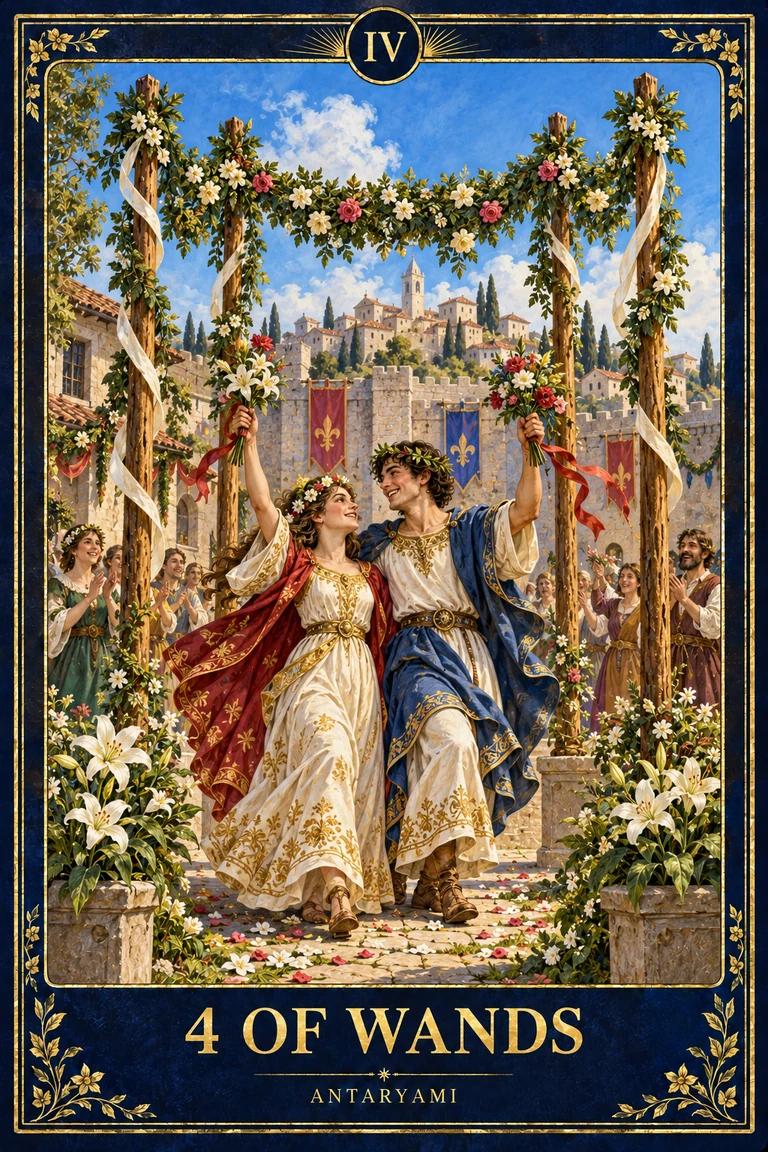
Four staffs and a garland: an open structure rather than a closed fortress
The Antaryami illustration shows four staffs supporting a garland, with celebrating figures and a courtyard beyond them. There is a structure, but it does not seal the scene away from the viewer. That makes a useful metaphor for welcome: boundaries can define a gathering without turning it into a test of who deserves entry. Ask what the occasion is for and what would help someone feel at ease. The decorative frame should serve the people, not require the people to perform happiness for it.
Waite's description links the garlanded staffs and house with refuge, harmony, repose and a domestic harvest-like celebration. An interesting historical detail is that his reversed account does not turn the meaning into an automatic opposite; he largely preserves its favourable character. Modern readers sometimes explore disrupted celebration or an unsettled home when the card is reversed. This guide labels those as contemporary possibilities rather than claiming they are the only authentic reading or an exact repetition of his text.
Our original artwork carries a recognisable tradition in a new setting, with its own colours, architecture and figures. It is not an archival reproduction. Nor do the four staffs supply a literal event date or a verified astrological muhurta. If you are arranging a celebration, use the actual calendar, guests' availability and practical requirements. The symbolism can enrich the meaning of the occasion, but it cannot confirm that a venue, date or relationship will work simply because the picture looks harmonious.
Sources: Waite: Four of Wands refuge, celebration and its unusual reversed account
Upright: name what has been achieved before rushing onward
An upright Four of Wands reading may be useful when you minimise an achievement because the next task is already waiting. Perhaps you finally completed an application, rebuilt a routine or helped organise a small event. You do not need to exaggerate the result to recognise the effort. Describe what changed and why it matters. This creates a more grounded form of celebration than insisting that every milestone must be life-changing before it deserves your attention.
If other people contributed, let the recognition be specific. A colleague may have solved an awkward handoff, a friend may have provided transport or someone may have quietly kept the household running while you studied. Generic praise can overlook these details. A thoughtful thank-you shows that the contribution was noticed. At the same time, do not use appreciation to replace an obligation such as payment or agreed support. Warm words and fair terms do different jobs, and a genuinely welcoming occasion should not blur them.
You can also celebrate privately when public attention would be uncomfortable. A quiet meal, a message to someone important or an hour spent enjoying the finished work may suit the milestone better than a large announcement. The upright card does not demand a particular social personality. Its useful invitation is to let the moment exist instead of passing over it automatically. Choose a form that reflects the achievement and the people involved, so the celebration feels like recognition rather than another task you must complete perfectly.
Reversed: when the occasion looks happy but does not feel welcoming
A contemporary reversed Four of Wands reading can explore an interrupted milestone, unstable arrangements or a celebration that creates pressure rather than belonging. The question is not whether the event is cursed. It is whether something practical or relational needs attention. Perhaps the timing excludes a key participant, the cost is uncomfortable or someone is expected to take on all the organising work. An attractive invitation cannot answer those concerns unless the people involved are allowed to discuss them honestly.
Imagine a family gathering where everyone agrees publicly but several people are anxious about the expense. The reversed theme could prompt a smaller plan, a clear budget or a change in expectations. That adjustment need not spoil the celebration. It may make genuine enjoyment possible. Similarly, a delayed project milestone can still be acknowledged without pretending the whole project is finished. Distinguish what has been achieved from what remains unresolved, so recognition does not become a way to silence legitimate questions.
Sometimes the difficulty is receiving attention. You may feel exposed by praise or assume that enjoying a milestone will make you complacent. Consider a form of acknowledgement that feels proportionate, without using discomfort as proof that you deserve no recognition. The reversed interpretation is only one reflective angle, and Waite's source does not require a negative reversal here. Read your context before forcing a problem into the card. A quieter or differently shaped celebration may be the most honest expression of the same underlying welcome.
Love and home: a welcome is more than a wedding symbol
The Four of Wands is often discussed in relationship readings because its scene resembles a shared occasion. That can make it a useful prompt about commitment, home or the way two people include each other in their lives. It does not prove that marriage is approaching. A wedding, cohabitation or family introduction depends on real choices and conversations. The card should help you examine those arrangements, not announce a decision another person has not made.
For an established relationship, ask what makes the shared space feel welcoming to both people. Are routines negotiated? Does each have some privacy? Are guests, chores and expenses discussed rather than assumed? The celebration theme becomes more interesting when it includes the ordinary home that remains after an event. Two people may enjoy a beautiful anniversary while still needing a clearer agreement about daily responsibilities. Recognition can open that conversation, but it should not be used to cover an imbalance nobody is allowed to name.
For someone single, the card can frame belonging without requiring a romantic partner. Friends, chosen family, neighbours and creative communities may all provide meaningful welcome. You do not have to interpret every positive tarot scene as evidence that your life is incomplete until a relationship arrives. Ask where you already participate and what kind of gathering you would like to help create. A shared milestone can be valuable in its own right, with no need to convert it into a prediction about who will eventually enter your home.
Work: celebrate delivery without turning recognition into decoration
A Four of Wands workplace reflection can ask whether completion is recognised in a way that helps people understand the result. A project event might explain what was delivered, acknowledge the actual contributors and record what the team learned. That is different from a polished celebration in which the work disappears behind speeches. The useful question is whether people leave with a clearer sense of their contribution and the next stage, rather than only a photograph proving that an event took place.
Recognition should also fit the team's circumstances. A compulsory evening gathering may burden someone with caring duties or a long journey home. An expensive outing may be less welcome than a thoughtful acknowledgement during working hours. Ask participants instead of assuming one format serves everyone. A welcoming culture is demonstrated by these practical choices, not by a card or slogan. Tarot can supply the prompt, while the organisation remains responsible for fair and accessible arrangements.
In a personal spending question, do not interpret celebratory imagery as approval for an unaffordable event. Set a budget from actual means and obligations. A meaningful milestone does not lose its value because the celebration is modest. You might choose one element that matters most and simplify the rest. The card's harmony can then become a design principle: make the occasion serve the people and purpose. That is more useful than treating prosperity as a promise that money spent on appearances will somehow return later.
Four of Wands versus Ten of Cups: milestone and ongoing emotional home
These cards can both evoke joy with others, but their emphasis differs in this series. The Four of Wands highlights a shared milestone, welcome or stable setting in which people gather. The Ten of Cups gives more attention to an ideal of emotional belonging and the everyday relationships represented beneath its rainbow. One may ask how you mark what has been achieved; the other may ask what kind of life the people are actually sharing. Their overlap does not erase the distinction.
Consider a housewarming. Choosing a date, welcoming guests and acknowledging the move fits the Four's occasion. The routines and relationships that develop in the home afterwards fit the Ten's continuing question. Neither card certifies that everyone is happy or that future difficulties have been removed. A harmonious image can point toward a value you want to cultivate while leaving room for the real complexity of a household. The reading becomes stronger when it names that complexity rather than insisting the picture settles it.
The Four is also not a universal yes to every invitation. If an event compromises your boundaries, resources or wellbeing, you can decline or suggest a different arrangement. Belonging does not require constant availability. A useful celebration allows an honest response and does not punish someone for participating differently. That distinction keeps the card's welcome generous rather than coercive. Read it as an opportunity to examine how people are included, not as a command to appear cheerful whenever a group expects you to join.
Try an Antaryami milestone pause: what are we recognising, and who belongs?
Within Antaryami's tarot experience, a question such as what deserves recognition in this situation gives the Four of Wands a focused role. The daily card and a newly shuffled spread should remain distinct in your understanding. If the card appears in a challenge position, you might examine the cost or inclusiveness of the occasion rather than assuming a celebration is certain. Optional reversals can widen the reflection, but they do not measure the emotional condition of every person represented in your question.
For an exercise, write the milestone in one sentence and list the people whose effort made it possible. Choose a way to acknowledge them that is specific, welcome and manageable. Then ask whether any practical concern would prevent someone from enjoying the moment. A smaller event, clearer expectations or a private thank-you may solve more than elaborate decoration. Afterwards, notice whether the recognition felt genuine. You can adjust future gatherings from that feedback instead of judging success by how impressive the photographs appear.
Antaryami's Journal, by Nitish Raj Walia for Temior Technologies Pvt Ltd, gives you room to inspect each instrument before choosing the product experience. Visit the app page for verified launch information and browse the walkthroughs to see how card selection and reveal work. The Four of Wands offers an appealing invitation to the brand's experience centre: arrive, explore at your own pace and choose what suits your needs. A good welcome makes the next step clear without insisting that everyone must celebrate or purchase in the same way.
Create a celebration people can actually enjoy
We completed something but rushed straight past it
Name the result and the specific contributions behind it. Choose a proportionate acknowledgement that lets the people involved recognise their effort without replacing any practical obligation owed to them.
The planned occasion is creating pressure
Ask which cost, timing or expectation is making participation difficult. Simplifying the arrangement can make the welcome more genuine than insisting that a polished event must proceed unchanged.
Astrological interpretations are for reflection, not a diagnosis, a guaranteed prediction or a substitute for professional advice. Journal guides are prepared with AI assistance; they are educational content, not individual consultations.


