 Antaryami
Tarot card meanings
Justice tarot card: look at the evidence before deciding what is fair
Fairness feels obvious when the facts are simple. It becomes harder when two people remember an agreement differently, a rule has been applied unevenly or a decision benefits you at someone else's expense. Justice brings a sword and scales into that uncomfortable space. This Antaryami guide by Nitish Raj Walia explores accountability, evidence and the difference between a fair process and a reassuring verdict. The card does not announce the result of a court case, and it cannot prove that someone deserved a difficult experience. Its value is in the questions you ask before making a judgment, including a judgment about yourself.
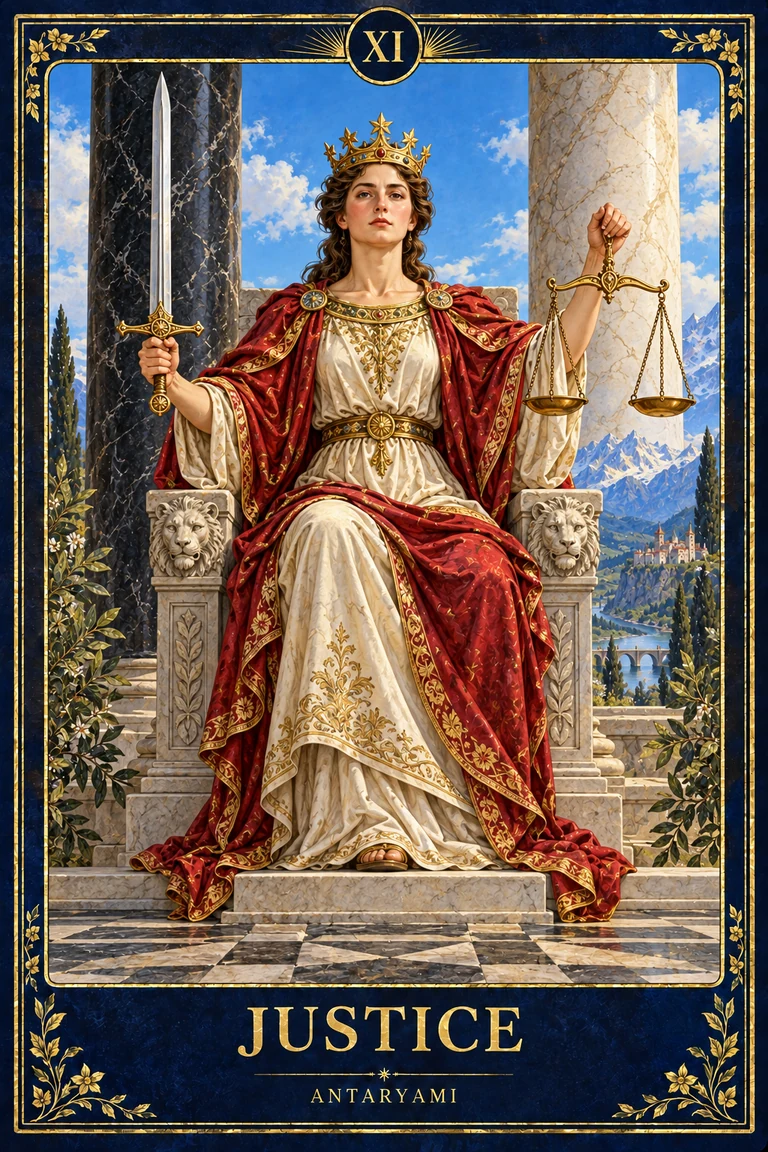
Justice meaning: a fair conclusion begins with a careful process
Contemporary Justice interpretations often emphasise fairness, accountability, consequences and the relationship between a decision and the evidence supporting it. Those themes can be useful well beyond a courtroom. A household arrangement, a workplace review or a disagreement between friends may involve expectations that need to be made explicit. The card can prompt you to examine how a conclusion was reached. It should not be used as proof that your preferred conclusion is correct simply because the image seems to stand on your side.
Picture two collaborators who disagree about credit for a finished project. One remembers doing most of the final work; the other remembers developing the idea and solving early problems. A Justice-themed reflection might ask what records exist, what was agreed beforehand and which contributions are being overlooked. That inquiry is more useful than asking the card to identify the good person and the bad person. A fair response may involve recognising different kinds of work instead of forcing every contribution into one convenient measure.
In a resource position, Justice might frame a transparent standard or a willingness to accept responsibility. In a challenge position, it may raise concerns about selective evidence, inconsistent rules or an overly punitive response. The reading should keep those possibilities open until the actual circumstances support an interpretation. People can disagree sincerely, and apparently neutral procedures can still contain unfair assumptions. A symbolic balance does not remove the need to check who had a voice, whose information was considered and whether the decision can be explained.
The scales and sword have different jobs; XI identifies this deck convention
In Antaryami's original Justice portrait, a crowned figure sits between pillars with scales in one hand and an upright sword in the other. As a visual exercise, the scales can represent examination and the sword a clear decision after that examination. The scene does not ask you to keep weighing forever, nor to decide before weighing anything. It suggests a relationship between deliberation and action. This is our practical reading of the artwork rather than a claim that an image can establish the facts of a dispute.
Waite notes the seated figure between pillars and distinguishes Justice's moral symbolism from the more mysterious significance he assigns to the High Priestess. Similar architectural framing does not make the two cards interchangeable. This deck uses Justice XI and Strength VIII, following the Rider-Waite-Smith-inspired ordering. Other traditions may use Justice VIII. Identify the convention when comparing decks instead of treating a different number as evidence that a deck is defective. A consistent system matters more than pretending that every historical arrangement was identical.
The sword also invites a question about precision in language. Are you saying that an action caused a particular consequence, or that you dislike the person who performed it? Are you describing a verified fact, a recollection or an inference? These distinctions can change the fairness of a conversation. You do not need to become cold or emotionless to make them. Feelings are relevant to human experience, but the existence of a strong feeling does not automatically establish every factual conclusion you attach to it.
Sources: Waite: Justice and its distinction from the High Priestess symbolism
Upright: make the standard visible and accept your part in the outcome
An upright Justice reflection may be constructive when an arrangement needs a clearer standard. Suppose several people share a responsibility but nobody has agreed on what completion means. One person considers the task finished; another sees important work remaining. Before deciding who has failed, define the expected result, the time available and the resources each person had. A visible standard can prevent a dispute that otherwise becomes personal. The card does not supply that standard for you; the participants still need to establish something workable and appropriate.
Accountability can mean acknowledging a specific action without condemning your whole character. If you missed a commitment, you can state what happened, recognise its effect and explain what you will do next. A long defence of your good intentions may leave the affected person without an answer to the practical problem. Justice can prompt a more direct response. That response should remain proportionate. One mistake does not prove that you are fundamentally unreliable, and taking responsibility does not require accepting blame for circumstances you did not create.
Upright clarity may also involve following a process you would accept if the roles were reversed. If a rule benefits you today, would you still regard it as reasonable when it disadvantages you? This thought experiment is not a complete theory of fairness, but it can expose convenient inconsistency. Consider the context as well: identical treatment is not always sufficient when people's circumstances differ. A useful Justice reflection looks beyond a pleasing slogan and asks whether the actual process gives the relevant people a fair opportunity to be heard.
Reversed: examine an uneven rule, missing evidence or harsh self-judgment
Reversed Justice is often interpreted through unfairness, avoidance of accountability or a distorted assessment. It should not be used to declare that another person is dishonest. Start with the observable issue instead. Perhaps a policy is applied differently to different people, a decision was made without consulting those affected, or an important piece of information has been omitted. Those concerns can be investigated through records and conversation. An inverted card cannot establish misconduct, and a blog cannot decide the facts of a situation it has not examined.
The distortion may be in your own assessment rather than in someone else's conduct. You might count every task you completed while forgetting the less visible work another person contributed. Or you might assume that a disappointing outcome proves you acted wrongly, even though several factors were outside your control. A reversed reflection can invite a more complete account. Ask what evidence would challenge your current story. If the only acceptable answer is one that confirms what you already believe, the scales are not really being used.
Harsh self-judgment deserves a separate distinction. Responsibility concerns what you did and what can be repaired; shame can turn the same event into a claim about your entire worth. Justice need not become a symbolic punishment. You can seek feedback, make amends where appropriate and revise a process without treating yourself as permanently condemned. Where a dispute involves legal rights, employment rules or other consequential matters, obtain suitable professional advice. The reversed image may help frame a question, but it cannot substitute for the relevant facts or expertise.
Relationships: fairness includes the work nobody has been counting
In relationships, Justice may draw attention to explicit agreements and invisible expectations. One person may assume that paying a bill is the whole contribution while another manages planning, reminders and coordination. A useful reflection asks which forms of work are being recognised and whether the arrangement remains acceptable to both people. The card does not determine that responsibilities must be divided into mathematically identical halves. It encourages a conversation about the actual burdens, available capacity and preferences of the people involved.
Consider friends organising a shared trip. If one friend books everything, their contribution may involve both effort and financial exposure. Another may offer to handle a different task but never receive the information needed to do it. Calling either person unfair without examining the process misses important details. A Justice question could ask what was agreed, what changed and which obligation now needs clarification. Put the answer in ordinary language. A simple written plan may resolve more than an elaborate reading about whose energy is more deserving.
Fairness also involves consent to the arrangement itself. A person should not be told that a card requires them to forgive, remain in a connection or surrender a boundary. Reconciliation is a choice, not a debt imposed by symbolism. If you have caused harm, another person's refusal to restore the old relationship does not automatically make them unjust. Repair and renewed closeness are different outcomes. Justice can help you recognise that distinction while leaving each participant free to decide what continued contact, if any, is appropriate.
Work and money: read the actual paperwork rather than predicting its outcome
A Justice-themed career question can focus on documentation, expectations and the process by which work is assessed. Before a review, gather concrete examples and understand the relevant criteria. Before accepting a role, clarify the responsibilities and terms. Before making an allegation, distinguish what you observed from what you inferred. These are practical habits, not outcomes guaranteed by tarot. The card may remind you to take a process seriously, but it cannot establish whether an employer, colleague or organisation has complied with a particular obligation.
The same applies to a purchase, subscription or shared expense. Read the price, renewal terms, deliverable and cancellation conditions before committing. If a charge is disputed, preserve the receipt and communicate through the proper support channel. A symbolic sword cannot replace a payment record or tell you that a refund will be approved. The educational meaning of Justice can support attention to paperwork without pretending to be legal guidance. Ask a qualified professional when a question requires interpretation of rights, contracts or applicable law.
Do not use this card to forecast litigation, immigration decisions, exam grading or regulatory action. Those processes depend on evidence, rules and decision-makers the card cannot inspect. A reassuring reading may feel comforting, but it does not change a deadline or supply a missing document. An alarming reading should not be allowed to persuade you that a valid application is hopeless. Prepare using verified requirements and appropriate advice. Justice is a prompt to examine the process, not an unofficial verdict delivered before the process has taken place.
Justice is not proof that suffering was deserved
A careless interpretation can turn the language of consequences into a claim that everything happening to someone must be deserved. This guide rejects that leap. People experience accidents, discrimination, illness and other hardships without a tarot card establishing a moral cause. You should not tell someone that their pain balances an invisible debt or proves wrongdoing in another life. Such a statement is neither supported by the card nor a compassionate way to understand the circumstances. Reflective symbolism should not be used to excuse mistreatment.
Even when a choice has consequences, the connection needs to be examined rather than assumed. Missing a deadline may affect an application, but that does not prove every later disappointment follows from the same mistake. A single cause rarely explains everything about a person's life. Justice can ask you to trace a specific action and its specific effect. It should not become a total explanation that prevents inquiry into structural conditions, other people's decisions or ordinary uncertainty. Accurate accountability is narrower and more useful than a sweeping moral story.
Compare Justice with Judgement to avoid another common confusion. Our Justice guide concerns standards, evidence and fairness in a decision. Judgement, in a contemporary reflective reading, can concern review, recognition and responding to a call for change. Both may involve looking back, but they frame different questions. You could need a fair assessment of what happened before deciding how to respond to what you have learned. Neither card can absolve or condemn you by itself, and their names do not turn the app into a court or spiritual authority.
An Antaryami evidence exercise: write the fact, the standard and the repair
When Justice appears in Antaryami, preserve the position and orientation rather than replacing them with a generic prediction about karma. Frame a question that can lead to a more careful process: which expectation needs clarification, what evidence is missing, or where should responsibility be acknowledged? If you ask for a contextual explanation, do not expect the app to identify a liar or decide another person's legal liability. It can discuss symbolic themes while being explicit that the real situation requires information beyond the card.
Try a three-part note about a manageable disagreement. First record a fact you can support, such as the date a task was due. Next record the standard that was actually agreed, not the one you wish had been agreed. Finally identify a possible repair, clarification or next conversation. Where memories differ, mark that uncertainty rather than quietly converting one account into proof. This exercise can reveal whether the issue is a missed commitment, an unclear agreement or a disagreement about the standard itself. Each requires a different response.
Temior Technologies Pvt Ltd publishes this AI-assisted Antaryami guide under Nitish Raj Walia's byline with the previously created Justice artwork. Current product pages explain app availability and access; this article makes no promise about a particular account's features. Let the scales encourage a fuller view and the sword a precise response. The goal is not to emerge from every disagreement feeling vindicated. It is to reach a conclusion you can explain honestly, recognise the people affected and take responsibility for the part that genuinely belongs to you.
Examine the decision before judging the person
We disagree about what was promised
Compare the actual agreement and available records. Mark uncertain recollections as uncertain, and clarify the standard before assigning blame. Justice can structure an inquiry; it cannot choose which person's memory is correct from a card alone.
I am hoping this predicts a legal victory
Do not treat the image as a forecast of a court or official decision. Check deadlines, documentation and qualified advice. The constructive Justice theme is careful preparation and a fair process, not a guaranteed verdict in your favour.
Astrological interpretations are for reflection, not a diagnosis, a guaranteed prediction or a substitute for professional advice. Journal guides are prepared with AI assistance; they are educational content, not individual consultations.


