 Antaryami
Tarot card meanings
King of Cups tarot card: remain present while the water around you moves
The room changes when someone can stay present without making everyone else's feelings disappear. They hear the concern, acknowledge the tension and still help the next step become understandable. The King of Cups gives that quality a striking setting: a throne surrounded by moving water. In this Antaryami article, Nitish Raj Walia explores steadiness as participation, not emotional distance. The card cannot prove that someone is trustworthy or reveal a hidden feeling behind a composed face. It offers a question about responsibility: how can you recognise what is happening, keep your response proportionate and act with care when the atmosphere is unsettled? Calm is most useful when it makes reality easier to face, rather than easier to avoid.
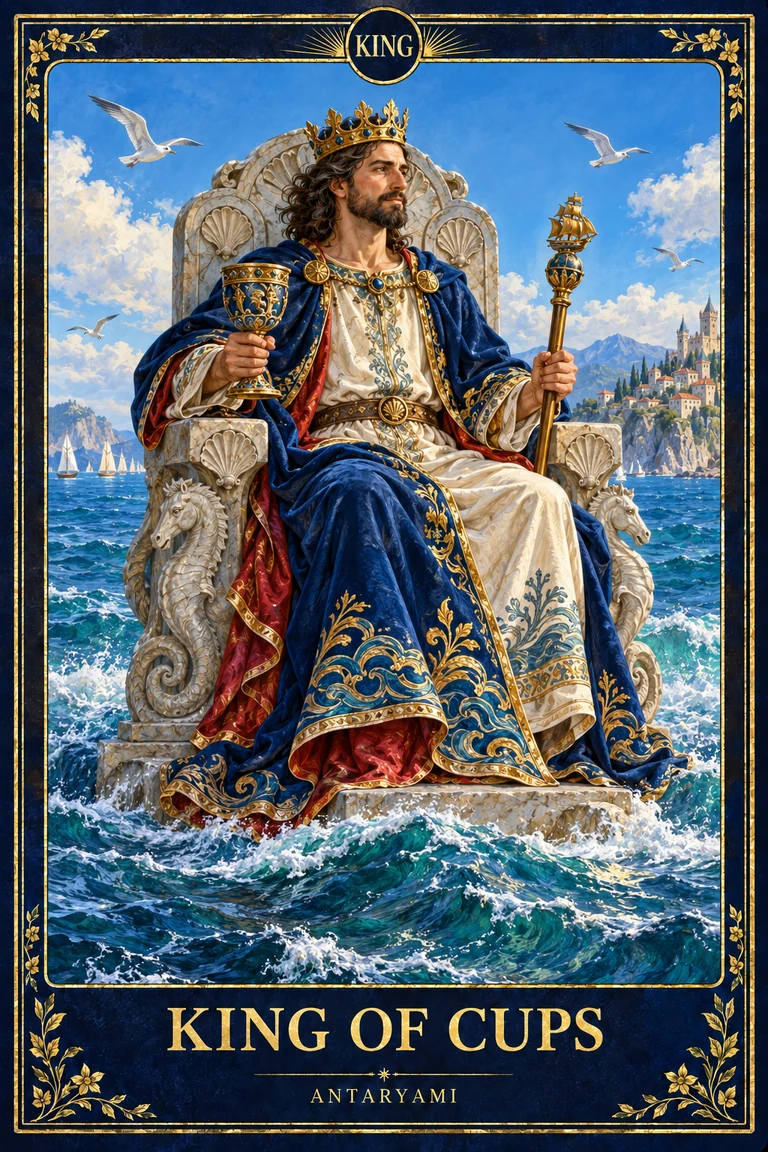
King of Cups meaning: steadiness includes an honest response
Contemporary King of Cups readings commonly emphasise emotional steadiness, considerate leadership, diplomacy and the ability to respond without being swept into every change of mood. As a court character, the King can frame a way of carrying responsibility rather than identify a literal man or authority figure. The useful quality is not the absence of feeling. It is the ability to acknowledge feeling while keeping actions connected to the actual circumstances, the people affected and the commitments you can reasonably fulfil.
Suppose a team receives disappointing feedback shortly before an event. One response would be to dismiss everyone's concern; another would be to allow the disappointment to decide every conversation. A King of Cups lens might prompt you to name the issue, hear the relevant information and identify a manageable next step. That does not guarantee the event will succeed. It changes the quality of participation, making room for concern without letting the whole situation become an argument about who is allowed to feel what.
Steadiness also means accountability. If your own decision contributed to a problem, a calm manner should not become a shield against acknowledging it. Explain what happened and what you will change. People may still disagree with you, and that disagreement deserves an appropriate response. The court card is most useful when its composure remains engaged with reality. A reliable presence can hold a difficult conversation open long enough for information, responsibility and a practical response to emerge, rather than closing the exchange with reassurance that nothing needs attention.
The throne amid water: a stable place does not make the sea motionless
Antaryami's original King of Cups holds a cup and sceptre while blue waves move around his carved throne. The contrast between the seat and the sea gives the illustration its central question. What helps you remain present while the setting changes? Our mountain horizon and decorative choices belong to the new Museum Tarot artwork. They are not evidence of a historical detail repeated in every deck, and the surrounding water does not calculate a birth-chart placement or assign the card to a person's identity.
Waite's historical description places the throne at sea and associates the King with responsibility and creative intelligence, alongside occupational and gendered character descriptions. His reversed list includes strong accusations. This guide reads that source as part of a particular tradition, not as a method for determining whether a real person is dishonest. The contemporary discussion of steady, accountable participation is an interpretive choice. The distinction matters: an old vocabulary, an original illustration and a practical exercise can inform one another without becoming interchangeable forms of evidence.
A throne is also a reminder that composure may be easier when someone has resources, authority or support. Do not use the image to criticise people facing circumstances you do not share. Ask what conditions make a constructive response possible, and whether you can improve those conditions. A pause, a clear agenda or practical assistance may help more than telling someone to be calm. The picture becomes humane when its steadiness is considered alongside the actual situation, rather than turned into a demand that everyone manage pressure in the same visible way.
Sources: Waite: King of Cups throne at sea, responsibility and creative intelligence
Upright: name the feeling and choose the next proportionate action
An upright King of Cups can frame a resource of measured response. Begin by identifying what has actually happened and which part requires action. You may feel disappointed, angry or protective without needing the first impulse to become the final response. A brief pause can help you choose language that addresses the matter. This is not a rule that every difficult feeling should be hidden. It is a question about how expression and responsibility can stay connected when the setting makes that connection harder.
Imagine receiving a complaint about a service you care about. Before defending the whole product, read the specific concern. Acknowledge what the customer experienced, check the relevant record and explain the available next step. If you do not know the answer, say when you will follow up rather than inventing reassurance. The King theme can help you remain engaged without making the exchange a contest about your intentions. The customer's issue becomes easier to address when the response has substance, not merely a composed tone.
At home, the same quality may involve admitting that you need a little time before continuing a conversation, while agreeing when it will resume. An unexplained disappearance is different from a communicated pause. Steady participation leaves the other person able to understand what is happening. An upright reflection can prompt that ordinary reliability: express the relevant feeling, state the boundary and return to the actual question. The card does not measure emotional mastery. Its usefulness can be examined through whether your response makes the situation clearer and more workable for the people involved.
Reversed: distinguish genuine composure from an issue being concealed
A reversed King of Cups can prompt reflection on avoidance, inconsistency, emotional pressure or a calm presentation that is not matched by responsible action. Start with observable conduct. Has a concern been heard? Has a promise been kept? Can the people affected ask questions without being dismissed? The card cannot establish manipulation, dishonesty or a hidden motive. Those conclusions require appropriate evidence. Its contemporary value lies in examining the gap between the reassuring manner and the practical reality of the exchange.
Suppose someone repeatedly says everything is fine while a shared responsibility remains unfinished. You can ask about the task, its deadline and what support is needed. There is no need to diagnose the person's character in order to address the missing action. If you are the person using reassurance to postpone a difficult admission, make the situation more explicit. A smaller, truthful commitment is more useful than a calm promise that preserves appearances for another day while leaving everyone else unable to plan.
The reversed theme can also concern an emotional reaction expressed indirectly. Silence, sarcasm or an unexplained change in availability may leave others guessing. Where it is safe and appropriate, state the issue more clearly and listen to the response. That is different from demanding that every feeling be disclosed immediately. Privacy and pacing still matter. The useful distinction is between a chosen boundary communicated honestly and an unresolved issue presented as though it does not exist. The King lens asks how responsibility can return to the conversation without requiring a perfect emotional performance.
Relationships: a composed face does not tell you what someone feels
In relationship reflection, the King of Cups can invite consideration of dependable presence. Does the person listen, respect boundaries and act consistently with what they say? A reserved style is not automatically devotion, and expressive warmth is not automatically instability. The card cannot identify an emotionally mature partner, confirm a concealed love or predict reconciliation. Look at the actual exchange. A useful reading question concerns the kind of participation you want to offer and the standards of clarity and respect you need from the relationship.
Consider a partner who prefers time to think before discussing disagreement. That preference can work if the pause is communicated and the conversation returns at an agreed point. It becomes less workable when one person is left indefinitely waiting for a topic that is always deferred. A King reflection can prompt you to distinguish those patterns without deciding that one temperament is superior. The practical question is whether both people can understand the arrangement, express their needs and rely on the commitment to engage.
For someone offering support to a friend, steadiness may mean not making the friend's distress about your ability to fix it. Hear what is wanted and provide the help you can genuinely sustain. Avoid promises about how everything will turn out. A thoughtful presence can remain valuable even when you do not have a solution. The card's cup and sceptre offer a memorable balance: care and responsibility held together, with the actual person allowed to retain their choices rather than becoming a project through which you demonstrate how composed or helpful you are.
Leadership: reassurance earns trust through information and follow-through
A King of Cups workplace reflection can help a person carrying responsibility during uncertainty. Start by telling people what is known, what remains undecided and what happens next. A steady delivery can make information easier to receive, but it must not hide the limits of that information. If a timeline changes, explain the change. If someone raises a concern, respond to its substance. The useful quality is a combination of emotional consideration and operational clarity, not an instruction to make every discussion feel pleasant.
Imagine presenting a new digital product. Visitors may be intrigued by the atmosphere and still need to know which features are available, what access includes and whether a download link is ready. A considered product gallery makes those details accessible. It does not treat curiosity as consent to buy. The King theme can support an invitation that remains calm enough for comparison and detailed enough for an informed decision. Confidence in the presentation is strongest when it is matched by an experience the visitor can actually inspect.
Financial, legal and wellbeing concerns still require their own evidence and appropriate expertise. A composed symbolic interpretation cannot certify a transaction, resolve a dispute or establish that a service is safe for a particular person. Keep those boundaries visible without turning the whole experience into a wall of warnings. Give clear information where it is needed and detailed context where someone chooses to look deeper. Responsible leadership makes the next step understandable, including the option not to take it, rather than using authority or emotional reassurance to make uncertainty disappear.
King of Cups versus Queen of Cups and King of Swords
The King of Cups often foregrounds steady, considerate responsibility. The Queen's Cups lens can bring the listening process and its boundaries into sharper view. The King of Swords often foregrounds judgment, standards and clear reasoning. These lenses can complement one another without becoming fixed personality categories. A difficult conversation may need careful listening, a proportionate response and a reasoned decision. The useful question is which part has been neglected, not which court title would make you appear most accomplished or emotionally sophisticated.
Suppose you must decide how to respond to a missed commitment. The Queen of Cups lens might ask whether you have heard the person's circumstances. The King of Cups lens might ask how to address the matter without letting frustration take over the exchange. The King of Swords lens might ask what standard applies and whether the decision can be explained consistently. Compassion does not automatically remove a boundary, and a standard does not automatically require coldness. The comparison helps you see how different forms of attention can serve the same practical situation.
Another misconception is that the Cups King should never show emotion. The image is not a competition in visible restraint. A person can speak honestly about disappointment and still act responsibly. Conversely, a quiet manner can coexist with avoidance or poor follow-through. Read the court character as a prompt for examining participation, not as a way to rank people by appearance. What matters is whether feeling, information and responsibility remain connected well enough that the people affected can understand the response and retain room for their own perspective.
Try an Antaryami response map: atmosphere, responsibility and the next step
For an Antaryami tarot draw, ask what would help me respond steadily without avoiding this issue. Read the King's named position before deciding how to apply the theme. A resource position may foreground dependable presence; a challenge position may foreground a reassurance unsupported by action. The inspected walkthrough offers optional questions and reversals, not a test of emotional intelligence or a way to verify someone's character. Let the reading clarify your own response, while consequential choices remain attached to evidence, relevant expertise and the people whose lives they affect.
In your own journal, draw a response map with three headings: the atmosphere you noticed, the responsibility that is actually yours and the next step you can explain. Keep another person's feelings out of the responsibility column unless they have made an appropriate request you can meet. Add what remains unknown and what would clarify it. After acting, review whether the exchange became more understandable. This practice does not certify wisdom. It gives the card's sea and throne a concrete role in helping you think about an unsettled situation without claiming control over its outcome.
Follow Antaryami's tarot walkthrough to see how a question, a spread position and original card art become a reflective experience. Check the current app page and plan details before choosing access. Nitish Raj Walia's Journal for Temior Technologies Pvt Ltd is designed to make that exploration inviting without leaving its substance hidden. The King of Cups offers a fitting reason to look deeper: a beautiful interface can hold your attention, while a clear explanation gives that attention somewhere useful to go. Explore at your pace, then choose the next step from what the product actually offers.
Keep composure connected to responsibility
I have been saying things are fine instead of naming an unfinished issue
Describe the specific gap and the next action you can genuinely take. A calm tone becomes useful when it carries information that lets the other person understand the situation and plan around it.
A difficult atmosphere is making me feel responsible for every reaction
Separate the concern you can address from feelings you cannot manage on someone else's behalf. Offer a clear, proportionate response without promising to remove every discomfort from the room.
Astrological interpretations are for reflection, not a diagnosis, a guaranteed prediction or a substitute for professional advice. Journal guides are prepared with AI assistance; they are educational content, not individual consultations.


