 Antaryami
Calculation workshop
359°59′ and 0°01′: reading across the end of a circle
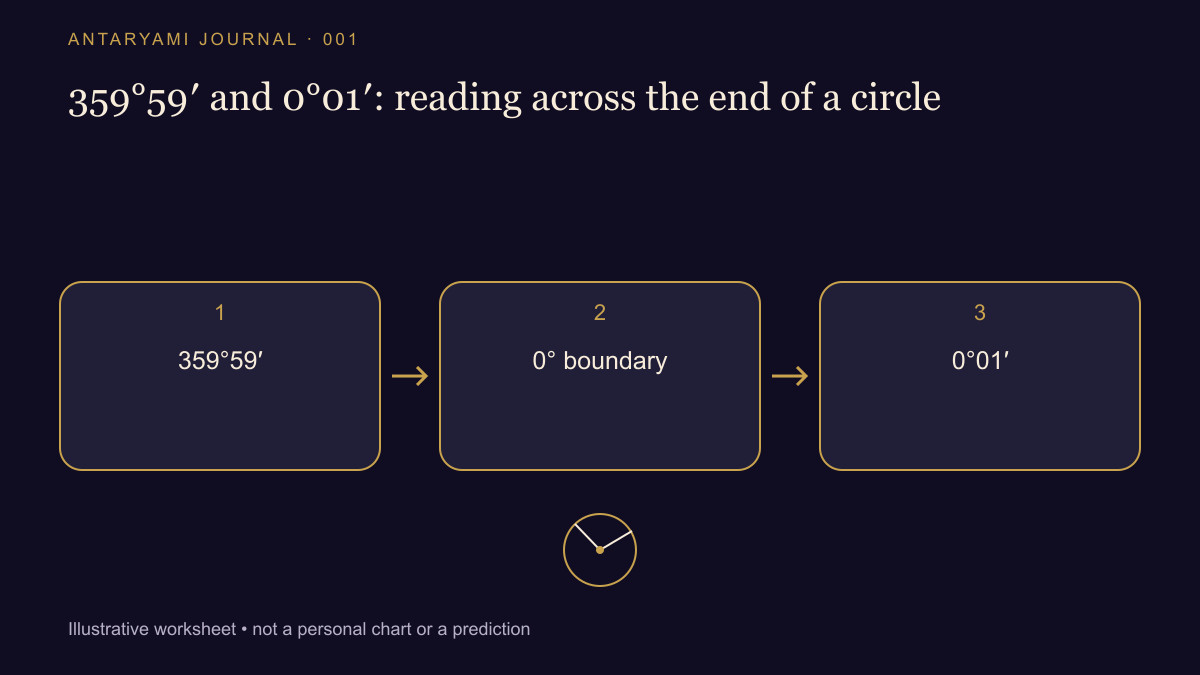
A chart lists one position as 359°59′ and another as 0°01′. A spreadsheet subtraction seems to put them almost a complete circle apart. On a circular scale they sit close to the same boundary. This small example matters when you compare planetary positions, inspect a correction or decide whether two screenshots actually disagree. The first task is to understand the scale, before attaching an interpretation to the result.
Walk across the boundary
One degree contains sixty arcminutes. Moving forward from 359°59′ to 360°00′ takes one arcminute. A circular longitude scale identifies 360°00′ with 0°00′; moving onward to 0°01′ takes one more. The short separation is therefore two arcminutes, not almost 360 degrees. Nothing has jumped across the sky simply because the printed number returned to zero.
For this example, convert each position into arcminutes. The first becomes 21,599; the second becomes 1. Their ordinary absolute difference is 21,598. A complete circle contains 21,600 arcminutes, so the shorter circular difference is the smaller of 21,598 and 21,600 minus 21,598. That leaves 2. Converting to integer arcminutes makes the boundary easy to audit without a decimal-rounding distraction.
Separate distance from direction
The short angular distance answers how close the two positions are on this circle. It does not, by itself, tell you which way an object travelled, whether it crossed a boundary during a particular interval, or how far it moved between observations. A moving object could have followed a longer route. You need ordered times and an appropriate calculation to discuss motion.
Write the question beside the arithmetic. “Shorter separation between these two longitudes” is a precise label. “Planetary movement” is too broad unless the records also identify the same object, coordinate convention and observation times. Similarly, a small longitude difference is not automatically a close three-dimensional encounter. Other coordinates and distances may matter to the question you are asking.
Keep the original values
Save the displayed positions and any available unrounded values before converting them. Check that both use the same zodiac reference and units. A tropical longitude and a sidereal longitude should not enter this subtraction as though they share the same origin. A value in radians also needs conversion before comparison with degrees.
When reporting a discrepancy, include the two original values, the declared conventions and your circular-difference calculation. A concise note might say: “Using the same longitude reference, these positions differ by two arcminutes across zero.” That tells a reviewer what was compared and what was not. It is much more useful than announcing a 359-degree error from a straight subtraction.
Try a second pair
Now compare 5° and 355°. The ordinary difference is 350°, but the shorter circular separation is 10°. Then compare 80° and 120°: their shorter separation is the ordinary 40°. The special handling belongs to a circular scale; it is not a rule that every large difference must be made small. Once the arithmetic is clear, any traditional interpretation can be discussed separately.
Astrological interpretations are for reflection, not a diagnosis, a guaranteed prediction or a substitute for professional advice. Journal guides are prepared with AI assistance; they are educational content, not individual consultations.