 Antaryami
Calculation workshop
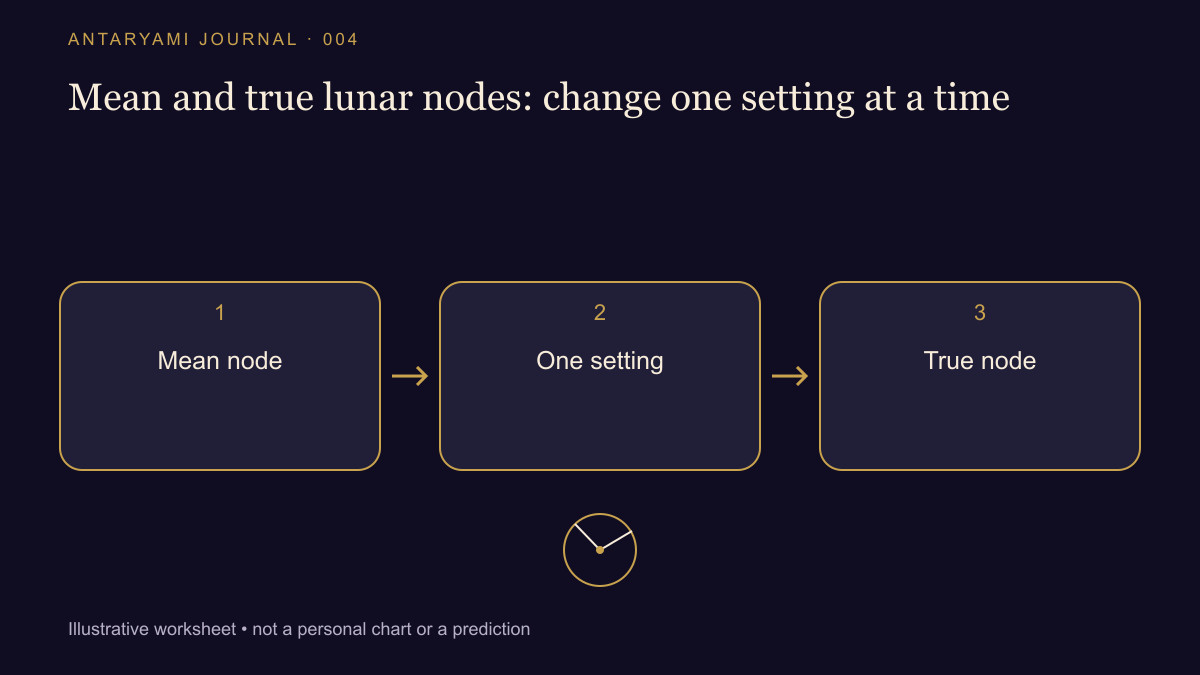
Mean and true lunar nodes: change one setting at a time
One chart says mean lunar node; another says true lunar node. The two labels can produce different values without either calculation being a random guess. This workshop is about setting up a fair comparison. It is not a verdict that one node convention is spiritually superior, nor a claim that a particular interpretation becomes certain when a different setting is selected.
Keep the method name attached
Swiss Ephemeris documentation distinguishes a mean node from a true, or osculating, node. These are calculation conventions with different definitions. Do not erase that distinction by copying both values into a field called Rahu and then treating a difference as an unexplained error. The calculation label should travel with the number wherever you discuss it.
Start a fictional comparison record with columns for time, time scale, longitude reference, node convention and resulting longitude. The exact numbers can be supplied by a declared calculation service. This article does not invent a live ephemeris result. Its task is to show the information a real result must retain if another person is expected to reproduce it.
Change only the node option
Run the same request with the mean-node option, then with the true-node option. Preserve all other inputs and settings. If you also change the ayanamsa, birthplace or instant, you cannot attribute the whole difference to the node option. A short settings checklist is often more valuable than a long argument about which screenshot looks familiar.
When the two values straddle a displayed boundary, inspect the unrounded positions before making a categorical statement. A boundary label can magnify a small coordinate difference into a different named category. That is a reason to explain the classification rule, not a reason to hide one of the positions. Report both the numeric difference and the resulting label change.
Distinguish opposition from proof
In the usual opposite-node representation, the second node is placed half a circle from the first. That arithmetic relationship does not resolve which first-node convention a chart used. It also does not establish the truth of an interpretation about relationships, travel or life events. A consistent geometric relationship and a personal reading are different claims.
If an explanation moves from a method comparison to a forecast, pause and name the transition. Ask which parts were calculated and which parts belong to a traditional interpretive framework. You can discuss the framework respectfully while refusing to treat a setting change as evidence that a promised event must occur.
Write a bounded conclusion
An appropriate conclusion might be: “The requests used different node conventions; after matching the convention, the comparison should be repeated.” If all relevant settings match and a difference remains, preserve a minimal reproducible example for review. Do not silently switch a user's preference merely to make a test pass. Method transparency matters more than forcing every table to display the same label.
Astrological interpretations are for reflection, not a diagnosis, a guaranteed prediction or a substitute for professional advice. Journal guides are prepared with AI assistance; they are educational content, not individual consultations.