 Antaryami
Calculation workshop
Geocentric or topocentric? Name the observer before comparing charts
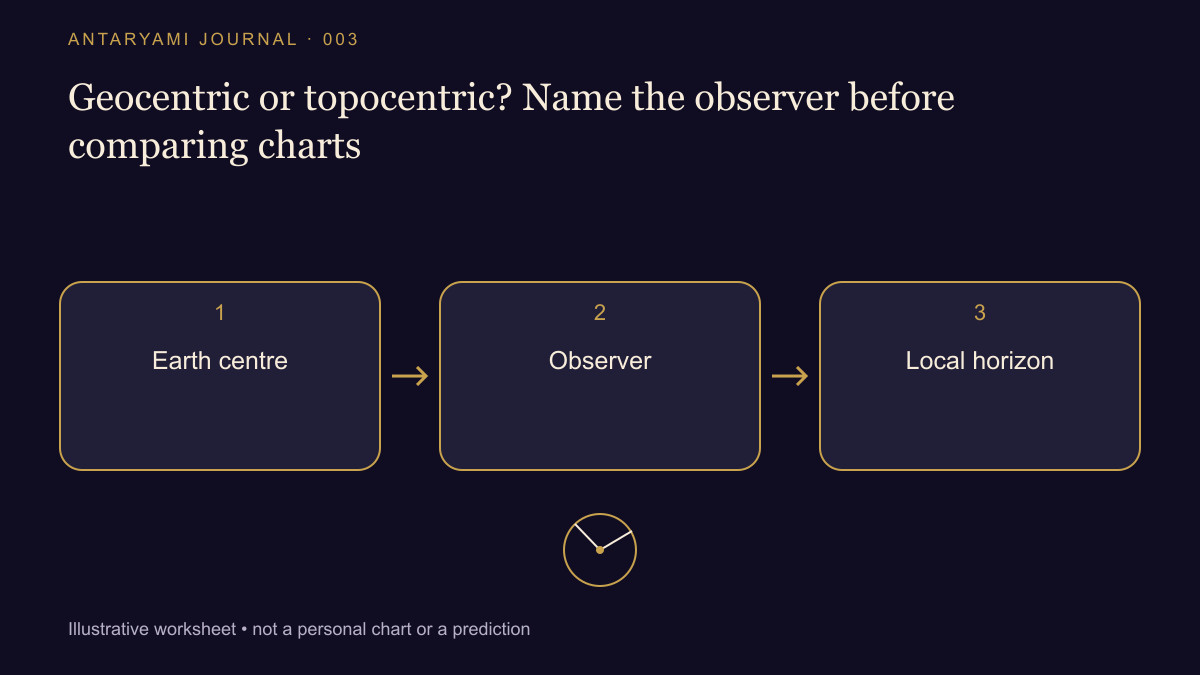
Two calculation services use the same date but return slightly different positions. Before choosing a winner, inspect where each observer is placed. A geocentric result refers to Earth's centre; a topocentric result uses a specified location on or near Earth's surface. That difference can matter to an accurate comparison even when both results are correctly calculated under their own settings.
Make the observer part of the question
JPL's Horizons manual distinguishes observing centres and provides both geocentric and topocentric situations. A topocentric request needs an observing site, while a geocentric comparison should not quietly borrow a surface location from another table. The observer is part of the calculation definition, not an optional note to add after inspecting the output.
Use a fictional example rather than a personal record. Table A is labelled “Earth centre”; table B is labelled “surface site, 30° north, 76° east.” A numerical difference between them does not yet demonstrate a software error. First repeat the comparison with the same centre on both sides. Record the original settings so the explanation remains traceable.
Hold the other settings steady
Changing the observer and the time scale together creates two explanations for the difference. The same problem appears if you switch the zodiac reference, use another epoch or compare apparent coordinates with geometric coordinates at the same time. A controlled comparison changes one declared setting while keeping the rest of the request equivalent.
Write a small comparison sheet: same object, same instant, same coordinate quantities, same reference frame, same units, different observer. Then repeat it with matching observers. If a difference remains, you have narrowed the investigation. If it disappears, you have explained a method difference. Neither outcome requires a dramatic claim that an entire school of astrology has been disproved by a single screenshot.
Avoid the word more accurate without a purpose
A surface observer is appropriate for some observing questions. An Earth-centred convention is appropriate for other tables and traditional calculation methods. The useful question is whether the chosen convention suits the declared task and is implemented consistently. More detailed location input is not automatically an improvement to every possible comparison.
Do not substitute your current city for a saved birthplace merely to make two tools agree. Those inputs may serve different parts of a system. Ask the provider which position convention its chart uses and which location each calculation consumes. This guide describes comparison practice; it does not announce that every observing mode is available in the current Antaryami release.
Record an explanation that someone can reproduce
A helpful note names both conventions and includes a fictional request that demonstrates the difference. Keep personal birth details out of a public issue report. If support needs private inputs, use the appropriate private route. “These tables used different observing centres” is a bounded explanation. “One table is wrong because its number differs” skips the very setting that may explain the result.
Astrological interpretations are for reflection, not a diagnosis, a guaranteed prediction or a substitute for professional advice. Journal guides are prepared with AI assistance; they are educational content, not individual consultations.