 Antaryami
Birth-record workshop
Noon, midnight and 12 AM: compare two records carefully
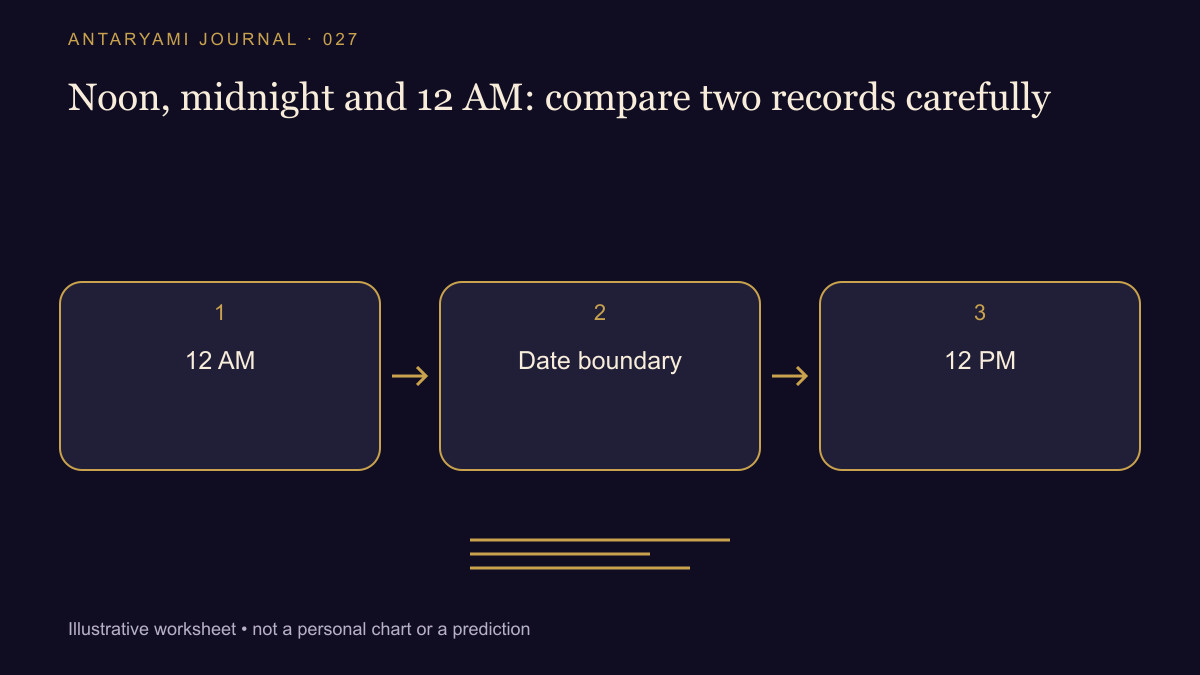
Two handwritten records say 12:15. One adds AM, the other PM. In ordinary twelve-hour notation those labels describe times twelve hours apart, yet a quick transcription can make them look nearly identical. This exercise shows how to preserve the distinction and how to ask for clarification when a source says only twelve without specifying noon or midnight.
Write the comparison in twenty-four-hour time
Under the ordinary twelve-hour convention, 12:15 AM becomes 00:15 and 12:15 PM becomes 12:15. The minute value stays the same; the hour interpretation changes. These are teaching examples, not competing records for a real person. Add a full local date to each line so a midnight boundary cannot disappear from the review.
If a record describes exactly noon or midnight, writing the word can be clearer than relying on an isolated twelve-hour label. For machine exchange, an unambiguous twenty-four-hour timestamp and a declared offset make the interpretation easier to reproduce. RFC 3339 documents one standard form for representing date-times with numeric offsets.
Do not guess from the surrounding story
A recollection of daylight, a meal or a shift change may be useful context, but it should not silently replace the actual record. Circumstances can be remembered imperfectly, and ordinary routines vary. If the source is ambiguous, keep the ambiguity visible while looking for contemporaneous evidence.
Likewise, do not choose AM or PM because one chart interpretation feels more flattering. That method can build the preferred answer into its own supposed evidence. The time field should reflect the best available event information, with any unresolved alternatives labelled as alternatives.
Keep dates attached to midnight
Midnight also creates a language problem: the midnight beginning a date is not the same boundary as midnight ending it. In an invitation or a correction note, write the date and 00:00 explicitly, then explain which side of the boundary is intended. Avoid phrases such as Friday night at twelve when precision matters.
A practical review table can have four columns: source wording, proposed twenty-four-hour reading, local date and reason for that reading. If a column is unknown, leave it unknown. Filling every cell with a guess makes the table neater without making the record better.
Check the saved result
Before confirming an entry, read the final date and twenty-four-hour time together. Ask the record owner to confirm any change from the original notation. A simple AM/PM correction can materially alter a calculated chart, but it does not establish a prediction about what the corrected chart must mean. Finish the transcription question before starting the interpretive conversation.
Astrological interpretations are for reflection, not a diagnosis, a guaranteed prediction or a substitute for professional advice. Journal guides are prepared with AI assistance; they are educational content, not individual consultations.