 Antaryami
Tarot card meanings
Page of Cups tarot card: meet a surprising feeling with curiosity and a little craft
A feeling can arrive in an unexpected form: a line of poetry, a small gesture or an idea that seems slightly strange before you know what to do with it. The Page of Cups gives that surprise a playful picture, with a fish appearing where an ordinary drink might have been expected. This Antaryami guide by Nitish Raj Walia explores emotional curiosity without declaring every impulse a supernatural message. The useful question is how to notice the response, give it a thoughtful form and remain open to what experience reveals. You do not need to be certain of its meaning before making a small, honest attempt to understand it.
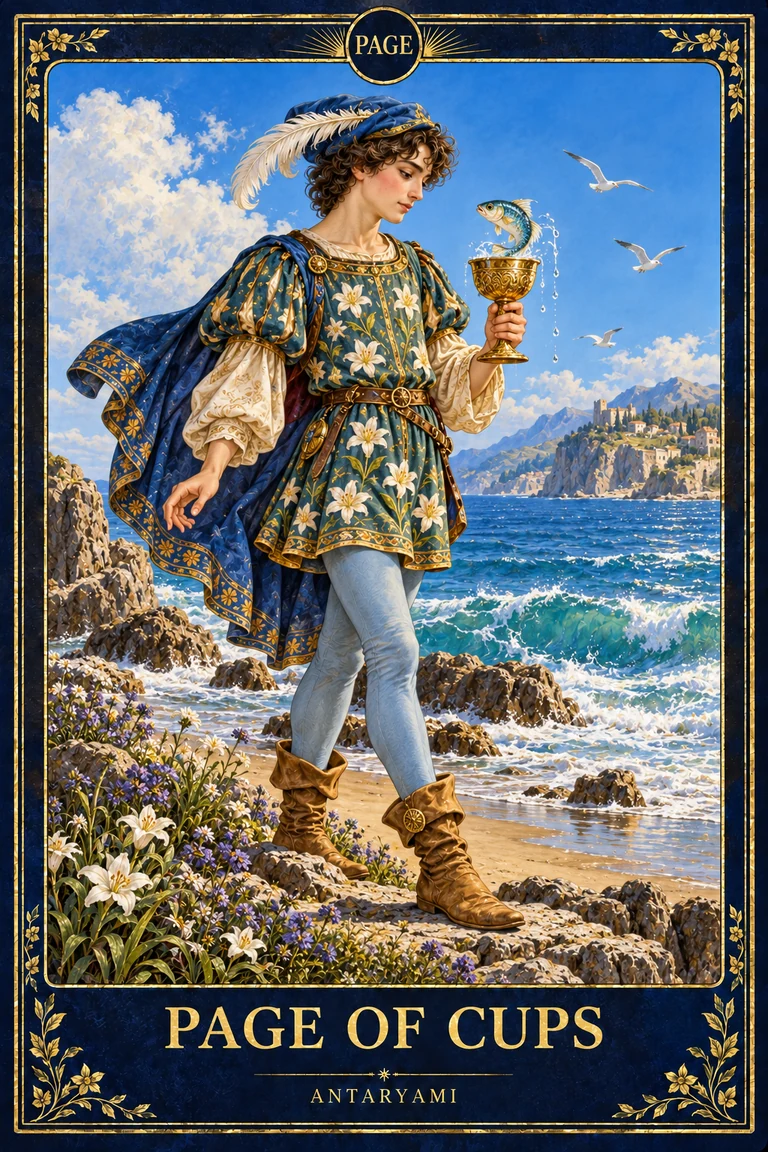
Page of Cups meaning: a feeling can be explored before it is explained
Contemporary Page of Cups readings often emphasise emotional curiosity, sensitivity, imaginative surprise, a tentative message or a creative response still finding its form. As a court card, the Page can frame a way of participating rather than identify a literal young person. You might be experienced in practical matters while approaching a new feeling with beginner-like uncertainty. The useful invitation is to notice without rushing to a final explanation. A response can deserve attention even when you do not yet know what it means.
Suppose a short conversation stays with you longer than expected. You may feel warmth, sadness or curiosity without being able to name why. A Page of Cups reflection could prompt a private note about the details you remember and the feeling they evoke. That is different from declaring the speaker a destined connection. You are investigating your response, not gaining access to theirs. The distinction lets the moment remain meaningful while protecting it from a story built on information you do not actually have.
Creative curiosity can work similarly. An unusual image may suggest a poem, drawing or melody before a complete project exists. Try a small form and notice what develops. You do not need to prove artistic talent through the first attempt. The Page's theme is exploratory, with enough care that the experiment can reveal something. It does not certify an intuitive gift or promise that every surprising idea will be valuable. Its usefulness lies in a willingness to meet the unfamiliar response with attention rather than dismissal or unquestioning belief.
The fish in the cup: surprise can be artistic without becoming an omen
Antaryami's original Page of Cups shows a blue-clad figure near the coast, looking at a fish emerging from a vessel. The composition interrupts an ordinary expectation. A cup should contain a drink, yet the figure encounters something alive and unexpected. That makes a memorable prompt for curiosity: what appeared in your experience that you had not planned for? The image can help you consider surprise without requiring you to treat it as a prediction, a warning or a message from an unseen authority.
Waite describes a page contemplating a fish in a cup and associates the image with something taking form in the mind. His historical meanings include reflection, application and a message, alongside period-specific descriptions we do not use to identify a person. Our creative-expression approach is contemporary. The Museum Tarot art is original, with its own coastal setting and figure, rather than a facsimile of the historical illustration. A shared motif can remain recognisable while the new composition has a distinct visual character.
The fish does not predict pregnancy, identify a zodiac sign or verify that a supernatural communication is occurring. Those would be claims beyond the picture. If an unexpected event has practical significance, inspect it through the relevant evidence. If it simply inspires an imaginative response, you can enjoy that response as art or reflection. Naming the lens keeps the card engaging without making every coincidence carry a hidden verdict. Surprise becomes useful when it opens a question, not when it closes the question with an explanation the facts cannot support.
Sources: Waite: Page of Cups fish, reflection and something taking form
Upright: try a small expression before demanding a complete meaning
An upright Page of Cups reflection can help when you want to express something but feel it must be perfectly understood first. Perhaps you wish to thank a friend, write a poem or acknowledge that an experience affected you. A simple, accurate expression may be enough. State what happened and how you responded without making the other person responsible for a larger story. The card's tentative quality can support honesty at a manageable scale, where the expression remains open to clarification.
For a creative experiment, choose a form that fits the available time. A few lines, a rough sketch or a short recording can hold an idea while it develops. Do not require the first result to become public content. Privacy may help you explore without the pressure of audience reaction. If you later share it, decide what context the viewer needs. A small imaginative piece can be meaningful without claiming to reveal an objective truth about the people or events that inspired it.
Sensitivity can also become attentive listening. You might notice that someone seems uncertain and ask whether they want to say more. Leave room for them to decline, and do not present your impression as knowledge of their inner state. The upright Page can encourage a considerate question rather than an intuitive verdict. Its value lies in the exchange that becomes possible: a feeling is noticed, a proportionate invitation is offered and the real response is allowed to shape what you understand next.
Reversed: sensitivity needs a boundary between feeling and fact
A reversed Page of Cups can prompt reflection on an unexpressed response, emotional overwhelm, a message without clarity or an imaginative story treated as evidence. Begin by separating what you felt from what you concluded. A brief reply may disappoint you, but it does not prove the sender dislikes you. A coincidence may feel striking, but it does not establish a hidden instruction. The card can help you examine the response without dismissing it or allowing it to decide facts it cannot know.
Imagine wanting to send a long message after a small misunderstanding. Before sending it, identify the actual question you need answered. A shorter request for clarification may serve the relationship better than an account of every fear the moment awakened. That does not make your feelings invalid. It gives the conversation a form the other person can understand and respond to. The reversed theme can encourage enough pause to keep expression connected to the present issue rather than asking one exchange to resolve a much wider history.
Another possibility is avoiding expression because you fear it will seem childish. A simple, honest statement can be appropriate even when the feeling is tender or uncertain. Choose a welcome setting and a proportionate form. Waite's historical reversed meanings include distraction and other difficult descriptions, but we do not turn them into a diagnosis or accusation. Here the contemporary question is how to make sensitivity useful: notice the response, check the story attached to it and decide whether expression, privacy or appropriate support fits the actual circumstances.
Relationships: a tentative message should leave room for a real answer
In relationship reflection, the Page of Cups can frame a gentle expression, an apology or the wish to open a conversation. It cannot prove that someone is about to contact you or that an absent person holds a particular feeling. If you want to reach out, consider whether contact is appropriate and welcome. A clear, modest message gives the other person room to respond. A card-based claim that the connection is destined can create pressure instead of the open exchange you hoped to invite.
A practical example is apologising after speaking carelessly. Name the conduct, acknowledge its effect and avoid making the apology a demand for reassurance. The other person may need time or may not want to resume the connection. Their response remains theirs. The Page's tentative quality can support humility, but it should not become an excuse for an unclear message that asks the recipient to guess whether you are taking responsibility. Tenderness and clarity can share the same sentence.
For dating, an imaginative response may make a new person feel unusually significant. Enjoy the interest while learning who they actually are. Ask questions, notice consistency and allow differences to appear. Do not assign the Page's sensitivity to them as a permanent personality label. The card's most useful relationship question concerns your own participation: how to be open enough to express interest and grounded enough to hear the answer, including an answer that does not match the story you first imagined.
Work and creativity: an unusual idea needs a clear way to be tried
A Page of Cups workplace reflection can support imaginative contributions that do not yet fit the usual format. Perhaps you see a more welcoming way to explain a process or an unexpected visual approach to a familiar topic. Offer a small sample and explain what it aims to improve. That gives others something to inspect. An unusual idea does not need to be defended as special insight; it can be tested through whether people understand, use or respond to it as intended.
If you are giving feedback, sensitivity can help you consider how the message will be received, but it should not remove the substance. State the issue clearly and offer a useful example. Vague reassurance may feel kind while leaving the person unable to improve. Conversely, bluntness is not automatically more honest. The card can prompt a balance of care and clarity, where the feedback serves the work and respects the person rather than becoming a performance of either warmth or toughness.
Commercial claims need a separate standard. An intuitive feeling about a product, customer or opportunity does not establish demand, profit or suitability. Use actual evidence and relevant advice. If you are creating public content, distinguish a fictional example from a verified result and ask permission before using someone else's personal story. The Page's creativity can be inviting when it is responsibly framed. A professional experience makes room for imagination without letting a poetic presentation imply technical knowledge or guaranteed outcomes the product does not possess.
Page of Cups versus Page of Wands and Knight of Cups
The Page of Cups often foregrounds emotional curiosity and imaginative surprise. The Page of Wands often foregrounds the learner's initiative and a desire to try something in the world. The Knight of Cups foregrounds an invitation or expression carried outward with a more deliberate presentation. These are interpretive roles, not fixed personality types. A creative project may involve all three questions at different moments: what moved you, what you want to attempt and how you will offer the result to another person.
Imagine writing a song. The Page of Cups lens may ask about the feeling or image that first appeared. The Page of Wands lens may ask what technique you want to learn by trying it. The Knight of Cups lens may ask how the song will be presented and whether the expression fits its audience. None of those cards establishes that the song will be successful or that its inspiration is supernatural. The comparison gives a more precise vocabulary for the work you are actually doing.
Another misconception is that a Page must describe a child or someone immature. This adult guide reads the character through a mode of attention available at any age. You can be accomplished and still approach a feeling with curiosity. You can be new to tarot and still ask clear, thoughtful questions. The card becomes more useful when it offers a practice you can examine rather than a demographic label. Emotional openness is not a rank, and an imaginative response does not exempt anyone from checking the facts attached to it.
An Antaryami surprise note: feeling, story and a small expression
For an Antaryami tarot draw, try how can I explore this response without claiming more than I know. The Page's named position can frame a resource of curiosity or a challenge of an unchecked story. The inspected walkthrough offers optional questions and reversals, but it does not verify intuition, diagnose sensitivity or deliver private messages from another person. Use the interpretation to examine your own response, with serious wellbeing or safety concerns connected to appropriate support rather than a symbolic explanation alone.
Write a surprise note in your own journal with three entries: what you felt, what story you added and one small expression you could try. Keep the first two separate. You may choose a private sketch, a concise message or a question that obtains real information. Afterward, notice whether the expression clarified the experience or changed your interpretation. This exercise does not prove that the card knew something hidden. It helps an unexpected response become understandable enough to engage with thoughtfully, while preserving your freedom to revise the meaning.
Explore Antaryami's tarot walkthrough and current app page before choosing access. Nitish Raj Walia's Journal for Temior Technologies Pvt Ltd pairs original artwork with primary-source context and practical contemporary explanations. The Page of Cups offers a fitting invitation to the experience centre: let something interesting catch your attention, then look closer. A beautiful detail can begin discovery, while clear information allows that discovery to become understanding rather than a claim you are expected to accept because it feels moving or mysterious.
Explore the response without turning it into evidence
A small event has produced a much larger story in my mind
Write the event, the feeling and the conclusion in separate lines. Ask which conclusion needs actual information, so a meaningful response does not silently become proof of another person's intentions.
I want to express something tender but cannot explain it perfectly
Choose a small, accurate form that fits a welcome setting. A private creative attempt or a concise message can clarify the feeling without requiring it to carry a complete theory about your life.
Astrological interpretations are for reflection, not a diagnosis, a guaranteed prediction or a substitute for professional advice. Journal guides are prepared with AI assistance; they are educational content, not individual consultations.


