Antaryami
Chart essentials
Planetary degrees: reading more than a zodiac sign
A planetary degree locates an object more precisely within the chosen zodiac than a sign name alone. The number is useful for comparing calculations, but more decimal places do not automatically mean the birth input or astrological interpretation is more reliable.
Sign position or full longitude?
First check what the number represents. A display may show a position within a sign, while an engine or reference table may use a longitude around the whole zodiac. These are different formats. Compare like with like and use the sign label alongside the degree rather than concluding that two differently formatted numbers describe different skies.
A zodiac sign is a broad positional label within the chosen convention. The degree adds a finer location. These two pieces of information work together rather than compete. Before reading a number, ask whether the table shows a position within a sign or a longitude across the full zodiac circle. The same written number can be confusing if the interface leaves that distinction unstated. A useful label tells you what the value measures.
For a simple mathematical illustration, divide a 360-degree circle into twelve equal spans of 30 degrees. A value written as 12 degrees within a named sign concerns a position inside one span. It is not the same as 12 degrees measured from the circle's starting reference. This example explains the coordinate idea only; it is not a personal placement, a chart calculation for a real birth or a claim about today's sky.
Also check the notation. A decimal degree and a degree-minute representation can describe the same quantity in different forms. The digits after a decimal point are not automatically minutes. For example, half a degree is 30 angular minutes, not 50. This is a mathematical conversion, not a special astrological rule. Reading the unit correctly is a useful first step before assigning any traditional meaning to the number.
Rounding is not a change of identity
A screen can round a position for readability. Near a boundary, the rounded label may be less informative than the underlying calculation. Do not add your own precision to an uncertain birth time. It is better to retain an explicit uncertainty note than to copy a long decimal and assume it resolves the limitations of the original record.
A rounded value can sit close to a displayed boundary. If an interface shortens the number, the printed text may conceal a small difference that mattered to the label. Do not infer the full stored value from a short display alone. When a sign or subdivision seems inconsistent, compare the underlying position and the rounding policy. A display issue and a calculation issue are different possibilities, even when they produce the same puzzling screenshot.
Birth uncertainty is another boundary question. If the recorded time is approximate, a fine output value does not make the input exact. A responsible result should explain which labels might be sensitive to the plausible input range. Testing alternatives can show that sensitivity; it cannot recover the true birth minute by itself. The fact that one interpretation sounds more appealing is not evidence that its associated time is correct.
Different zodiac conventions can also change the displayed sign-degree pair. Align the method before comparing two services. A sidereal value under one ayanamsa and a tropical value are not identically configured results. Record the object name and convention beside the degree. That makes the comparison inspectable rather than reducing it to a debate about which app feels more precise.
What to include in a comparison
Use the same birth date, time, place, zodiac convention and method. Check whether both tools refer to a birth moment or whether one is showing transits for a later date. Then compare one named planet at a time. A correct transit position should not be expected to match the planet's natal position simply because both appear on the same profile.
The extra detail can help you inspect the chart without treating it as a stronger prediction. A precise position is useful for applying a stated rule or comparing values. It does not prove a precise claim about someone's character or future. If an interpretation becomes more confident simply because the table displays additional digits, ask what supports that confidence. Numerical detail and interpretive evidence are not the same resource.
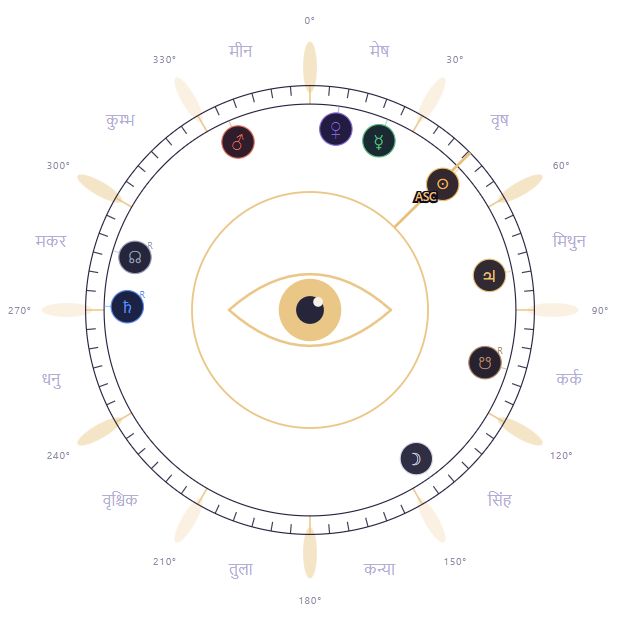
Suppose two views appear to put the Moon in different places. Begin with the named table entries rather than measuring the illustrations. The renderer may move text or glyphs to preserve readability. Compare the numerical positions under the same person, instant and method. If those agree, the problem may concern how the drawing is arranged or read. If they differ, you have a narrower calculation question to investigate.
Likewise, a condition label such as proximity to another planet should identify the values being compared and the rule used. One degree number on its own may not explain the condition. A helpful explanation connects the operands, the method and the resulting label. It should not ask the reader to infer the calculation from the colour of a warning or a pair of overlapping icons.
Why numbers do not settle meaning
A degree answers a positional question. Traditional interpretation adds a separate layer of symbolism and rules. Do not treat a precise number as proof that a forecast is certain. Antaryami's instruments are intended to make positions inspectable and explanations readable; the user should still be able to distinguish a calculation from a claim about what must happen next.
For a first reading, choose one placement and translate its display into ordinary language: this named object is at this position under this zodiac convention. Then read any uncertainty note. You do not need to memorise every degree before the chart becomes useful. Learning the distinction between a sign span and a finer coordinate already makes many later labels easier to understand.
In Antaryami, the degree table and the explanation must belong to the selected saved profile. A family member's value is not yours because it appears beside a familiar generic paragraph. Check the name and input context before interpreting. A stored report may also use an earlier profile version, so compare generation context as well as the number. Personal ownership and numerical clarity need to travel together.
Nitish Raj Walia's Antaryami Journal aims to make these details approachable without turning them into a performance of certainty. Thank you for checking what the number actually means. A few careful questions about units, rounding and method can explain more than a long argument about accuracy. Once the coordinate is clear, you can approach the traditional interpretation with context and keep your own judgement in view.
Astrological interpretations are for reflection, not a diagnosis, a guaranteed prediction or a substitute for professional advice. Journal guides are prepared with AI assistance; they are educational content, not individual consultations.