 Antaryami
Reading thoughtfully
Why the same question can receive different AI wording
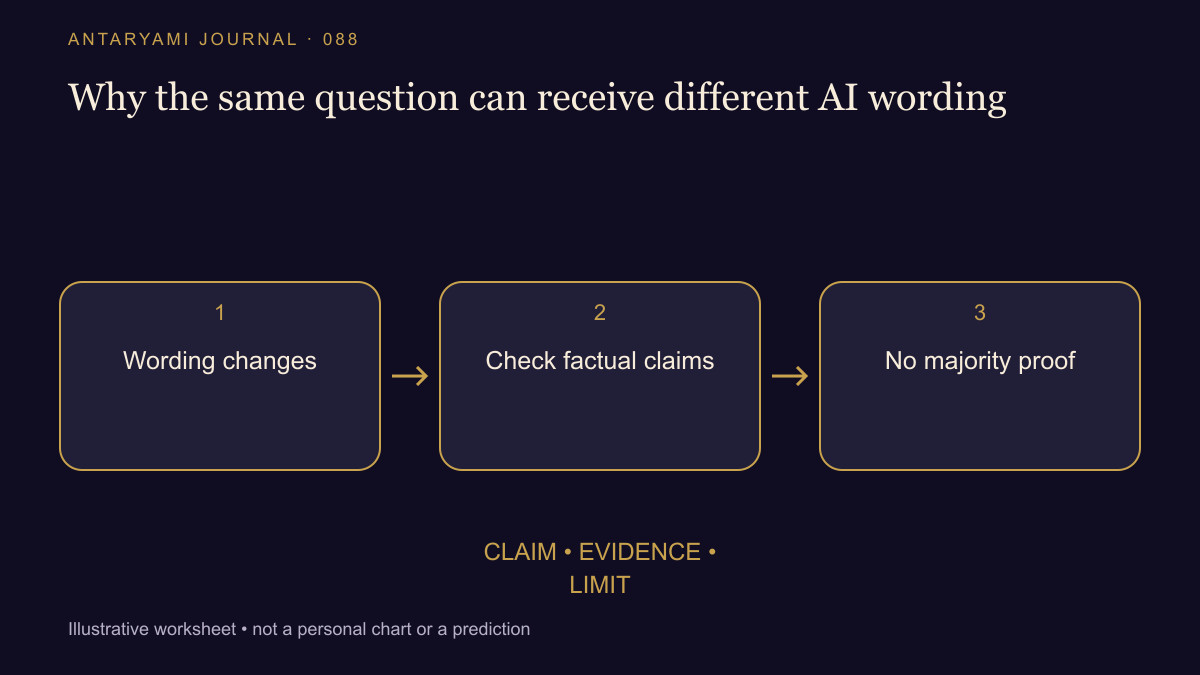
Asking the same question twice can produce different AI wording. A model may emphasise different details, choose a different structure or generate an inconsistent statement. Variation alone does not show which answer is correct. It also does not prove that the underlying chart changed. Compare the factual claims and selected context before interpreting differences in tone as differences in truth.
Separate style changes from factual changes
Take a fictional question about preparing for a presentation. One answer suggests organising notes; another suggests rehearsing aloud. Those recommendations can coexist without contradicting each other. A different issue arises if one response names a placement that conflicts with the displayed chart or changes the selected person's identity.
Write the relevant claims side by side. Mark which are numerical or contextual facts, which are traditional associations and which are optional suggestions. This prevents a longer or more confident paragraph from being treated as a stronger calculation. Helpful phrasing and factual accuracy need separate assessment.
Do not vote among repeated responses
Generating ten answers and selecting the most common claim is not an independent verification of that claim. The responses may share the same missing context or systematic error. Repetition can also incur cost without producing new evidence. For a calculation dispute, inspect the supplied result and settings rather than repeatedly requesting a more reassuring explanation.
NIST's guidance on generative-AI risks describes the possibility of confidently generated erroneous content. It does not mean every variation is a failure, nor does it identify the cause of any particular mismatch. The appropriate response depends on whether the change concerns presentation, interpretation or an actual factual contradiction.
Ask for a narrower explanation
If an answer is too broad, specify the field or question you want explained and ask that uncertainty remain visible. For example, request an explanation of the supplied placement without predicting a job offer. This improves the task's boundaries, but it still does not certify the model's output. Check important factual claims through appropriate sources.
When reporting an inconsistency, retain the two relevant excerpts, the selected context and the observation time while removing private details. Avoid treating the model's self-diagnosis as a technical incident report. A good outcome is an explanation whose claims match the confirmed input and whose suggestions remain proportionate. There is no need for identical prose on every attempt, but there is a need to avoid letting stylistic variation conceal a changed fact, unsupported certainty or a different person's context.
Astrological interpretations are for reflection, not a diagnosis, a guaranteed prediction or a substitute for professional advice. Journal guides are prepared with AI assistance; they are educational content, not individual consultations.