Antaryami
Chart essentials
How to read a North Indian birth chart without mixing signs and houses
Begin a North Indian chart by identifying its house layout and the sign labels inside it. Do not assume every number means a house number. The chart is a display format; interpretation still depends on the underlying placements and calculation convention.
Find the legend before reading symbols
Different renderers use numbers, abbreviations or names for signs and planets. Look at the legend first. A small mark next to a planet might describe motion, not a second planet. If a label is unclear, open the placement list and match the object by name. Guessing at tiny symbols is an avoidable source of confusion.
The first few seconds with a diamond chart can feel like opening a map without knowing which way is north. Your eye notices a number, a cluster of letters and an unfamiliar shape, then tries to turn them into a story. Give yourself permission to pause. The most useful first task is not interpretation. It is learning what the display means by each mark. Once the visual language becomes familiar, the chart stops looking like a puzzle that must be solved all at once.
Begin with the title and legend, not the busiest compartment. Is this a birth chart, an example, or another chart view? Does the legend identify full planet names or abbreviations? Are sign names written out, or represented by numbers? A number does not explain its own purpose. Read the convention before assigning meaning. If the page provides no legend, the responsible next step is to ask for one rather than invent a rule from a single screenshot.
Keep a short reading note beside the screen. Write the selected profile name, the chart type and the labels you have confidently identified. Leave unclear symbols as questions. This gives your next visit a starting point and stops an early guess becoming a remembered fact. You do not need to copy private birth details into a public comment or social post. A general question about the legend can usually be asked without sharing the person behind the chart.
Separate the house from the sign
A house position and a zodiac sign answer different questions. In the familiar North Indian layout, houses occupy fixed positions while the displayed signs depend on the chart. Check the first house and Ascendant label before following the remaining houses. Reading a sign number as a house number can scramble an otherwise correctly calculated chart.
Try a deliberately simple exercise: point to the first house, then read the sign assigned to it. Say those two pieces separately. The compartment tells you where you are in the layout; the sign label tells you what the calculation has assigned there. When the same digit could plausibly be mistaken for either, use the explicit legend or accompanying table. The purpose is to build a reliable habit, not to memorise every placement on your first attempt.
Imagine that you switch from your profile to another saved family profile. The familiar arrangement of compartments may remain, while the labels and planetary placements change. That is exactly why visual familiarity cannot confirm whose data is on screen. Look at the selected name again and check a placement in the table. A correct diagram accompanied by information from somebody else is still an incorrect personal experience. Both the picture and its explanation must belong to the same selected person.
House and sign are also separate pieces of vocabulary in a reading. If an explanation mentions one while you are looking for the other, ask which label it refers to. A sentence can sound persuasive while leaving this distinction unclear. Good educational copy helps you locate the claim in the chart. It should not require you to guess whether a reference to a number means a sign, a house or an unrelated item in a numbered list.
Cross-check one planet
Choose one object, such as the Moon. Find its sign and house in the numerical table, then locate the same object in the drawing. Repeat with another planet before attempting interpretation. This small exercise confirms that you understand the renderer. It also helps distinguish a display misunderstanding from a genuine mismatch between the chart and its accompanying information.
For the cross-check, choose a planet whose name you can recognise easily. Read its sign in the placement list, locate its marker in the drawing and check the house label supplied by the same result. There is no prize for doing this quickly. You are verifying that you can move between two representations of one calculation. If the table and picture disagree, stop before drawing a personal conclusion and record the specific discrepancy.
A cluster can make this exercise harder because several abbreviated names sit close together. Read each object independently rather than treating the cluster as one symbol. A nearby motion marker or annotation should not become another planet in your notes. Where a renderer supports opening an object label, use it to confirm the full name. Where it does not, rely on the placement list. Clear text is a better source than trying to infer an overlapping letter from its colour.
Repeat the exercise with a second object in another part of the chart. This helps reveal whether your first successful match was accidental. Then try describing the result in plain language without predicting anything: the named object appears in the listed sign and house under these settings. That modest sentence is useful. It establishes what the chart displays before you consider what an astrological tradition might associate with the placement.
Move between formats carefully
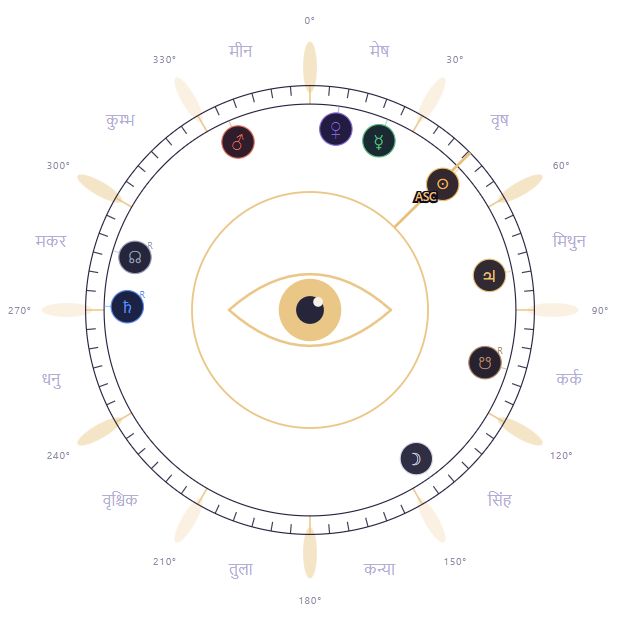
A circular Bhacakra and a North Indian diagram should preserve the placements when method and inputs are unchanged. Compare the same selected profile, not a fictional example beside your account data. Changing the visual format should not change the person. If labels disagree, note the exact object and method and seek clarification before relying on any personal reading.
Switching to a wheel is a change of presentation only when the underlying inputs and settings remain the same. Make a tiny comparison checklist: same profile, same chart type, same calculation context, same object. Do not compare a public demonstration with your saved result and expect their placements to match. The fictional example is there to teach the interface, not to stand in for your birth record. Attractive artwork does not establish a personal calculation.
If two services disagree, begin with the inputs and method before blaming the diagram. Birth-time interpretation, location selection and calculation conventions deserve attention. A format name tells you how information is arranged, not everything about how it was calculated. Keep the comparison narrow enough to investigate. One named placement with its settings is a clearer question than saying that an entire chart feels wrong.
Antaryami should make this learning experience welcoming. You can explore the public instruments, understand a few labels and return when you are ready to examine your own saved profile. Thank you for taking the time to check before interpreting. Confidence comes from knowing what you are looking at, not from rushing to a dramatic conclusion. A clear first reading leaves you with better questions and a chart you can actually navigate.
Astrological interpretations are for reflection, not a diagnosis, a guaranteed prediction or a substitute for professional advice. Journal guides are prepared with AI assistance; they are educational content, not individual consultations.