 Antaryami
Calculation workshop
What belongs in a reproducible chart-calculation record?
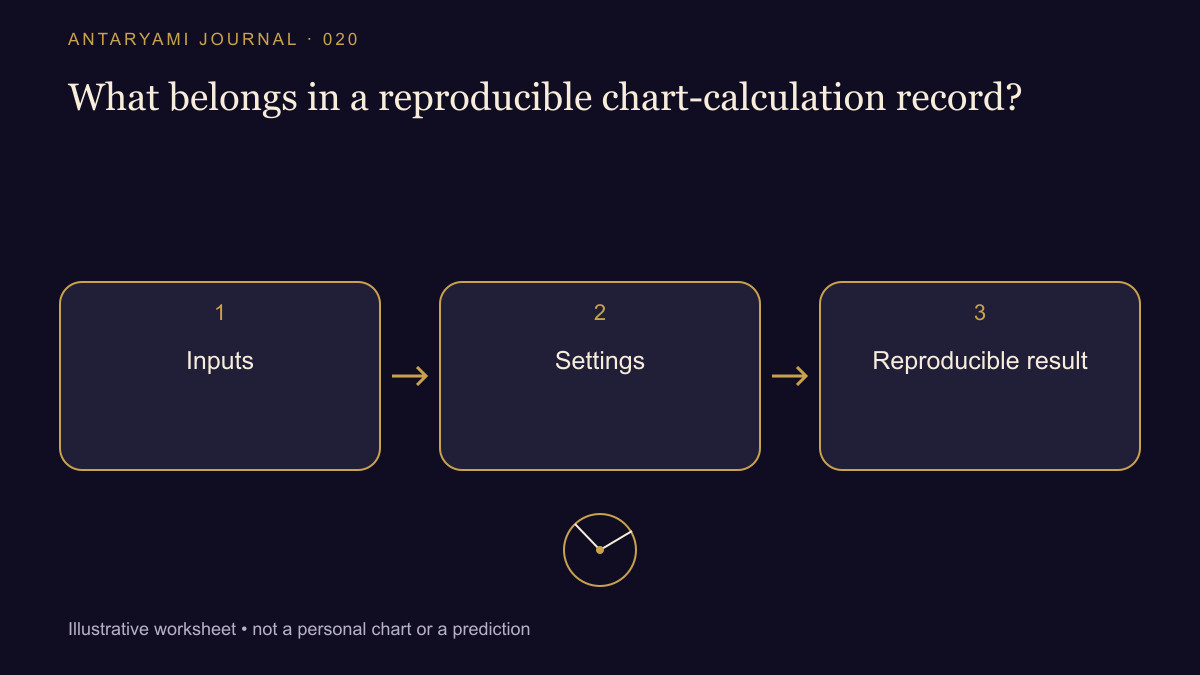
Two screenshots disagree, and both look professionally designed. A reproducible calculation record is a better starting point than choosing the more confident explanation. The aim is to preserve enough information for another reviewer to repeat the request while keeping private birth details out of a public discussion. A comparison should identify its assumptions before it announces a conclusion.
Describe the question precisely
Begin with what is being compared: a planetary longitude, a house assignment, a period label or another defined result. State the object and units. JPL's Horizons documentation illustrates how observing centres, time scales and reference frames form part of an astronomical request. A screenshot of one number rarely preserves all of that context.
Use fictional inputs for a public example whenever possible. Record the date-time representation, location convention, zodiac reference, relevant house method and other settings that genuinely affect the chosen result. Do not include an unrelated option merely to make the list look comprehensive. The record should be sufficient and understandable, not a dump of everything the application knows.
Save before and after separately
If an input is edited, keep the original and corrected values distinct. Record which field changed and why. A review becomes difficult when the screenshot shows the old input but the written explanation uses the new one. Clear version labels prevent a reviewer from accidentally combining parts of two requests.
Also preserve the application's version or the date of observation when available. A later update may legitimately change a calculation or display. That does not establish what happened in an earlier session. A dated record helps someone distinguish a current reproducible issue from an older observation that can no longer be reconstructed exactly.
Compare one layer at a time
First check whether the numeric requests are equivalent. Then compare raw or adequately precise values. Next compare classification rules and display rounding. Finally discuss the interpretation separately. Moving through these layers prevents a visual label difference from being described as an ephemeris failure before the underlying values have been checked.
An incomplete result can still be useful. You might establish that two tools use different node conventions while leaving another discrepancy unresolved. State the narrow finding and the next missing input. Do not force every question into pass or fail when the evidence supports a more specific description.
Astrological interpretations are for reflection, not a diagnosis, a guaranteed prediction or a substitute for professional advice. Journal guides are prepared with AI assistance; they are educational content, not individual consultations.