 Antaryami
Tarot card meanings
Six of Cups tarot card: let a good memory inform the present without replacing it
A familiar song, a recipe or a place can make an earlier part of life feel suddenly close. The Six of Cups gives memory a gentle scene, with flowers offered between figures in a courtyard. This Antaryami guide by Nitish Raj Walia explores nostalgia without assuming the past was simpler for everyone or that a remembered person must return. A memory can offer warmth, a useful preference or a clue about what once mattered. It can also leave out difficulties. The card asks how to receive the memory thoughtfully, so the present becomes better understood rather than being judged against an ideal version of a time you can no longer fully revisit.
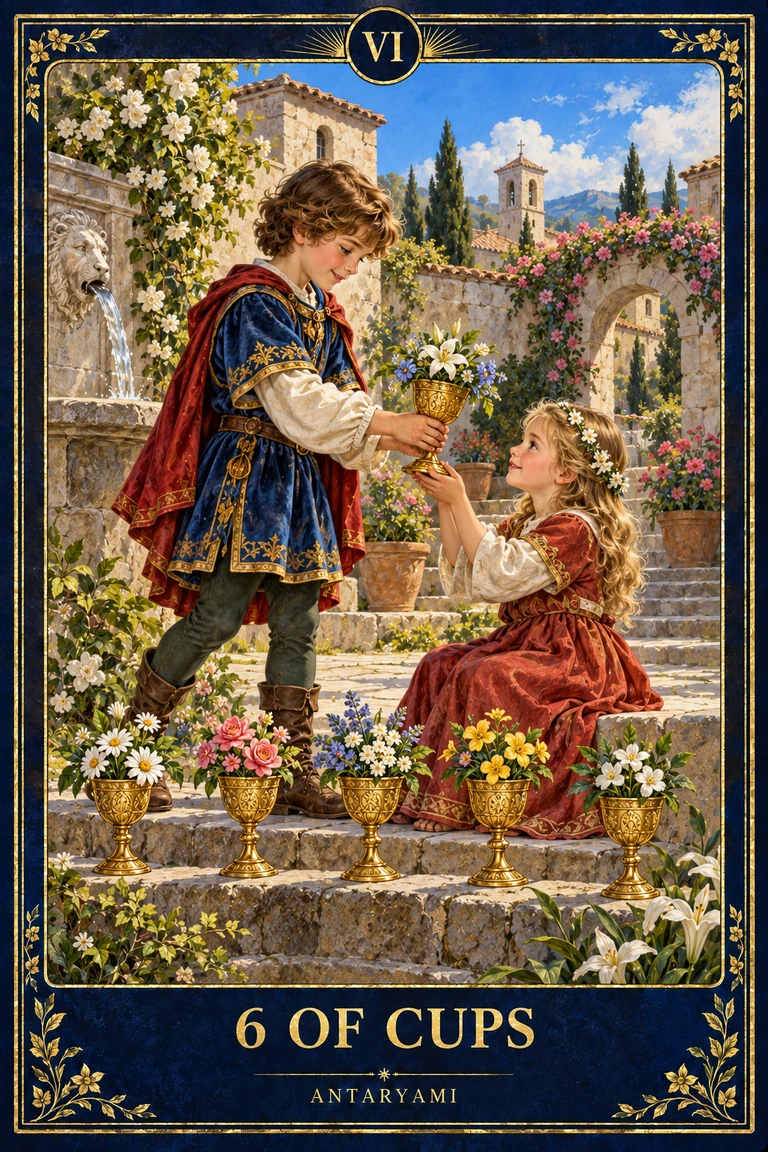
Six of Cups meaning: memory is material for reflection, not a complete record
Contemporary Six of Cups readings often emphasise nostalgia, familiar experiences, generosity, childhood imagery or a connection with the past. The useful distinction is between remembering and reconstructing. A memory may be vivid while still being partial. You can value what it brings without treating it as a complete account of every person and circumstance involved. The card can prompt a question about what the memory means now, rather than declaring that earlier life was objectively better or that returning would reproduce the same experience.
Suppose a dish reminds you of a relative who cooked it. You may want to learn the recipe, preserve a story or share the experience with someone today. That is a practical way for memory to inform the present. It does not require recreating the entire household or insisting that everyone else feels the same nostalgia. A remembered detail can become a generous contribution when it is offered with room for different experiences and preferences. The value lies in what you choose to carry forward, not in proving the past was perfect.
Familiarity can also influence decisions. An old pattern may feel comfortable because you know how to behave within it, even if it no longer serves you. Ask whether the present circumstances actually match the memory. People, roles and needs may have changed. The Six becomes useful when it helps you distinguish a warm association from a current agreement. Its gentle image should not persuade you to ignore new information simply because an earlier connection once felt safe, meaningful or easy to understand.
Flower-filled cups in a courtyard: giving is central to the picture
Antaryami's original Six of Cups shows two young figures sharing a flower-filled vessel, with other cups arranged in a courtyard. The flowers make the cups feel like offerings rather than containers being emptied. A reflective question is what can be given freely from an earlier experience: a skill, a story, a recipe or a simple gesture. The picture does not establish the age or identity of anyone in your question, and it should not be used to infer facts about a child.
Waite describes children in an old garden with flower-filled cups and associates the card with memories and enjoyment connected to the past. An interesting historical detail is that he also records an alternative reading involving a new environment, while the reversed account points toward the future and renewal. Our present-day discussion of nostalgia is therefore a contemporary emphasis, not the only meaning his text permits. The Museum Tarot artwork is newly created, with its own courtyard, figures and visual arrangement rather than a historical facsimile.
The youthful scene is symbolic material for this adult educational guide. It is not a prediction of parenthood, a reading of a child's character or evidence that an app knows private family history. If you share a real memory involving another person, consider their privacy and permission before publishing details or images. The card's generosity can inspire thoughtful sharing without overriding those responsibilities. A meaningful past connection deserves care in how it is carried into the present, especially when the memory belongs to more than one person.
Sources: Waite: Six of Cups flower-filled vessels, memory and alternative readings
Upright: carry one worthwhile detail into today
An upright Six of Cups reflection can encourage you to revisit something that once brought genuine enjoyment. Perhaps you liked drawing, gardening or a particular kind of gathering before your routine became crowded. Choose one manageable version now rather than demanding a complete return to an earlier life. You might sketch for an hour, grow a small plant or invite a friend for a familiar meal. The activity can be meaningful even if it feels different because you and your circumstances have changed.
For a generous gesture, ask what would actually be welcome. An old photograph, story or object may matter to you but not to every recipient. Offer it without requiring a particular emotional response. That keeps the gift voluntary. You can explain why the detail is meaningful while leaving the other person free to receive it in their own way. The card's warmth becomes more useful when it supports a real exchange rather than expecting others to participate in your nostalgia exactly as you do.
An upright reading can also help you recognise a skill inherited through ordinary learning. Someone may have taught you how to repair a thing, organise a gathering or make a difficult task less intimidating. You can use and adapt that knowledge now. This is not a claim about past-life memory or a supernatural lineage. It is an invitation to notice practical continuity. The past can supply material for a present choice, with enough flexibility that what you carry forward serves today's needs instead of becoming a rule nobody is allowed to change.
Reversed: notice when nostalgia edits out the difficult parts
A reversed Six of Cups can prompt reflection on idealising the past, repeating an outdated pattern or becoming ready to relate differently to a memory. Ask what your remembered account includes and what it leaves out. You may recall a place as carefree while forgetting the limitations you wanted to escape. That does not make the pleasant memory false. It means the full decision needs more than its brightest detail. A card should not persuade you to return solely because familiarity feels emotionally convincing.
Imagine considering an old job because you miss the colleagues. The people may remain important, but the workload, pay or responsibilities may be the same reasons you left. You can reconnect with colleagues without returning to the whole arrangement. A useful reversed reflection separates the element you value from the setting that once contained it. That creates more options than a binary choice between forgetting the past and recreating it. The meaningful part may be carried forward in a different form.
Sometimes the shift is simply accepting that people have changed. A reunion may not reproduce the old dynamic, and that does not necessarily mean the connection is ruined. Ask who the person is now rather than requiring them to perform the role you remember. Waite's reversed account includes future-oriented renewal, which supports keeping the historical interpretation more open than a blanket negative label. Here the modern invitation is to let memory remain meaningful while allowing present evidence, preferences and boundaries to shape the relationship that exists today.
Relationships: a reunion needs a present-day conversation
In a relationship reading, the Six of Cups can frame an old connection, familiar affection or memories that influence how you relate now. It does not prove that an ex-partner will return, that they miss you or that reconciliation would be suitable. A remembered bond can matter while the present circumstances are different. If contact is appropriate, approach the person as they are now and leave room for their answer. Nostalgia cannot supply consent or erase a boundary established after the earlier relationship.
For an existing partnership, the card may invite revisiting something you enjoyed together. Ask whether the activity still appeals and adapt it to current needs. A place, meal or tradition can create warmth without being forced to reproduce an exact earlier feeling. You might discover that one person values the memory differently. That difference can become an interesting conversation rather than a test of who cares more. Shared history is richer when it allows several perspectives instead of requiring one approved version.
Family memories deserve the same care. Not everyone experienced a period as happy, and a cheerful account should not silence someone else's difficulty. Offer your memory as your perspective, not the final truth about the household. If the topic is painful or sensitive, respect the person's choice not to discuss it. The Six's most useful relational theme is continuity with room for change: recognising what was meaningful while allowing current people, circumstances and boundaries to remain visible rather than disappearing behind a sentimental picture.
Work: familiar methods can be valuable without becoming untouchable
A Six of Cups workplace reflection can ask which established practices deserve preservation and which need revision. A method may have worked well under earlier conditions but no longer fit the present scale. Respect the knowledge behind it while checking the current result. That is different from dismissing everything old as outdated or protecting every tradition from examination. The card can prompt a balanced inquiry into what the organisation has learned and what today's users or colleagues actually need.
For a creative business, a familiar style can build recognition, but imitation of an earlier success may become limiting. Ask which quality people valued: clarity, craftsmanship, warmth or a particular visual detail. Preserve the useful principle while allowing the form to evolve. Tarot cannot establish market demand or guarantee that nostalgia sells. Use actual feedback and evidence. A remembered response can suggest a question to test, but it should not become the only reason for a new commercial commitment.
Mentorship is another useful theme. If someone taught you a skill, you may now be able to make the first steps easier for another learner. Explain the method clearly and acknowledge where your own knowledge ends. Passing on experience does not require claiming authority over every approach. The Six's generosity can become a practical invitation to share something helpful, with room for the learner to adapt it. The best continuity is not a frozen repetition of the past; it is knowledge carried forward in a form that remains useful and honestly labelled.
Six of Cups versus Four of Cups and Judgement
The Six of Cups often highlights memory and familiar experience. The Four of Cups often highlights present disengagement or a pause before an offer. Judgement, in this series, raises a wider question about review, responsibility and responding to what has become clear. These distinctions can help you identify the task. Are you remembering something, examining your current response or reassessing a pattern with new understanding? A nostalgic feeling and a considered review are not automatically the same process.
Imagine being invited to an old group's reunion. The Six's lens may ask what the group once meant to you. The Four's lens may ask whether the current invitation interests you and fits your capacity. Judgement's lens may ask whether your account of that period needs a more honest review. None requires attendance or predicts the experience. The comparison gives you several questions, so your answer can include both the memory and the present conditions rather than being decided by the strongest emotion attached to the past.
Another misconception is that the Six always means innocence or an uncomplicated childhood. Real histories vary, and an image cannot make a difficult experience benign. This guide uses the youthful scene as symbolic material without declaring what anyone's past must have been. Ask which detail is genuinely relevant and leave room for mixed feelings. The card becomes more respectful when it allows warmth, uncertainty and complexity together, instead of insisting that every reader should find comfort in a period they may remember very differently.
An Antaryami memory bridge: then, now and what is worth carrying forward
For an Antaryami tarot draw, try what from this memory would serve the present. The Six's named position can distinguish a resource of experience from a challenge of idealising an old pattern. The inspected walkthrough allows optional questions and reversals, but it does not retrieve private memories or verify a past-life claim. Bring only the circumstances you choose to reflect on, with respect for other people's privacy. The card can help organise a question without becoming an authority over your personal history.
Write a memory bridge in your own notes with three entries: then, now and carry forward. Under then, describe the remembered detail as your perspective. Under now, record the current conditions and people involved. Under carry forward, choose one value, skill or gesture that remains useful. You may decide to revive a small activity, share a story privately or leave a former arrangement in the past. The exercise widens your options without requiring the memory to be either perfect or meaningless.
Explore Antaryami's tarot walkthrough and current app page before selecting access. Nitish Raj Walia's Journal for Temior Technologies Pvt Ltd pairs original art with clear historical references and contemporary practical questions, so the instrument can be understood rather than merely admired. The Six of Cups offers a fitting final thought: a good tradition stays valuable when it can be carried thoughtfully into the present. Discovery becomes richer when familiar beauty is accompanied by honest context and enough room for the reader's actual experience to remain their own.
Carry the useful detail, not the whole old arrangement
I miss an earlier period and want to recreate it exactly
Identify the specific quality you miss, such as a friendship or creative habit, and ask how it could exist today. Present circumstances may offer a different form without invalidating the original memory.
An old connection feels familiar, but important things have changed
Approach the person and arrangement as they are now. Check current willingness, terms and boundaries rather than assuming a past bond supplies agreement for a new stage.
Astrological interpretations are for reflection, not a diagnosis, a guaranteed prediction or a substitute for professional advice. Journal guides are prepared with AI assistance; they are educational content, not individual consultations.


