 Antaryami
Tarot reading workshop
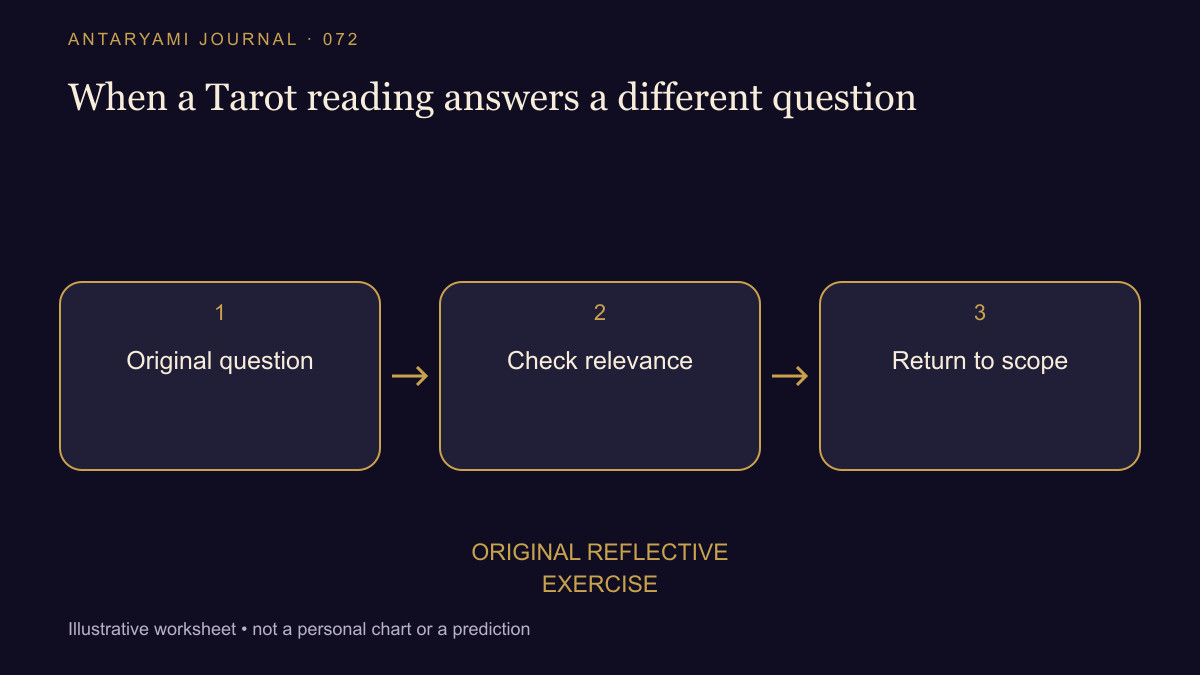
When a Tarot reading answers a different question
A reading can sound persuasive while answering a different question from the one asked. Someone asks how to prepare for a conversation and receives a prediction about whether another person loves them. The change may be subtle, but it replaces an actionable topic with an unverified claim. Returning to the original question protects both clarity and the other person's privacy.
Keep the question visible
Write the agreed question before laying out the cards. For a fictional example, use how can I explain my availability to a project partner? A relevant answer concerns the person's own communication, commitments and boundaries. A statement about the partner's secret resentment answers something else and is not established by the spread.
Under each interpretation, ask which words connect it to the actual question. If that connection requires inventing motives or events, pause. A card can prompt an association without making that association evidence. The reader can say that a thought arose but does not address the agreed task.
Return through an observable step
Translate the relevant part of the reflection into a possible action. The person might prepare a list of available hours, state which deadline they can meet and ask the partner to prioritise conflicting tasks. Those steps remain useful even if the symbolic story is set aside. Their effect can be checked through the actual conversation.
Do not rescue an irrelevant interpretation by broadening the question until it fits everything. If the person wants to discuss a different topic, obtain their agreement and label it as a new question. That is a change of scope, not evidence that the first spread foresaw a deeper issue.
Record the correction without embarrassment
A useful note can say that the initial interpretation drifted into speculation about someone else's feelings, so the discussion returned to communication and scheduling. It does not need to defend every statement made during the session. Acknowledging drift is more informative than pretending every association was necessary.
When reviewing the reading later, compare it with the written original question rather than with a memory of the conversation. Record whether the person found a practical next step and whether the actual discussion supplied new information. This does not validate Tarot as a predictive method; it checks whether the exercise respected its own purpose. A focused reading leaves people with agency over their actions, while allowing unanswered questions about other people's minds and future events to remain unanswered.
Astrological interpretations are for reflection, not a diagnosis, a guaranteed prediction or a substitute for professional advice. Journal guides are prepared with AI assistance; they are educational content, not individual consultations.