 Antaryami
Tarot card meanings
The Devil tarot card: look honestly at a binding pattern without calling yourself bad
Something can feel rewarding in the moment and still leave you less free over time. A habit, an approval loop or an arrangement may be difficult to question precisely because it gives you something you want. The Devil makes that tension visible through chains and a commanding figure. Nitish Raj Walia's Antaryami guide explores attachment, power and the possibility of a more honest choice. Drawing this card does not mean you are evil, cursed or secretly being controlled by supernatural forces. We will study its difficult imagery without using fear to sell certainty, and we will distinguish a manageable habit from circumstances that need professional or practical support.
The Devil meaning: ask what the arrangement gives you and what it costs
Contemporary Devil interpretations often concern attachment, temptation, limiting patterns or a relationship with power that reduces freedom. The card can frame a tension between a short-term reward and a longer-term cost. That does not mean pleasure itself is wrong. The useful question is whether the arrangement remains chosen and workable, or whether it has begun to govern you in ways you do not want. A symbolic image cannot diagnose addiction or coercion. It can prompt an honest description that you then compare with the actual pattern.
Consider checking a project's reactions repeatedly after publishing it. Each check offers a moment of anticipation, but the pattern interrupts other work and makes your mood depend on a number you cannot fully control. A Devil-themed reflection might ask what you are seeking from the checking and whether there is another way to meet that need. The response could be a modest boundary, a different feedback process or support if the pattern is difficult to change. The card does not establish that everyone who enjoys feedback has a harmful problem.
Position helps keep the reflection specific. In an obstacle position, the card may frame an attachment that complicates your choices. In a resource position, it might invite frank recognition of a desire that you have avoided naming. Desire can be acknowledged without automatically being acted on. Ask what is actually binding the situation: a contract, a practical dependency, an emotional reward or another person's conduct. Those mechanisms differ. Treating them all as a mysterious negative energy would obscure the concrete information needed to respond responsibly.
The chains make a relationship with power visible; they do not prove a curse
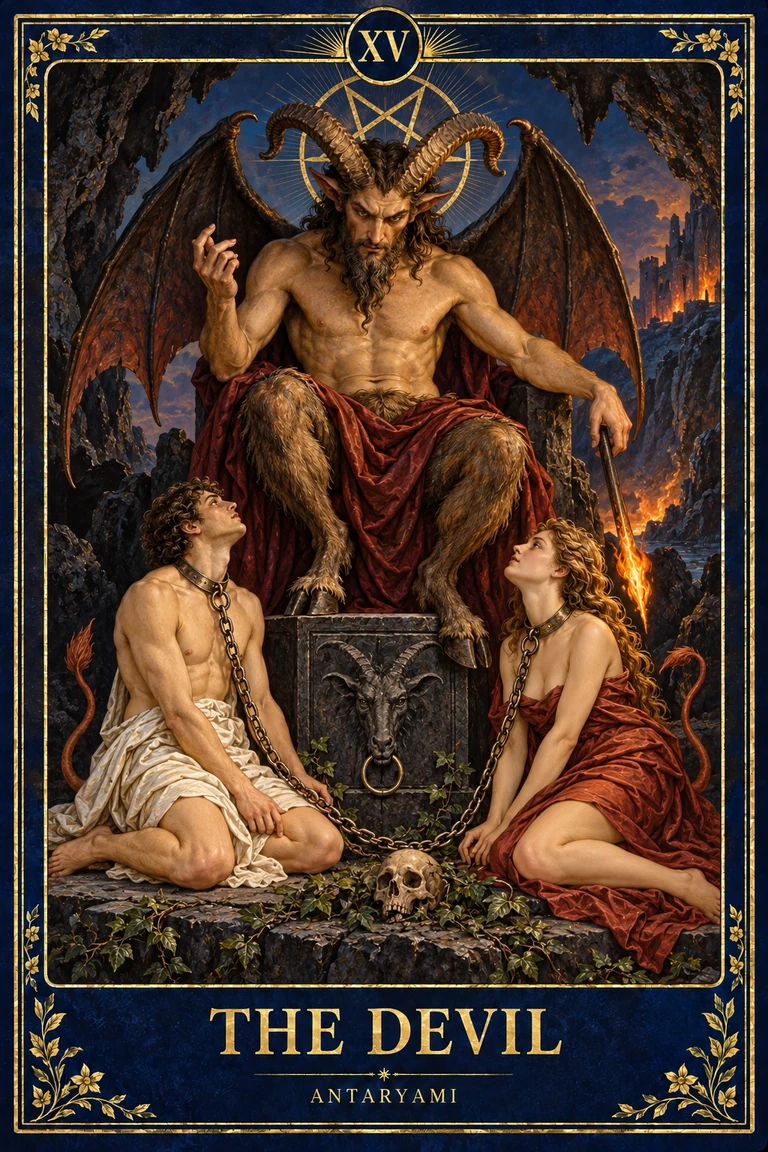
Antaryami's original Devil portrait places a horned, winged figure above two human figures connected by chains in a dark architectural setting. The composition makes unequal power easy to notice. As a visual prompt, you can ask what sustains the relationship and where a choice has become restricted. This is an interpretive exercise, not evidence that a real person is under occult influence. The card's dramatic features belong to its symbolism. They should not be used to diagnose a supernatural threat or justify paying someone to remove one.
Waite describes the batlike wings, inverted torch, ring and chains, and connects the human figures with other imagery in the deck. His discussion concerns material bondage within a mystical account, including the idea that the figure will not remain their master forever. That historical language does not establish a clinical theory of compulsive behaviour or a factual account of a reader's circumstances. The linked page helps identify his symbolic framework. Our contemporary examples concern ordinary choices and power structures, with their actual constraints kept in view.
A popular modern observation is that the figures' chains may look removable. Use that metaphor carefully rather than turning it into a judgment about people who face real coercion or dependency. In our image, the chain is visible; the available real-world options are not. A person may need resources, protection or assistance before change is possible. The card should not tell them that they are trapped only because they choose to be. Reflective interpretation becomes more responsible when it distinguishes a symbolic possibility of freedom from an assessment of someone's actual ability to leave.
Sources: Waite: The Devil, the chained figures and material-bondage symbolism
Upright: name the reward that makes the pattern difficult to question
An upright Devil reflection may be useful when you recognise a pattern but keep explaining away its cost. Start with the reward. Perhaps constant availability brings approval, an unnecessary purchase offers excitement or agreeing with a powerful person avoids an uncomfortable disagreement. Acknowledging the reward makes the pattern easier to understand. It is not a confession of bad character. You are examining why an arrangement persists, which can reveal what an alternative needs to provide if it is going to be realistic rather than merely admirable.
Suppose you accept every request because being indispensable feels reassuring. Over time, the workload becomes unmanageable and your own priorities disappear. A constructive reading might ask whether reliability has become confused with unlimited access to your time. You could define which requests you can fulfil, which need a later date and which require someone else. The goal is not to stop caring about others. It is to consider whether the form of caring has become dependent on a reward that no longer justifies the cost.
Honesty also includes what you do not know. A card cannot reveal another person's secret intentions or prove that a relationship is exploitative. Look at conduct, agreements and consequences. If the arrangement is harmful, appropriate help may be needed. If it is merely uncomfortable, a clearer conversation or boundary may suffice. The upright theme supports looking directly at the tension rather than disguising it as fate. What follows should be chosen from the real circumstances, not from a dramatic story in which the card has identified a villain.
Reversed: a wish for freedom becomes useful through a feasible next step
Reversed Devil interpretations often explore loosening an attachment, recognising a limiting pattern or resisting a change that would alter it. The orientation is not proof that a problem has been solved. A person can understand a pattern and still need time, support or a practical plan to change it. Ask what would make a different choice feasible. A declaration of freedom can feel powerful, but a workable next step is more informative: a changed commitment, a trusted conversation or access to the resources needed for a safer alternative.
For a manageable digital habit, that step might be removing a recurring prompt, choosing a limited time for checking or moving an app away from the first screen. These are examples, not treatment recommendations. Observe whether the change helps rather than assuming a reversed card has broken the pattern. If the behaviour causes significant distress or feels beyond your control, suitable professional support can matter. Tarot should not become a competing authority that tells you to solve a serious difficulty through willpower alone or avoid care because the symbolic chain is supposedly released.
Reversal can also reveal a fantasy of change without a change in the arrangement. You may promise yourself a boundary while continuing to accept the same requests automatically. Rather than treating this as hypocrisy, examine the obstacle: fear of disappointing someone, unclear authority or a practical dependence. Different obstacles need different responses. The card can keep the question visible, but it cannot supply missing resources. A humane reading allows progress to be uneven and does not label every setback as evidence that you have chosen bondage over freedom.
Relationships: attraction and attachment are not permission or proof of love
In relationship reflection, The Devil can prompt questions about attraction, possessiveness, dependency or an arrangement that makes it difficult to exercise choice. It should not be used to declare that a strong attraction is inherently harmful. Nor should attraction be treated as proof that a connection must continue. Desire, consent and commitment are separate questions. A reading becomes clearer when it asks what behaviour is occurring and whether each person remains free to set limits, rather than treating intensity as sufficient evidence of either destiny or danger.
Consider a connection in which one person expects immediate replies and interprets ordinary independence as disloyalty. The relevant issue is the expectation and its effect, not whether a card labels the person as dark or obsessive. You might need to clarify a boundary, examine the pattern or seek support depending on the circumstances. The Devil image cannot determine the safety of a confrontation. Do not let a symbolic explanation minimise intimidation or tell the affected person that they should simply remove the chain through confidence.
A card also cannot verify infidelity, hidden sexual conduct or another person's private thoughts. Accusing someone on that basis can cause real harm. If you have a concern, distinguish observations from assumptions and use an appropriate conversation or support process. Where contact is unwanted, respect that limit rather than describing the bond as too powerful to resist. The Devil's useful question is whether choice is being constrained, not whether a supposedly irresistible connection gives anyone permission to override another person's refusal.
Work and money: make the hidden cost visible before committing again
At work, The Devil may frame an incentive that rewards a pattern you no longer find sustainable. A culture may praise constant availability while treating rest or a reasonable boundary as disloyalty. Before assuming that the only answer is personal resilience, look at the actual expectations and your available options. You may need documentation, a conversation with an appropriate person or professional advice. The card can make a power question visible; it cannot assess employment rights or tell you that leaving immediately is safe or financially possible.
For a purchase or subscription, examine the full cost rather than only the immediate attraction. What renews, what is included, what can be cancelled and what obligation continues? A tempting offer is not automatically deceptive, but its suitability depends on those details and your circumstances. The image of a chain can remind you to read terms before accepting a recurring commitment. It is not a substitute for the actual contract or a reason to assume that every commercial offer conceals manipulation. Evidence must support any conclusion about the seller's conduct.
Avoid using this card to choose a risky financial strategy or to explain debt as a moral failing. Financial difficulty can involve structural constraints, unexpected expenses and other factors a reading cannot inspect. If an arrangement is already causing trouble, factual advice and practical assistance may be relevant. Tarot's attachment vocabulary should not shame the person or promise that a ritual will clear the obligation. A useful reflection asks what the commitment really requires and which legitimate options exist for addressing it.
The Devil, The Lovers and The Tower describe different tensions
The Lovers and The Devil both include relationships between figures, but our contemporary guides ask different questions. The Lovers can frame values, alignment and a freely considered commitment. The Devil can frame an attachment or power relation that makes choice harder to exercise. A meaningful commitment is not simply a chain, and an intense attachment is not automatically a considered commitment. Comparing the cards can help you ask whether an arrangement expresses your values or continues mainly because its reward or constraint is difficult to question.
The Tower introduces another angle: a disruption to an assumed structure. A Devil-themed reflection might concern a limiting arrangement that remains intact, while a Tower-themed reflection could examine what happens when a structure is suddenly challenged. These are not forecasts of a required sequence. You do not have to wait for a dramatic crisis before changing a manageable pattern. Nor does drawing The Devil mean a Tower event is approaching. The cards can provide different questions about a situation without forming an inevitable plot that your life must follow.
Pleasure deserves a final distinction. Enjoying food, company, ambition or material comfort does not make a person spiritually inferior. The issue in this guide is the relationship between enjoyment and choice, not a rule that desire must be eliminated. Ask whether the activity remains compatible with your responsibilities and wellbeing, using actual information rather than a moral accusation. A clear-eyed reading can appreciate what something gives you while noticing its costs. That is more constructive than dividing the world into pure choices and forbidden ones based on a single frightening image.
An Antaryami pattern exercise: describe the reward, cost and available support
When The Devil appears in Antaryami, keep the displayed position and orientation and choose a question that you can explore responsibly. You might ask which reward sustains a habit or where an agreement has restricted your choices. Do not ask the app to diagnose addiction, identify a curse or name a dangerous person from the card. A contextual explanation should distinguish symbolic themes from facts you have actually supplied. The image can be compelling without claiming to inspect private motives or provide an assessment that requires professional expertise.
For a manageable pattern, write three notes: what it gives you immediately, what it costs over time and what could support a different choice. A repeated approval check might give anticipation, cost concentration and become easier to change through a scheduled feedback conversation. Your own pattern may have very different conditions. Choose a modest next step and observe it without treating a setback as a moral verdict. If the situation involves coercion, significant distress or safety concerns, focus on appropriate support rather than trying to force a self-guided exercise to solve it.
This AI-assisted Antaryami Journal article is attributed to Nitish Raj Walia and Temior Technologies Pvt Ltd and reuses the original Devil portrait already made for our deck. Current product information remains the source for app access and availability. Let the card offer a candid question instead of an accusation: what keeps this arrangement in place, and what would increase your real freedom to choose? The answer may involve a boundary, a revised expectation or help from others. It does not require fear of an occult threat or shame about being human.
Understand the bond before deciding how to change it
A manageable habit gives a reward but disrupts my day
Name both the immediate reward and the longer-term cost. Consider a small environmental change or a different way to obtain useful feedback, then observe the result. This reflection is not a diagnosis or a substitute for support when a difficulty is significant.
Someone is restricting my choices or making me feel unsafe
Take the real conduct and your safety seriously. A chain metaphor does not establish that leaving is simple or that the constraint is your fault. Seek appropriate practical support; the card cannot assess the circumstances or prescribe a confrontation.
Astrological interpretations are for reflection, not a diagnosis, a guaranteed prediction or a substitute for professional advice. Journal guides are prepared with AI assistance; they are educational content, not individual consultations.


