 Antaryami
Tarot card meanings
The Tower tarot card: when an assumption breaks, protect people before rebuilding the plan
Some changes arrive politely. Others interrupt the story you were relying on. The Tower belongs to tarot's most arresting images: lightning, broken architecture and people displaced from a structure that once looked secure. In this Antaryami guide, Nitish Raj Walia explores what that image can teach about assumptions, disruption and rebuilding. It does not forecast an accident, disaster or inevitable personal collapse. Nor does it tell you that suffering is good because a lesson may follow. The constructive question is more careful: when something you relied on is challenged, what needs immediate protection and what must be understood before you build again?
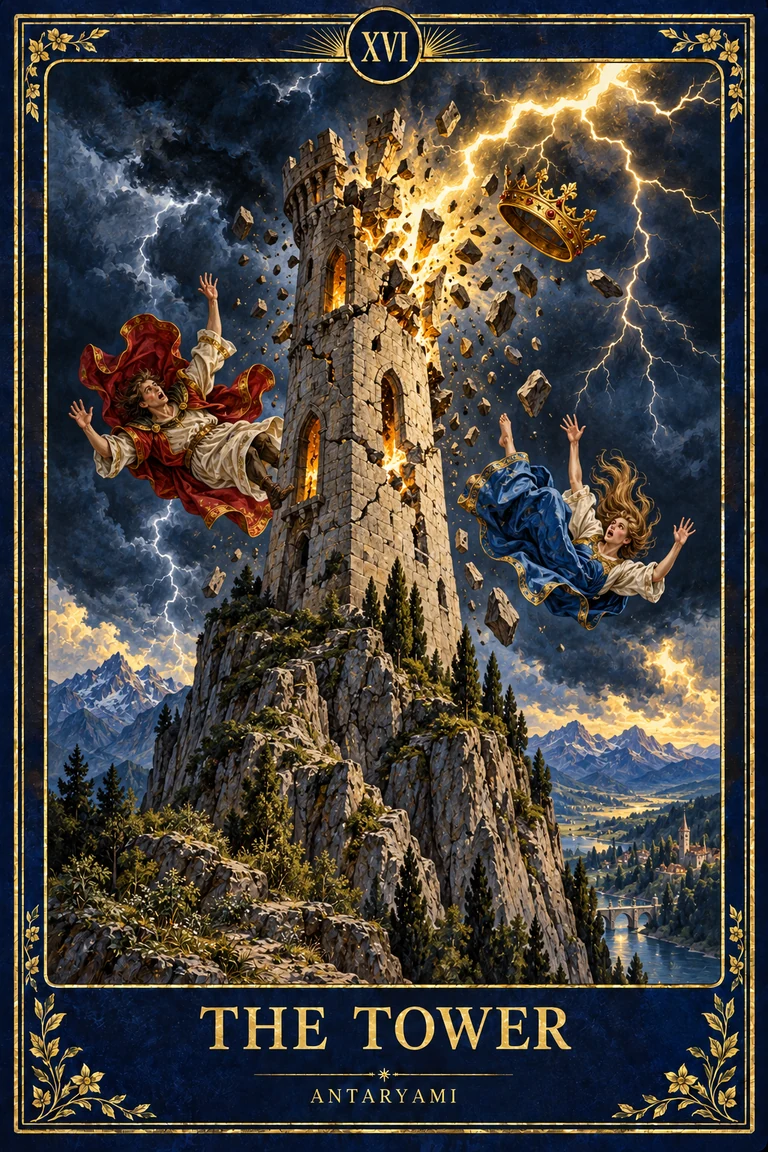
The Tower meaning: an assumed structure may not be as reliable as it seemed
Contemporary Tower interpretations often concern disruption, sudden recognition or the failure of a structure that appeared dependable. That structure might be a plan, an expectation or a story you tell about how a situation works. The card can help examine what happens when reality challenges it. This does not mean a disruption is about to occur because the card was selected. Begin with an actual situation or a clearly framed hypothetical question. A symbolic image should not send you searching anxiously for the disaster it must supposedly predict.
Imagine a project that depends on a file only one person can access. Everything works until that person becomes unavailable, and the team discovers that a routine assumption was a critical vulnerability. A Tower-themed reflection could examine the dependency and its consequences. The immediate task is to restore access appropriately and protect commitments; the later task is to improve the process. Neither task requires a story about cosmic punishment. The image can make the failure of an assumption memorable while the solution remains practical and specific.
In a challenge position, The Tower may prompt scrutiny of a fragile arrangement. In a resource position, it might frame a difficult but clarifying recognition that allows correction. Be cautious with that second angle: clarity does not cancel the cost of disruption. People affected may need time, support or compensation, depending on the circumstances. A useful interpretation can acknowledge a new understanding without calling the whole experience beneficial. The card should help you distinguish the information revealed from the harm caused, rather than pretending the former automatically justifies the latter.
Lightning and the displaced crown challenge the appearance of security
Antaryami's original Tower portrait shows lightning striking stone architecture, flames, a displaced crown and falling figures. The title is not the only intense part; the composition removes the distance between a damaged structure and the people depending on it. As our contemporary visual reading, the crown can prompt a question about authority or confidence resting on an unreliable base. The figures keep the human consequence visible. Do not reduce them to proof that pride deserves punishment, or assume that anyone facing disruption must have caused it through arrogance.
Waite discusses The Tower through several occult interpretations, especially the collapse of a house of doctrine or falsehood. His explanation is not merely a prediction that a physical building will fall. It concerns a symbolic and intellectual structure within his mystical framework. That distinction helps separate historical commentary from a literal disaster forecast. Our everyday examples apply a contemporary assumption-checking theme; they are not presented as Waite's own instructions for managing projects or relationships. The linked primary text allows you to see where the historical account differs.
The image's intensity can make every disagreement feel like a Tower event. Resist that inflation. A minor correction, a difficult conversation and a serious disruption differ in scale and consequence. Describing everything as collapse may prevent a proportionate response. Ask what has actually failed, what still functions and who is affected. A striking card can support attention, but it cannot measure severity. The most useful interpretation names the specific assumption that has been challenged instead of attaching the whole drama of the picture to an ordinary inconvenience.
Sources: Waite: The Tower and the collapse of a symbolic house of doctrine
Upright: establish what needs attention before searching for a grand meaning
An upright Tower reflection may fit a disruption that has already made an old plan unworkable. Before deciding what the event means for your whole life, identify immediate priorities. Which people need information? Which commitments are affected? What can safely continue, and what needs to stop? These questions reduce confusion without denying the emotional force of the moment. The card can frame the need for a response, but it does not supply emergency instructions or replace appropriate professional assistance where the circumstances require it.
For an ordinary organisational example, suppose an event venue cancels unexpectedly. The first task is not to prove that the cancellation happened for a reason. You need to contact participants, understand contractual details and consider realistic alternatives. Later, you can review why the plan relied on a single venue and whether a contingency would have helped. Separating response from review prevents an urgent problem from becoming an abstract debate while practical obligations are neglected. A Tower-themed question can support that sequencing without claiming that the replacement event will be better.
Upright recognition can also be quieter than the artwork. You may discover that a belief about your own work was based on incomplete feedback. That realisation can be uncomfortable without being catastrophic. Ask what the new evidence changes and what it does not. One correction does not invalidate every previous achievement. The image can encourage honest revision rather than defensive denial, but it should not push you into destroying a workable arrangement simply to demonstrate that you are brave enough to embrace dramatic change.
Reversed: review a vulnerability without inventing an approaching catastrophe
Reversed Tower readings often concern resisting a necessary recognition, containing disruption or avoiding an issue that already needs attention. Those themes should not become a claim that a hidden disaster is waiting. Focus on observable warning signs. Is a process repeatedly failing at the same point? Has an important concern been dismissed without examination? Are people concealing errors because the response is punitive? A reversal can frame the question, but evidence must establish whether there is a real vulnerability and how serious it is.
Consider a team that keeps fixing the same small error without asking why it recurs. The repeated patch may be appropriate temporarily, but the underlying cause deserves investigation. A reversed reflection could prompt a review of the process before the next cycle. That is different from predicting that the whole organisation will collapse. Proportion matters. Some vulnerabilities need a straightforward correction; others require a larger redesign. The card cannot classify them without the facts, and its dramatic reputation should not encourage an unnecessarily alarming conclusion.
Another reversed angle is fear of admitting that your previous view was mistaken. You may worry that acknowledging one flawed assumption will make you lose all credibility. In many manageable situations, a clear correction can be more trustworthy than a defensive explanation. State what changed, what you now understand and what you will do differently. This is an example of responsible revision, not a universal rule about how others will respond. If the context is consequential or unsafe, obtain appropriate advice rather than relying on the image to determine the right disclosure.
Relationships: a challenged expectation needs facts, consent and a proportionate response
In relationship reflection, The Tower may concern the discovery that an expectation was not shared. One person assumed a commitment; another understood the arrangement differently. That can be painful, but the card cannot determine which account is accurate or establish that the other person intentionally deceived you. Ask what was actually said and what was inferred. A clearer conversation may reveal a misunderstanding, a changed decision or a genuine breach. Those possibilities should not be compressed into a single dramatic accusation because the picture contains falling figures.
Suppose a friend makes a major decision without consulting you, and you feel excluded. The relevant question may be whether consultation was ever agreed or whether you had expected it silently. Your feeling still matters, but the factual distinction affects the conversation. A Tower-themed reflection could help you identify the expectation that was challenged and state it clearly. It cannot guarantee that the friend will share it in the future. Understanding a difference may lead to a revised boundary rather than restoring the exact arrangement you hoped was already in place.
If actual harm or intimidation is involved, attend to safety and appropriate support. Do not frame a harmful incident as a necessary spiritual demolition that you should welcome. Nor should the card command a breakup or demand forgiveness. Those choices require the real circumstances and the people affected. The image can accompany reflection on a disruption without becoming an authority over your relationship. A responsible guide preserves your ability to ask for help, maintain distance or take time before deciding what continued contact is appropriate.
Work: rebuild around verified dependencies rather than the old appearance of certainty
A Tower-themed work review can begin by identifying the assumption that failed. Was information unavailable, responsibility unclear or a promised capacity never verified? Describe the mechanism rather than attaching blame to the first visible person. A useful review examines both individual actions and the process that made the failure possible. It should not become a performance of humiliation. If people are afraid to report problems, the next vulnerability may remain hidden. The card can prompt honesty while the actual review needs fairness and relevant expertise.
Rebuilding does not always require replacing everything. You may need a documented handoff, a backup supplier or a clearer approval path. Preserve the parts that still work and test the revised dependency before declaring the plan reliable. A more impressive presentation is not proof of a stronger foundation. The Tower's visual contrast between height and instability can make that distinction memorable. Judge the revised arrangement by what it can actually do, including how it behaves when a normal dependency is unavailable, rather than by how reassuring it looks.
Do not use the card to forecast job loss, market collapse or the failure of a business. Those claims require evidence the image cannot provide. If real financial or contractual concerns exist, review the facts and seek suitable advice. An alarming card is not a reason to make an impulsive resignation, sale or purchase. The reflective theme can encourage checking a vulnerability and preparing responsibly, but it should not manufacture urgency so intense that you abandon the very verification the card's constructive interpretation is meant to support.
A useful lesson does not make every disruption necessary or deserved
It is possible to learn from a difficult event without claiming that the event was required. That distinction is central to this guide. A person may develop a new skill after a setback, but the skill does not prove the setback was good or deserved. Calling every Tower experience a blessing can silence legitimate grief, anger or a request for accountability. You can acknowledge what has become clearer while still recognising what should not have happened. Symbolic interpretation does not need to turn suffering into a promotional story.
Compare The Tower with Death and Wheel of Fortune. Death can frame a recognised ending and its transition; Wheel of Fortune can frame changing conditions; The Tower can focus attention on a challenged structure or assumption. One event may raise all three questions, but the cards are not an inevitable sequence. You do not have to suffer a collapse to make a thoughtful change. A manageable correction made early may be entirely sufficient. Nor does drawing a difficult card mean the next card must complete a predetermined drama.
If the image makes you anxious, stepping away is legitimate. Repeated draws to check whether disaster has been cancelled can increase attention to the fear without adding reliable information. You may prefer a different reflective practice or a less intense image. Tarot should remain a choice, not a loop in which you feel obliged to purchase reassurance. The Tower can be studied as art, history and symbolism while maintaining the simple boundary that it does not establish an impending catastrophe in the reader's life.
An Antaryami assumption audit: what failed, what remains and what needs checking?
When The Tower appears in Antaryami, read the actual position and orientation and anchor the question in a situation you can describe. You might explore which assumption needs verification or how to review a disrupted plan. Do not ask the app to predict an accident or identify the date of a personal crisis. A contextual explanation should keep its symbolic scope visible and avoid inventing dramatic events. For an actual emergency or a serious legal, financial or health concern, relevant real-world help takes priority over continuing the reading.
For a manageable planning problem, make three columns: the assumption that failed, the parts that still work and the next fact to verify. A cancelled venue might reveal reliance on one booking, leave the programme intact and require checking another location's capacity. That exercise narrows the response. You are no longer rebuilding your entire life; you are addressing a particular dependency. Add the people who need an update and the commitments requiring a decision. The practical value comes from those observations, not from an assertion that the card caused or foresaw the disruption.
This Antaryami Journal guide from Temior Technologies Pvt Ltd uses AI-assisted writing, Nitish Raj Walia's byline and our previously created original Tower portrait. Current product pages remain the reference for availability and access. Let the image sharpen your attention without taking over your sense of proportion. A structure can be questioned, a plan can be revised and a mistaken assumption can be corrected. What matters most is how you protect the people affected and rebuild from verified information, rather than how dramatically you describe the moment when certainty changed.
Respond to the actual disruption, not the whole drama of the image
A plan has already become unworkable
Identify immediate obligations, the people needing an update and the parts that can continue. Review the failed assumption after urgent practical needs are addressed. A useful lesson does not prove that the disruption was necessary, deserved or beneficial overall.
I am worried this predicts a disaster
The card does not establish an approaching accident or catastrophe. Step away if the image is distressing. Check real concerns through evidence and appropriate support rather than repeated draws intended to cancel a symbolic warning.
Astrological interpretations are for reflection, not a diagnosis, a guaranteed prediction or a substitute for professional advice. Journal guides are prepared with AI assistance; they are educational content, not individual consultations.


