 Antaryami
Tarot card meanings
The Emperor tarot card: structure should support people, not control them
Some situations need more inspiration. Others need somebody to say what happens next, who is responsible and where the limits are. The Emperor belongs to that second conversation. His throne makes authority visible, but authority is only useful when its responsibilities are visible too. In this Antaryami guide, Nitish Raj Walia explores structure without turning it into a celebration of domination. We look at upright and reversed interpretations, practical boundaries and the difference between creating a dependable framework and demanding that everyone surrender their judgment to the person sitting at its centre.
The Emperor meaning: dependable structure has a purpose
A contemporary Rider-Waite-Smith-inspired Emperor reading often concerns order, responsibility, leadership and boundaries. These themes can sound severe until you consider what a good structure makes possible. A clear agreement can prevent repeated arguments. A reliable schedule can protect time for rest. A named decision-maker can stop a team from waiting indefinitely for someone else to act. The card can invite attention to those practical arrangements, rather than suggesting that power itself is the goal or that strictness proves wisdom.
Imagine a shared workspace where everyone assumes somebody else will maintain the equipment. The problem is not necessarily a shortage of goodwill. Responsibility has not been assigned clearly enough to become dependable. An Emperor-themed question would ask who maintains what, when and with which resources. The resulting arrangement should be understandable and open to review. A framework that exists only in one person's head cannot reliably support the people expected to follow it. Good order includes explanation, not merely enforcement.
In a spread position about support, The Emperor may bring a useful boundary or organisational skill into view. In a challenge position, it may prompt examination of rigidity or an authority that has outgrown its purpose. Neither reading establishes that a particular person is a leader, a tyrant or a father figure. Compare the image with observable arrangements and behaviour. Tarot language is most helpful when it leads to specific questions that can be answered without assuming the card has classified everyone involved.
The throne and ram imagery: authority made visible
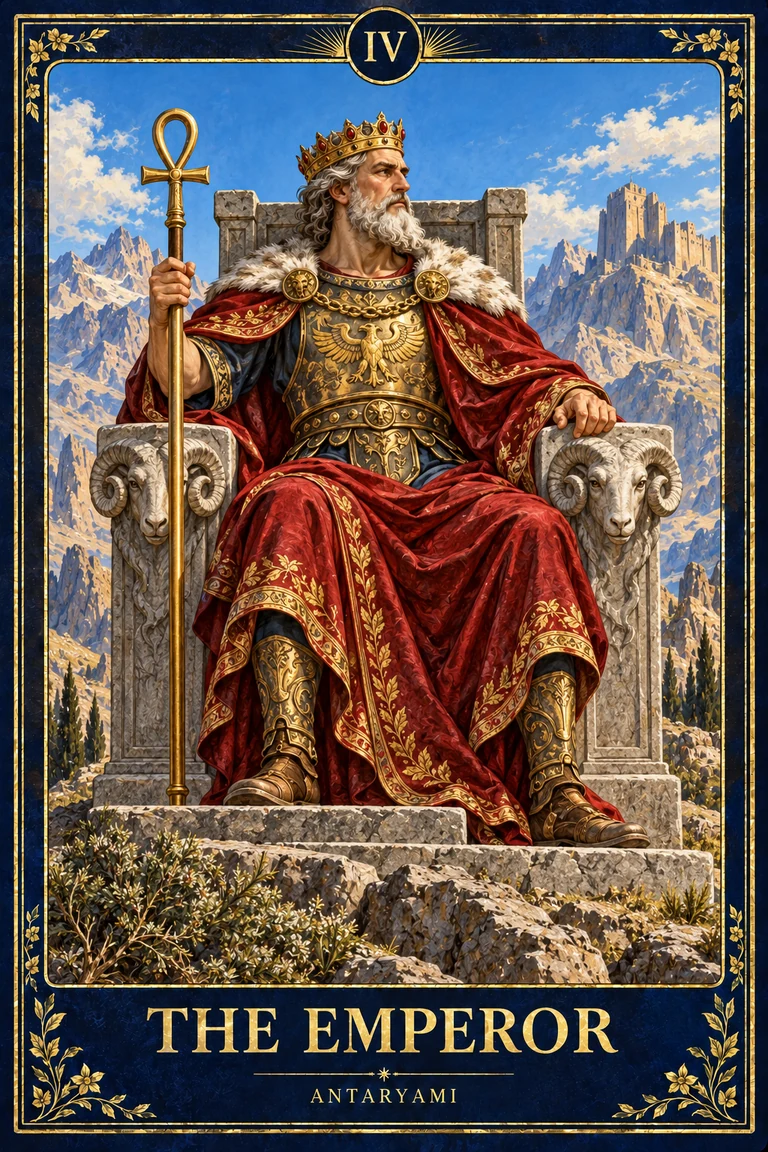
Antaryami's original illustration shows a crowned ruler, a substantial stone throne, ram motifs and a rugged landscape. The composition feels more formal and resistant than the cultivated garden around The Empress. As a modern visual exercise, you can ask what is being held steady and what movement the arrangement permits. Solidity may protect something valuable, but it can also make adaptation difficult. The picture invites that comparison without telling you which side describes your workplace, household or relationship.
Waite's historical account identifies the ram-headed throne, globe and distinctive sceptre, and discusses executive power and realised intention. That account provides a named historical reference for the Rider-Waite-Smith symbolic family. Our discussion of agreements and accountable leadership is a contemporary interpretation, not a transcription of his doctrine. Antaryami Museum Tarot uses original AI-generated art with its own costumes and setting. Its traditional motifs should not be mistaken for a certificate of historical exactness or an empirical model of human authority.
Some tarot systems connect the ram symbolism with Aries. That is an interpretive attribution, not evidence that the person reading this page has an Aries placement or should obey an Aries individual. A card picture does not calculate a horoscope. Likewise, the number four can support a metaphor of stability without proving that every person associated with four is orderly. Keep those associations within their named systems. The Emperor can be interesting on its own terms without borrowing the language of mathematics or astronomy to make an unsupported claim.
Sources: Waite: The Emperor scene and historical interpretation
Upright: make the agreement clear enough to use
An upright Emperor reflection can be useful when a recurring problem needs a repeatable arrangement. Suppose a group shares a responsibility but discussions become personal every time something is missed. Define the task, the owner and the review point before another disagreement occurs. That does not remove the need for kindness; it reduces the ambiguity that can turn ordinary failures into accusations. A good agreement describes what happens when somebody cannot fulfil it, rather than pretending that responsible people never encounter difficulty.
For someone managing a personal project, the upright theme might mean choosing a realistic deadline and protecting the work needed to meet it. Not every hour needs a rule. Start with the bottleneck: the decision, appointment or task that repeatedly gets displaced. A small framework can be more effective than an elaborate routine you cannot maintain. The card's solidity becomes practical when it supports a specific intention. It should not become an invitation to punish yourself whenever your actual capacity differs from your ideal plan.
Leadership also involves making a decision when enough relevant information is available, while stating what remains uncertain. Waiting forever can burden everyone who depends on the outcome. Yet acting decisively does not require pretending to know more than you do. You might choose a provisional arrangement, record its assumptions and set a review date. That gives people something reliable to work with while leaving room for correction. The Emperor's constructive theme is responsibility that can be examined, not a performance of absolute certainty.
Reversed: ask whether the framework has become the problem
Modern reversed Emperor interpretations can explore controlling behaviour, brittle rules, absent accountability or an inability to organise effectively. Those are not all the same pattern. One situation may need a limit on an overbearing authority; another may need someone to take responsibility instead of avoiding it. Begin with what actually happens. Who can question the arrangement? Who carries the consequences when it fails? Does the rule serve a clear purpose? The reversed card cannot answer those questions, but it can help you formulate them.
Picture a manager who changes the standard after work has been completed and then calls the team unreliable. The practical issue is an unstable expectation hidden inside a rigid tone. An Emperor-themed reflection might ask for the criteria to be written before the next task begins. This does not prove that the manager has malicious intentions. It identifies an arrangement that can be discussed and improved. Clear documentation may also reveal a legitimate requirement that had not been communicated well, which is a different issue from deliberate control.
Now consider a household where every difficult choice is postponed because nobody wants to seem demanding. Here the missing structure may be the problem. A shared agreement about expenses or responsibilities can be respectful rather than authoritarian. Do not apply the same advice to both examples merely because the orientation matches. Reversed readings need context, and context includes who has power, who can leave and whether the conversation is safe. If a situation involves harm or coercion, appropriate real-world support matters more than finding a reassuring symbolic interpretation.
Relationships: a boundary describes your participation, not someone else's ownership
In relationship reflection, The Emperor can bring consistency, responsibility and boundaries into focus. A boundary might concern availability, privacy, money or the kind of conversation you are willing to have. It becomes clearer when stated in terms of your own participation. You can explain what you will do if an agreement is not respected, but a tarot card does not grant control over another adult's friendships, choices or private information. Dependability is different from possession, even when both are described with the language of protection.
An established couple might discover that vague expectations about practical tasks have become a recurring source of resentment. The useful exercise is to make the work visible and distribute it by agreement, not to assign authority based on the card's gendered image. Neither person has to become the symbolic ruler. The question is which arrangement both can understand and maintain. Responsibility may be shared, rotated or divided according to circumstances. A structure should serve the relationship rather than forcing the relationship to imitate a throne room.
For a new connection, do not read The Emperor as proof that a person will commit, provide financial security or become an ideal partner. Those expectations can outrun what the person has actually offered. Observe consistency, discuss needs and allow time for trust to develop. The card can prompt you to ask what dependable behaviour looks like to you. It cannot guarantee that someone else will supply it. A clear standard is useful; a prediction that removes the need to evaluate behaviour is not.
Work: leadership includes a way to question the leader
At work, an Emperor-themed discussion may ask whether decisions have an owner and whether people know how to raise a concern. A framework becomes more trustworthy when accountability travels upwards as well as downwards. If a deadline is impossible because resources were not supplied, the explanation should not stop at the person closest to the unfinished task. Examine the decision that created the conditions. The card's authority theme can support that inquiry without certifying that a particular organisational model will succeed.
A practical project example is defining completion before work begins. What must be delivered, who approves it, and which changes count as new scope? These questions can protect collaboration from endless reinterpretation. They also make it easier to distinguish a missed requirement from a changing requirement. The resulting record need not be elaborate. It must simply be clear enough for the people doing and accepting the work. Structure earns its place by reducing confusion, not by adding ceremonial paperwork that nobody can use.
For financial or legal questions, keep the symbolism outside the professional decision. The Emperor cannot establish that a contract is enforceable, that an investment is secure or that a person has legal authority. Review actual documents and seek qualified advice where appropriate. A card associated with order can make an unreliable offer feel reassuring if you do not separate the two. The constructive use is to ask what needs to be documented and verified, not to treat the appearance of a throne as evidence that everything has already been secured.
Is The Emperor a person, a role or a situation?
Readers sometimes identify The Emperor with an influential person, but that is an interpretation to test, not an identification supplied by the deck. It may be more useful to read the card as a role you are temporarily occupying or a structure you are interacting with. You might organise a project at work while preferring a flexible routine at home. Human behaviour changes with context. Reducing someone to an Emperor personality can hide the details that determine whether their authority is helpful or harmful.
The card's masculine figure is also not a command to assign leadership to men. People of any gender can create order, take responsibility or misuse power. Historical imagery reflects its cultural setting; a contemporary educational guide can explain it without endorsing every hierarchy associated with that setting. If you find the ruler image alienating, ask whether the practical theme of accountable organisation is still useful. You do not have to admire the character to learn from the tension the picture makes visible.
Compare The Emperor with The Hierophant. In this series, the Emperor foregrounds operational structure and responsibility, while the Hierophant foregrounds taught systems, shared tradition and institutional authority. They can overlap, but a schedule is not a doctrine and an inherited practice is not automatically a well-run process. The distinction helps you ask whether a problem concerns organisation, belief or both. It is more precise than treating every formal figure as the same message that rules must be followed.
An Antaryami structure check: name the owner, limit and review point
When exploring The Emperor in Antaryami, keep the spread's position and selected options attached to the interpretation. A card shown as a challenge may prompt a different question from one shown as a resource. The daily selection should not be confused with an interactive shuffled draw. You can ask where clearer responsibility would help or which rule needs reconsideration. If you use contextual Ask, describe the card and the specific arrangement you are reflecting on rather than asking the system to classify a person it does not know.
Choose one recurring source of confusion and write three things: who is responsible, which boundary applies and when the arrangement will be reviewed. A shared errand might need a named owner; a project might need an approval limit; a personal routine might need a deadline that can be adjusted when circumstances change. Then check whether the people affected understand and accept it. The exercise is not a binding contract or legal advice. It is a way to make an ordinary expectation visible enough to discuss.
This Antaryami Journal guide for Temior Technologies Pvt Ltd carries Nitish Raj Walia's byline and original branded Emperor artwork, with its historical reference separated from contemporary examples. Check current app availability through the app page rather than inferring access from an article. Let the ruler leave you with a question about service: what does this structure make possible, and for whom? Authority is most useful here when it reduces confusion, acknowledges its limits and remains accountable to the people living within it.
Inspect the framework, not just the person in charge
Everyone assumes someone else will handle the task
Name the task owner, the resources needed and the date for checking completion. Clarify what happens if the owner cannot do it. This is the Emperor as usable structure, not as an order to become harsher with everyone.
The rules are strict but keep changing
Ask for the criteria to be recorded before the next commitment and distinguish new requirements from missed requirements. The card cannot determine motives; a clearer record can make the actual arrangement easier to evaluate.
Astrological interpretations are for reflection, not a diagnosis, a guaranteed prediction or a substitute for professional advice. Journal guides are prepared with AI assistance; they are educational content, not individual consultations.


