 Antaryami
Tarot card meanings
The Hierophant tarot card: learn the tradition, then ask what it serves
Nobody learns everything alone. We inherit methods, ask teachers for help and enter communities where knowledge has already been organised. The Hierophant gives that process a ceremonial image: a teacher, listeners and symbols of an established system. This Antaryami guide by Nitish Raj Walia explores the value of learning from a tradition without assuming that age or authority makes every claim correct. The card's central tension is worth keeping: a framework can open a door, but it can also become a gate that nobody is allowed to question.
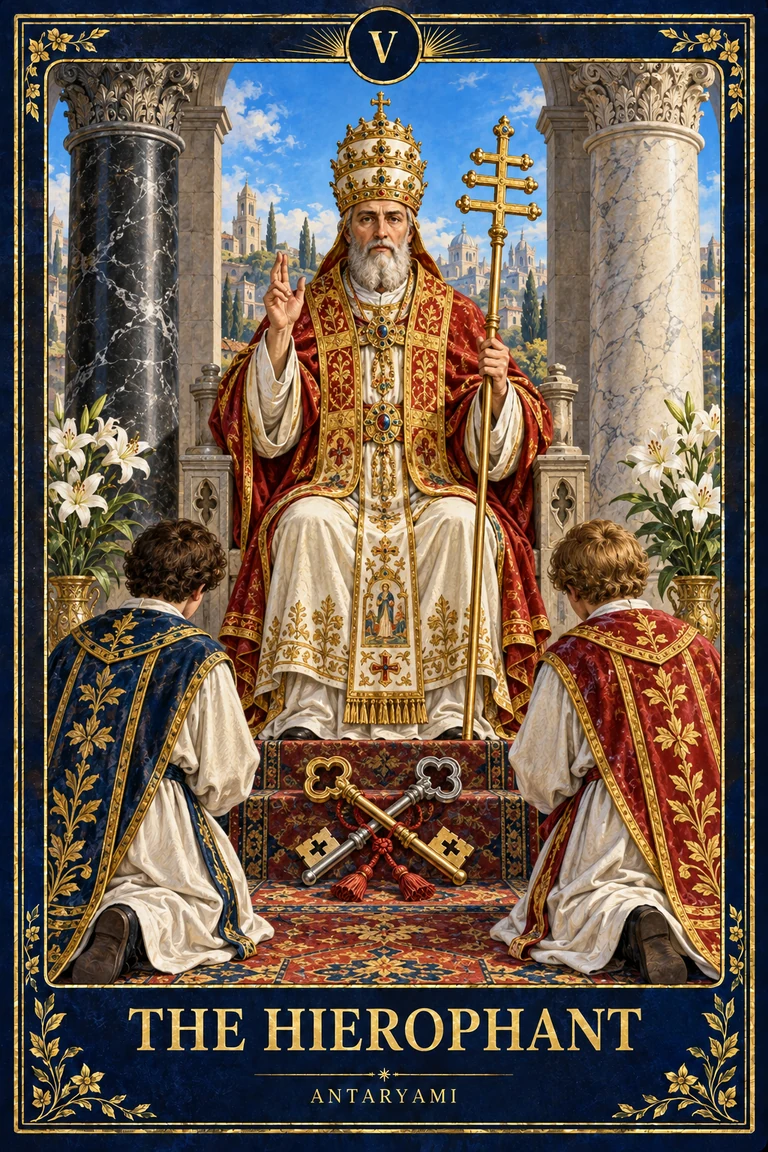
The Hierophant meaning: knowledge received through a system
Contemporary Rider-Waite-Smith-inspired readings often connect The Hierophant with teaching, shared values, established practice, institutions and formal commitment. These themes concern how knowledge and expectations are transmitted. A course has a sequence; a profession has standards; a community has practices that help its members recognise one another. The card can prompt you to ask which system you are entering and what participation involves. It does not certify that the system is wise, safe or appropriate merely because it has a recognised name.
Imagine learning a craft from someone experienced. A standard method may spare you years of avoidable mistakes, and a teacher can explain why a step matters. There is real value in that inheritance. At the same time, you should be able to distinguish a practical requirement from a personal preference and ask where the method's limits lie. The Hierophant can frame a relationship with learning that is respectful without being passive. Receiving instruction does not require surrendering every question you have about it.
In a resource position, the card might invite attention to a mentor, curriculum or shared practice that could help. In a challenge position, it might raise concerns about conformity or an institution that discourages scrutiny. Those readings depend on the question and the circumstances, not just the upright title. Before deciding that the card tells you to join or leave something, identify what you need to learn, what the system offers and what evidence would help you assess the fit.
The crossed keys and listeners: access, teaching and responsibility
Antaryami's original Hierophant artwork shows a central ceremonial figure, two listeners, pillars and crossed keys near the base. The composition is public and organised, unlike the more inward threshold of The High Priestess. A modern reflective reading can ask how access to knowledge is arranged. Who teaches, who listens and who is permitted to advance? These questions are inspired by the picture, not answers encoded in it. A key motif can suggest access without proving that the card unlocks hidden information.
Waite identifies the triple crown, triple-cross sceptre, crossed keys and two ministers, and discusses the outward institutional expression of religious authority. His text supplies a historical explanation of the Rider-Waite-Smith design. Our examples of courses, professional standards and community practices are contemporary extensions, not quotations from that account. Antaryami Museum Tarot presents newly generated artwork inspired by this tradition rather than a historical facsimile. The design's familiar motifs do not certify the legitimacy of a modern teacher or organisation.
Religious imagery deserves particular care. The card depicts a tradition-specific character; it does not rank religions, establish divine approval or tell a reader which faith to adopt. People can learn about the image without sharing its theology. Likewise, using an astrological app does not make every tarot symbol part of Vedic doctrine. Keep the instrument and source tradition named. Respectful explanation makes room for cultural difference instead of merging distinct systems into a vague claim that all authorities secretly say the same thing.
Upright: use a method you can actually learn and examine
An upright Hierophant reflection may be useful when you are trying to learn through fragments. Perhaps you watch many short tutorials but cannot connect the steps into a usable skill. A structured course, a good textbook or an appropriate teacher could supply the sequence you are missing. The card can prompt the question of what foundation needs to be built. It does not select the provider for you. Compare the teaching, requirements, costs and relevant evidence before making a commitment.
For someone entering a workplace, the theme may concern understanding conventions before dismissing them. A process that seems tedious could preserve safety, prevent repeated mistakes or support collaboration across a large team. Ask why it exists and how it is meant to work. That inquiry can reveal both legitimate purposes and outdated habits. Learning the explanation puts you in a stronger position to contribute. It is more useful than assuming that every inherited procedure is either sacred or foolish before you have examined it.
Shared rituals can also have ordinary social value. A recurring family meal or community gathering may create a dependable opportunity for connection. You can appreciate that role without claiming the ritual guarantees harmony or good fortune. Participation should remain compatible with consent and the circumstances of those involved. A tradition becomes more hospitable when people can discuss its meaning and practical demands. The upright card can encourage thoughtful belonging, not compulsory participation enforced by guilt or by a supposedly authoritative reading.
Reversed: questioning a system is not the same as refusing to learn
Modern reversed Hierophant interpretations may explore restrictive conformity, a mismatch with conventional expectations or the need to examine inherited beliefs. None of these automatically means that every institution is harmful. Sometimes a reader needs a different learning path; sometimes they need to understand a standard more carefully; sometimes a genuine abuse of authority requires attention. Begin with the specific issue. What expectation is being challenged, what purpose is claimed for it and who bears the cost of following it?
Consider a student told that asking for the reasoning behind an instruction shows disrespect. The useful question is whether the environment supports understanding or merely obedience. A practical response could be seeking a teacher who can explain the method's purpose and limits. Yet not every brief instruction is an attempt to suppress inquiry. There may be a time-sensitive task followed by a suitable opportunity for discussion. Context keeps the reversed reading from turning every disagreement into a grand conflict between freedom and oppression.
Another example is someone who rejects every course because being taught feels like losing independence. An alternative path may suit them, but it still needs a way to test understanding and discover mistakes. Self-direction is not self-verification. Ask where feedback will come from and what standard the work must meet. The Hierophant's challenge can then become a better relationship with learning rather than an identity built around refusing all guidance. Independence grows through informed choices, not through treating every source of instruction as an enemy.
Work: standards matter, and claims about credentials need checking
At work, the Hierophant theme may concern training, certification, professional practice or learning how an institution operates. Some tasks require specific qualifications or standards for good reasons. A tarot card cannot establish that a person holds them, that a certificate is recognised or that a service meets a regulatory requirement. Verify those matters through the appropriate records and authorities. The symbolic question is which established knowledge you need; the factual question is whether a particular provider can legitimately supply it.
A team might use the theme to examine how newcomers learn. Are important instructions written down, or does every person have to discover them through avoidable mistakes? A useful improvement could be a concise explanation with examples and a way to ask questions. That is knowledge transmission in a practical form. It need not become a large training programme. What matters is whether the material helps people perform the work safely and consistently, while making the limits of the instruction visible.
Be cautious when a seller uses a spiritual lineage, impressive title or ancient origin story to discourage scrutiny. A tradition may be meaningful without making every commercial claim true. Ask what is being offered, what it costs and what evidence supports any consequential promise. Do not buy a course or service because a card seems to endorse the provider. Financial, medical and legal matters need appropriate professional judgment. Respect for learning includes the willingness to recognise when a claimed authority is outside its competence.
Does traditional mean correct? Not automatically
Tradition describes transmission across time or through a community; it does not independently validate every assertion being transmitted. A practice can have historical significance, aesthetic value or personal meaning without proving a forecast. This distinction lets you take cultural knowledge seriously while asking appropriate questions about evidence. The Hierophant can be read as an image of that tension: a meaningful inheritance arrives through a human system, and human systems can preserve insight, repeat mistakes or contain both.
The same caution applies when tarot appears beside astrology and numerology. These instruments have different histories, vocabularies and mechanisms. Calling them all wisdom does not make their claims equivalent or mutually confirming. In Antaryami's educational setting, a tarot attribution should remain recognisable as a tarot attribution. You can compare a theme across instruments for reflection without saying that a card, number and chart have independently proved the same personal outcome. Similar language is not the same as independent evidence.
The Hierophant also differs from The Emperor. One can organise a reliable workflow without teaching a doctrine, and one can inherit a doctrine within a poorly organised institution. In this series, the Hierophant foregrounds shared teaching and accepted conventions; the Emperor foregrounds structure and responsibility. Comparing the two helps you identify whether the issue is how work is arranged or how an expectation is justified. That sharper question is more useful than deciding that both simply mean an authority figure has appeared in your life.
An Antaryami learning map: inherited, chosen and still unexamined
When reading The Hierophant in Antaryami, name the position and keep the question specific. You might ask which learning framework would help, or which expectation needs explanation before you accept it. The daily card and shuffled spread should remain distinct, and reversal settings belong to the interpretation you are discussing. A contextual Ask response can explain the theme, but it cannot verify a teacher's identity, approve a contract or determine which belief you must hold. Those questions need their own sources of information.
Try writing three lists: expectations you inherited, practices you have deliberately chosen and questions you have never examined. Select one item from the last list and ask what purpose it serves, who benefits and whether its current form is necessary. A workplace convention might turn out to solve a real coordination problem. A personal custom might be valuable but adaptable. You do not need to reject everything to learn something new. The exercise aims for understanding rather than a dramatic declaration of allegiance or rebellion.
For Temior Technologies Pvt Ltd, this Antaryami Journal article combines the Nitish Raj Walia byline with individual original Hierophant art and a clearly named historical reference. Consult the app page for actual release and access information; a guide is not proof that every feature is available now. Leave this card with a more deliberate relationship to authority: learn what can genuinely help, ask how it works and retain the freedom to decide that a particular system is not the right one for you.
Choose a question about the system
I keep collecting fragments but cannot build the skill
Identify the foundation that is missing and look for a coherent teaching sequence with useful feedback. Check the provider and requirements separately. The Hierophant can frame the value of instruction without certifying any particular course.
I follow an expectation but do not understand its purpose
Ask what the expectation is meant to preserve, who it affects and whether an alternative could serve the same purpose. Understanding may support keeping, adapting or declining it. None of those choices is settled by the card alone.
Astrological interpretations are for reflection, not a diagnosis, a guaranteed prediction or a substitute for professional advice. Journal guides are prepared with AI assistance; they are educational content, not individual consultations.


