 Antaryami
Tarot card meanings
The Empress tarot card: care is the environment in which something can grow
A good idea rarely grows because someone praises it once. It needs conditions: time, material, attention and permission to develop beyond its first awkward shape. The Empress brings those conditions into a rich landscape of wheat, water and shelter. In this Antaryami article, Nitish Raj Walia explores the card through creativity, care and the practical meaning of nourishment. We also make the limit explicit from the beginning: an image associated with growth does not predict pregnancy, measure fertility or tell you what another person's body can do. Its value here is symbolic and reflective.
The Empress meaning: ask what growth needs around it
Contemporary Rider-Waite-Smith-inspired readings commonly connect The Empress with nurture, creative development, material comfort and abundance. These words become more useful when you ask what supports the thing you want to grow. A garden needs more than admiration, and a relationship needs more than an affectionate label. The card can invite attention to the surrounding conditions, including whether they are sufficient, sustainable and freely offered. It is not a promise that every effort will flourish or that every period of life should be productive.
For example, you may want to write more but have nowhere quiet to work and no manageable schedule. An Empress reflection could ask whether you have made a hospitable place for the practice. That might mean a small protected hour, a simple notebook or permission to create an imperfect draft. The answer need not involve luxury. Nourishment is often ordinary and specific. Something modest that reliably supports a process may matter more than a beautiful arrangement you cannot maintain.
It also matters who supplies that support. If one person always absorbs the cost of everyone else's comfort, calling the environment abundant can hide an unfair distribution of effort. The card's caring theme is strongest when care includes the caregiver's limits. In a resource position, it may highlight what helps you develop; in a challenge position, it may prompt examination of excess, dependency or neglected maintenance. Keep the position connected to the question instead of allowing a lush picture to mean that everything is automatically well.
The wheat, water and starry crown: imagery with a named tradition
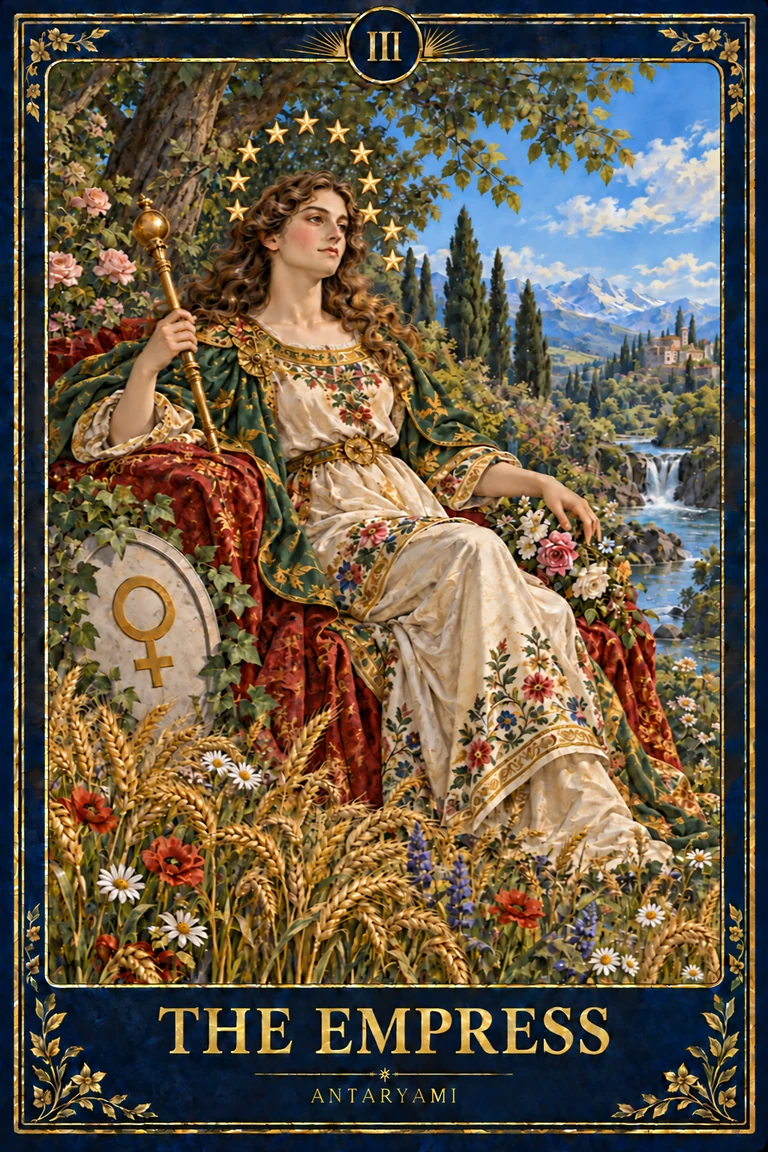
Antaryami's original Empress illustration shows a seated figure within a cultivated landscape, a visible twelve-star halo and a shield bearing the Venus sign. The scene makes growth tangible rather than abstract. Wheat suggests something that must be tended through a process; water suggests a continuing source of support. These are reflective readings of the composition. They do not encode an agricultural forecast, a biological test or a guarantee about a customer's home. Let the picture offer a question without treating it as a measurement.
Waite's historical description identifies a twelve-star diadem, the Venus symbol, ripening grain and falling water. His account gives the card a spiritual and symbolic vocabulary that belongs to its period. Our discussion of creative environments is a contemporary interpretation beside that source. The artwork is newly generated and branded for Antaryami Museum Tarot, not a facsimile of Pamela Colman Smith's illustration. A shared motif can retain a recognisable tradition while appearing in an original landscape and costume.
A Venus sign also does not mean that the card has calculated a Venus placement. Tarot imagery and astrological calculation perform different jobs. Some interpretive traditions connect them, but such a connection should be labelled as an attribution rather than scientific evidence. You cannot determine someone's natal Venus, compatibility or purchasing prospects from the picture alone. This distinction is especially important in a product that offers several instruments: the beauty of a visual bridge should not erase the boundaries of the methods it connects.
Sources: Waite: The Empress imagery and historical symbolism
Upright: sustain a process instead of demanding an instant result
Imagine a person learning to bake bread. They keep changing recipes after every imperfect loaf, expecting a new instruction to solve everything. An Empress-themed approach might be to slow down, understand the ingredients and allow one method to be practised carefully. The nourishment is not a mystical force; it is a better environment for learning. A single disappointing attempt does not make the person incapable, and an attractive card does not guarantee the next loaf. Attention to conditions gives the practice a fairer chance to develop.
For a community project, the upright theme could ask whether people have the resources to participate. A welcoming announcement is not enough if the meeting time excludes everyone with caring responsibilities or the instructions are difficult to follow. Look at access, clarity and the work needed behind the scenes. The Empress can become a prompt to make something genuinely hospitable. That includes noticing whom your preferred arrangement does not serve, rather than assuming that a warm intention has already met every need.
Creative care also includes rest and non-commercial activity. Not every drawing, meal or conversation needs to become a product. You may enjoy making something because the process itself matters. A card associated with abundance should not become another demand to extract value from every moment. Sometimes an upright reading offers permission to cultivate a practice that remains private or playful. The relevant question is whether it supports your life, not whether it can be displayed as evidence that you are always growing.
Reversed: notice depletion, smothering and comfort without maintenance
Modern reversed Empress interpretations may explore creative blockage, neglected care, overgiving or support that has become controlling. These themes need different responses. A depleted person may need help; an overmanaged project may need room to breathe; a comfortable routine may need a neglected responsibility addressed. The reversed orientation cannot diagnose the cause. Start with the real conditions and ask which interpretation, if any, is relevant. There is no obligation to find a problem simply because the image is upside down.
Consider someone who says yes to every request because being needed has become their main way to feel valued. The card can frame a question about whether care has lost its limits. A practical step might be to state what help is available and what is not, rather than disappearing or becoming resentful. This is not a diagnosis of the person's psychology. It is an example of how a symbolic theme can lead to an observable agreement. Sustainable support requires enough honesty for other people to know its boundaries.
Another reversed example is a creative project revised so often by its sponsor that nobody can finish it. The intention may be to improve quality, but excessive intervention can prevent the work from acquiring its own shape. Ask which decisions need guidance and which can be entrusted to the person doing the work. Nurture is not synonymous with constant correction. Sometimes the most supportive change is to define a clear standard, supply what is needed and allow a competent collaborator to proceed without being watched at every step.
Relationships: warmth matters, and reciprocity matters too
In relationship reflection, The Empress can bring attention to affection, generosity and the everyday gestures that make a connection feel cared for. A remembered preference, an attentive conversation or a meal shared without distraction may matter more than an expensive performance of romance. But the card cannot certify love or determine whether a relationship will last. Look at whether care is mutual, welcome and consistent. A symbolic image should help you examine the relationship you have, not replace it with an idealised story.
There can also be a useful question about receiving. Some people offer support easily but feel uncomfortable accepting it. You might notice whether you dismiss every kind gesture, apologise for ordinary needs or assume that help must immediately be repaid. An Empress-themed exercise could be allowing one appropriate offer without converting it into an obligation. Yet receiving is not automatically healthy in every context. A gift used to pressure, control or create unwanted access is not made benevolent by a tarot interpretation.
Avoid using the card's traditional feminine imagery to impose a role on anyone. Caring ability, creativity and appreciation of comfort are not exclusive to one gender, and a person does not owe parenthood or domestic service because a card appears. Read the figure as a symbolic character within the deck, not as a rule for who the reader must become. The most respectful relationship question is what kind of care each person wants and can offer, with room for different preferences and legitimate limits.
Work: cultivate quality without confusing abundance with revenue
A workplace Empress reflection can ask about the environment in which useful work is expected to happen. Are instructions clear? Is the necessary equipment available? Is someone expected to produce a polished result while constantly being interrupted? The card does not diagnose an organisation, but it can make a broad complaint more specific. Instead of saying that creativity has disappeared, identify which condition is missing. A concrete request about time, feedback or resources is more actionable than a claim that the team's energy has become blocked.
For a business, abundance should not be confused with guaranteed sales. Attractive design, a caring tone and a rich product experience may be valuable, but commercial results depend on many factors outside the card. Assess demand, cost, delivery and honest customer feedback. The Empress can inspire a question about whether the product is genuinely useful and supported after purchase. It cannot calculate profit, validate a pricing model or assure you that a launch will succeed because it occurs under a favourable symbol.
At a personal level, the card may invite appreciation of what is already sufficient. That need not mean ignoring financial constraints or pretending everyone has equal resources. A thoughtful reading can acknowledge lack while asking what support is realistically available. Avoid purchasing something unaffordable merely to enact the idea of abundance. Material wellbeing is not demonstrated by spending as if circumstances were different. Practical decisions about money should rest on actual means, terms and relevant professional advice, not on the emotional appeal of a lush illustration.
Does The Empress predict pregnancy? No: symbolic growth is not a medical result
The word fertility appears in historical and modern discussions of this card, but it must not be turned into a claim about a person's reproductive health. A tarot image cannot detect pregnancy, predict conception, assess fertility or determine fetal sex. If those questions matter to you, seek appropriate clinical care. The presence or absence of The Empress has no evidential role in a medical answer. This boundary should remain clear even when a reader finds the image emotionally meaningful during family planning.
Nor should a reversed card be used to suggest that a person is infertile, insufficiently feminine or responsible for a disappointing outcome. Those interpretations can cause harm and attach blame where the picture supplies no knowledge. The symbolic vocabulary of growth can instead be used for a creative practice, a caring relationship or the conditions around a project. Even there, it remains metaphorical. Moving to a safer topic does not turn the same card into a validated predictor of another kind of result.
The Empress and The Emperor also deserve to be compared without making them a compulsory couple. This guide uses the Empress to examine nurture and conditions for development; the Emperor can examine structure, responsibility and limits. A person or project may need both kinds of question at different times. They are not fixed assignments based on gender, marital status or family role. Learning the distinction adds vocabulary to reflection while leaving real people free to define how they care and organise their lives.
Your Antaryami growth note: what needs tending, and who pays the cost?
When The Empress appears in Antaryami, start with the spread position and your original question. If it is a daily selection, remember that the inspected daily mechanism is distinct from a shuffled reading. You might ask which condition would help a project develop or where caring has become unsustainable. Do not use the app to seek a reproductive verdict from this card. If you request an explanation through Ask, keep the symbolic question explicit and assess the response against the circumstances you actually know.
For a practical exercise, choose one thing you are trying to sustain. Write what it needs, what it currently receives and which person supplies the missing effort. A friendship may need unhurried attention, while a skill may need regular practice and useful feedback. Then choose a small change that does not create an unfair new burden. Review it after a sensible interval. Did the condition improve? Did the support remain manageable? These observations are more informative than deciding the card was right simply because something pleasant later occurred.
Temior Technologies Pvt Ltd's Antaryami Journal presents this card guide with the Nitish Raj Walia byline, individual original artwork and clearly separated historical references. Current app access and release details belong on the app page, not in an implied promise attached to a blog. Take the Empress's richness as an invitation to notice what sustains life and work. You can value beauty, comfort and generosity while still asking practical questions about consent, resources, maintenance and the freedom of every person involved.
Choose the kind of care this situation actually needs
My project has enthusiasm but no supportive routine
Identify one missing condition: time, material, feedback or a clearer brief. Supply that condition on a manageable scale and observe what changes. The Empress theme concerns tending the process, not guaranteeing the result.
I keep caring for everyone and feel depleted
List the help you can realistically offer and one limit that needs to be communicated. Care that relies on hidden exhaustion is difficult to sustain. A tarot reflection is not a clinical assessment, and getting appropriate support remains a practical option.
Astrological interpretations are for reflection, not a diagnosis, a guaranteed prediction or a substitute for professional advice. Journal guides are prepared with AI assistance; they are educational content, not individual consultations.


