 Antaryami
Tarot card meanings
The Lovers tarot card: attraction asks a question that values must answer
The Lovers is an easy card to recognise and an easy one to oversimplify. Two figures appear together, so the mind jumps straight to romance. Yet a meaningful connection involves more than attraction: it asks what you choose, what you value and whether the other person is choosing freely too. In this Antaryami guide, Nitish Raj Walia explores the card's relationship language alongside its wider question about alignment. We read the garden as a symbolic scene, not as proof that someone is destined for you or that a difficult decision has already been made on your behalf.
The Lovers meaning: connection and conscious choice belong together
In contemporary Rider-Waite-Smith-inspired practice, The Lovers often brings partnership, attraction, shared values and consequential choice into the discussion. Its relevance is not limited to romance. You might be deciding whether a role fits the way you want to work, whether a collaboration respects both participants, or whether a habit reflects the priorities you claim to hold. The central question is not simply what feels appealing. It is what kind of relationship you are creating through the choice and whether you can stand behind that choice honestly.
Attraction is information, but it is not the whole decision. A person, opportunity or idea may feel compelling while asking you to ignore an important boundary. A Lovers-themed reflection can invite you to examine that tension rather than forcing a simple yes. Conversely, a worthwhile commitment may not feel dramatically exciting every day. Shared values can appear in quiet consistency as well as in chemistry. The card does not choose between those realities; it helps you articulate what each would mean in your actual circumstances.
Position matters here. In a resource position, the card may prompt attention to genuine cooperation or a clearly chosen value. In a challenge position, it may bring a mismatch or unresolved choice into focus. The same scene should not automatically be read as a romantic prediction in every spread. Begin with the question you asked, including who is affected and what remains unknown. A meaningful interpretation becomes more specific through context, not through claiming that the picture knows details nobody supplied.
The garden is an image of openness, not a relationship certificate
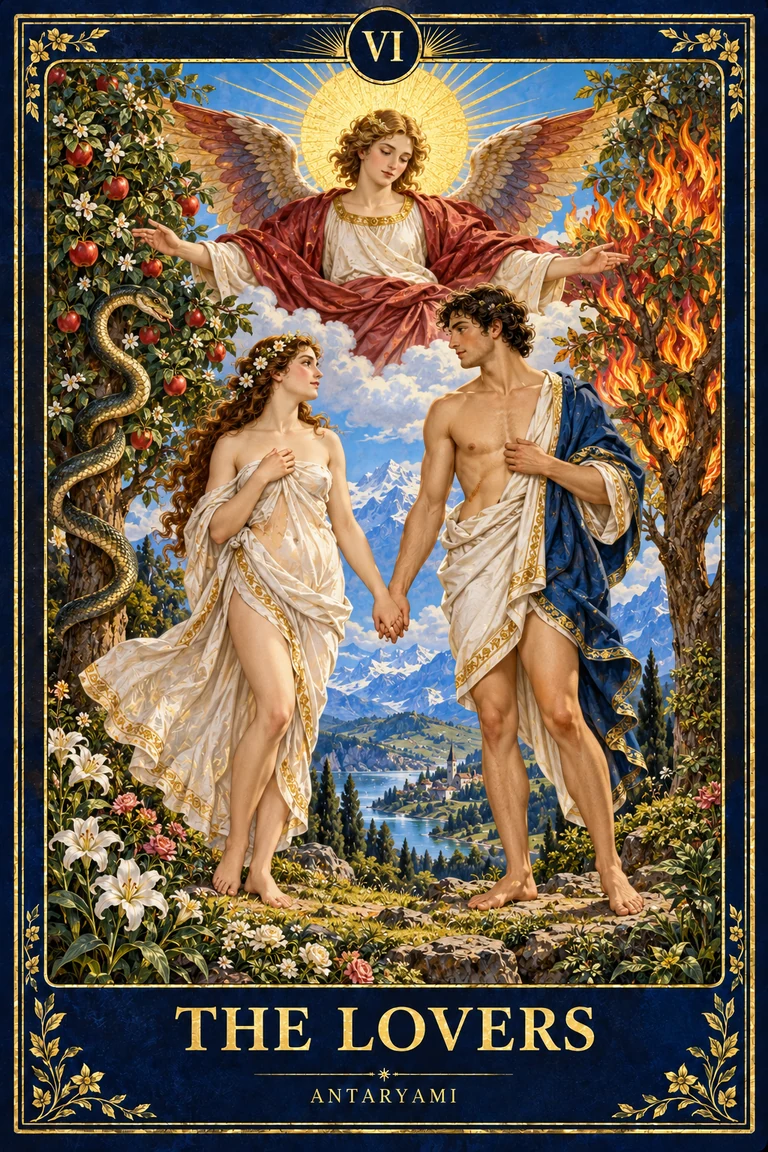
Antaryami's original Lovers artwork places two adult figures in a bright garden beneath a winged figure, with trees and a mountain in the scene. Notice that they are separate people, not one merged shape. That detail offers a useful modern question: can connection exist without erasing either participant? You may read the openness of the image as a prompt about honesty and vulnerability, but it does not require unlimited disclosure. A healthy boundary can coexist with closeness, and nobody owes exposure because a symbolic scene appears unclothed or unveiled.
Waite's historical description explicitly uses Adam-and-Eve imagery, a serpent, two trees and a great winged figure. His account differs from older Lovers pictures and gives the Rider-Waite-Smith scene its particular religious setting. Our discussion of consent and shared values is a contemporary educational reading, not a claim that every modern relationship interpretation is stated in that text. The Antaryami Museum Tarot image is an original generated interpretation of the symbolic tradition rather than a reproduction of a historical plate.
The garden should therefore not be used to rank relationships by gender, orientation, religious belief or formal status. A historical image can be explained without making its depicted pair the only legitimate form of connection. Nor does a winged figure certify divine approval for a particular partner. Let the scene help you ask about openness and alignment while keeping authority with the people involved. Their consent, lived experience and observable treatment of one another remain more important than a reader's preferred symbolic story.
Upright: recognise an agreement you can actually live
An upright Lovers reflection may be useful when affection and values are moving in a compatible direction. Imagine two people who enjoy each other's company and can also discuss practical differences without punishing one another. The card can frame appreciation of that cooperation. It does not establish that conflict will never occur. A connection is often strengthened by how differences are handled, not by pretending differences do not exist. Look for agreements that show up in behaviour rather than a romantic label that explains away every contradiction.
Outside romance, consider a collaboration where both participants understand the purpose, workload and credit. Each brings something distinct, and neither must disappear to make the partnership work. The Lovers theme can ask what makes that alignment possible and what needs protection. Perhaps the clarity of the agreement matters as much as the enthusiasm for the idea. An upright interpretation becomes practical when it directs attention to those conditions. It should not imply that two people are automatically compatible because they happen to want the same headline outcome.
For a personal choice, ask whether the action matches a value you have deliberately chosen. If you say that family time matters but accept every avoidable commitment that displaces it, the tension is worth examining. The answer might involve a limit, a renegotiation or an honest change in priority. Tarot cannot decide which value should win. It can provide an image through which you notice the gap between a statement and the choices that make it real. Alignment is something you practise, not a status awarded by a card.
Reversed: name the mismatch before assuming a separation
Modern reversed Lovers interpretations can concern conflicting values, difficult choices, disconnection or a commitment that is not being shared equally. Reversal does not prove betrayal or predict a breakup. Those conclusions could seriously affect real people while resting on no evidence beyond orientation. Begin with the actual mismatch. Is it a disagreement about plans, an unspoken expectation, a lack of respect or something else? Different concerns require different conversations and, where relevant, different kinds of support.
Suppose one collaborator expects a casual experiment and the other expects a long-term business. Their enthusiasm may have hidden the fact that they are agreeing to different things. A reversed Lovers reflection could prompt them to make the expectations explicit before investing more time or money. The problem is not necessarily that either person is bad. Their understandings are incompatible in a way that needs attention. A clarified agreement might allow the project to continue, or it might reveal that proceeding together is unsuitable.
Another reversed pattern is avoiding a choice because each option requires accepting a loss. You may keep searching for a reading that removes the trade-off. Instead, write what each option offers and what it asks you to give up. It is possible to make a considered decision and still feel sadness about the path not taken. A symbolic exercise should not promise that alignment removes every uncomfortable emotion. It can help you become more honest about the choice without pretending that one card has delivered the only correct answer.
Love readings: mutual consent is not optional symbolism
For love questions, The Lovers can be an engaging prompt about how closeness is built. You might ask whether you are communicating clearly, respecting boundaries and leaving room for the other person's preferences. It cannot reveal a stranger's hidden attraction, authorise repeated unwanted contact or prove that an ex is meant to return. A person's actual response matters. If they decline involvement, a tarot interpretation does not overrule that decision. The card's beauty should never be used to make persistence sound like a sacred obligation.
In a continuing relationship, a useful exercise is to identify one agreement you each believe exists and compare the descriptions. You may discover that the same word means different things. Support, independence and commitment can each cover several practical expectations. Discuss a concrete example before assuming complete alignment. This is not a compatibility test or a substitute for relationship counselling when that is needed. It is a way to make ordinary communication clearer and leave less room for an idealised image to carry the whole conversation.
If the relationship involves fear, coercion or harm, do not use the card to romanticise endurance. A prediction of destined love can make it harder to assess what is happening. Seek appropriate real-world support and attend to safety. A reflective tarot guide cannot evaluate the circumstances adequately or prescribe the right intervention. It can, however, refuse to turn a difficult situation into proof that you must stay. The freedom to reconsider or leave a relationship is not cancelled by a favourable-looking card.
Work: a tempting offer may still conflict with a chosen value
At work, The Lovers can prompt a question about fit rather than a promise of success. An offer may provide more income while reducing time for something you consider important. A project may be prestigious while requiring a method you are uncomfortable using. These are real trade-offs, and the card cannot calculate their correct resolution. Compare the terms, your circumstances and the people affected. A useful reading helps you state what the decision involves instead of claiming that excitement has already settled it.
For a partnership, identify how disagreements will be handled before they happen. Who decides which issue, how are contributions recognised and what happens if one participant wants to stop? Shared enthusiasm is not a substitute for that conversation. The Lovers image can inspire attention to mutuality, but legal and financial arrangements need proper documents and relevant professional advice. A card cannot make an unclear agreement binding, ensure fair payment or establish that someone will keep an informal promise.
You can also use the theme to examine the audience you serve. Are you making a claim because it helps people understand the product, or because it is likely to persuade them regardless of accuracy? Alignment is not only personal comfort; it can concern the relationship between stated values and public conduct. If honesty is important, keep limitations visible even when a more dramatic promise would sell better. That is a practical value choice, not a magical strategy guaranteeing that integrity will immediately produce commercial reward.
The Lovers is not interchangeable with the Two of Cups
The Two of Cups and The Lovers are both often discussed in connection with relationships, but their images and roles differ. In this series, The Lovers foregrounds values, choice and the kind of commitment you are forming. The Two of Cups can focus more closely on an exchange or meeting between participants. These are contemporary teaching distinctions, not universal rules followed by every tarot school. Comparing cards gives you a richer vocabulary than deciding that every paired figure means romance is about to arrive.
A yes-or-no question can flatten those distinctions. If you ask whether someone loves you and treat the card as a yes, you may stop observing their behaviour or speaking to them. A more workable question is what you need to understand about the connection, or which expectation needs to be discussed. The answer can remain open to evidence. Tarot may offer language for reflection, but it does not replace the person's own account of what they feel or consent to.
Nor does drawing the card repeatedly prove that an outcome is inevitable. Digital selection mechanisms, the options used and chance can explain repetitions without invoking destiny. Repeated checking may also stop being useful when the underlying issue needs a conversation or a decision. You are allowed to put the deck down. A Lovers reading is not made more meaningful by consulting until the image agrees with your preferred answer. Its most constructive role may be helping you name a choice you already know needs attention.
An Antaryami values exercise: what am I choosing, and who else must choose?
In Antaryami's tarot experience, retain the spread position alongside the revealed Lovers card. Is the position discussing support, a challenge or a possible approach? The daily image and an interactive shuffled draw have different mechanisms, so do not merge them into a single claim that the app has confirmed your relationship. If you use Ask, identify the symbolic question rather than requesting private knowledge about another person. An explanation should preserve both the card's tradition and the limits of what the system can know.
Write one decision in a sentence, then name the values it involves. Add whose consent or agreement is needed and which facts remain unverified. A personal routine may be yours to change, while a shared commitment requires more than your own preference. Choose one respectful next step: clarify a term, ask an open question or take time to compare the real options. Afterwards, evaluate what you learned from that step rather than treating any pleasant response as proof that the card predicted the outcome.
This guide is prepared for Temior Technologies Pvt Ltd's Antaryami Journal with AI assistance, the Nitish Raj Walia byline and a unique original Lovers illustration. Current app access belongs to the verified information on the app page, not to an implied promise inside a romantic article. Keep the card's central invitation generous but grounded: connection is worth enjoying, choice is worth making consciously and every other person retains a voice that no image can speak for them.
Ask about alignment rather than destiny
The attraction is strong, but an important value differs
Name the difference and discuss a concrete situation in which it would matter. Attraction does not settle the trade-off. The Lovers can frame a question about mutual choice, while the people involved provide the answer through their own words and conduct.
I keep asking whether this person is meant for me
Shift to what you can observe and discuss: respect, consistency, shared expectations and freely given interest. No card supplies consent or establishes a soulmate identity. A useful reflection leaves you able to accept information that does not match the story you hoped for.
Astrological interpretations are for reflection, not a diagnosis, a guaranteed prediction or a substitute for professional advice. Journal guides are prepared with AI assistance; they are educational content, not individual consultations.


