 Antaryami
Tarot card meanings
The Star tarot card: let hope become a small, honest act of renewal
Hope is not always a grand conviction that everything will work out. Sometimes it is the decision to care for one small part of life again: opening a sketchbook, answering a kind message or making a realistic plan after disappointment. The Star gives that quiet possibility an open landscape and water flowing from two vessels. In this Antaryami guide, Nitish Raj Walia explores contemporary meanings of renewal, openness and trust without demanding optimism. The card does not guarantee healing, a relationship or a successful outcome. It can offer a gentler question: what is still worth tending, even while the larger answer remains uncertain?
The Star meaning: possibility can be meaningful without becoming certainty
Contemporary Star interpretations often centre hope, renewal, openness and a sense of being able to reconnect with what matters. These themes are most helpful when they leave uncertainty intact. You can care for a project without knowing whether it will succeed, or accept support without claiming that a difficult period is finished. The card need not erase disappointment to introduce possibility. Its reflective question concerns what can be nourished now, not whether the entire future has been certified as favourable by a beautiful image.
Imagine returning to a creative activity after a project did not receive the response you hoped for. You may not feel ready for another ambitious launch. A Star-themed reflection could ask which part of the activity you still enjoy independently of public approval. Perhaps drawing for an hour, revisiting a useful technique or sharing work with one trusted person would restore a more workable connection. That is not a guarantee of eventual recognition. It is a way to identify a meaningful action that does not depend on certainty about the final result.
As a resource, The Star might frame encouragement, a supportive connection or a practice that helps you begin again. As a challenge, it might ask whether hope has become passive waiting or an obligation to appear positive. Those possibilities should remain distinct. A hopeful plan still needs appropriate information and effort; a person experiencing difficulty does not owe anyone a cheerful performance. The card can support openness while respecting your actual capacity, including the possibility that rest, practical help or a different direction is more appropriate than another attempt today.
The two vessels connect land and water beneath a generous sky
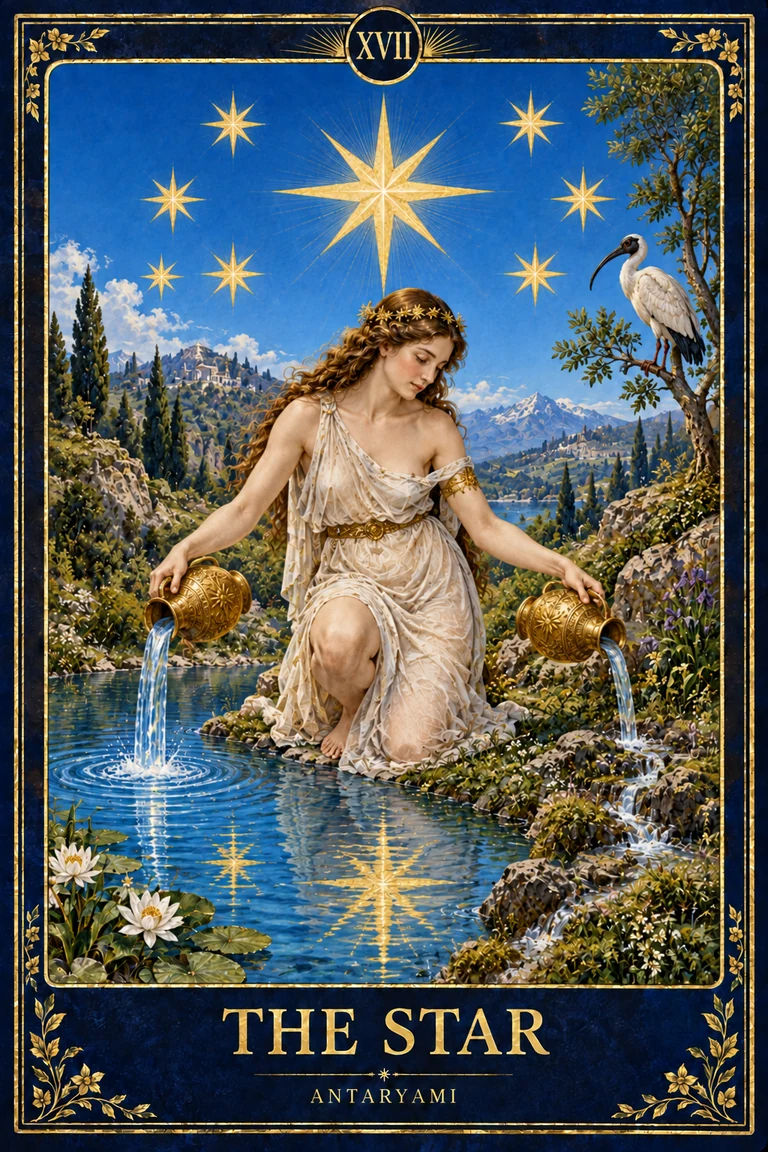
Antaryami's original Star image places a figure beside water, pouring from two vessels beneath a prominent golden star and a surrounding field of smaller stars. A bird appears in the landscape. Compared with the enclosed architecture of several other cards, the scene feels open. As our contemporary visual interpretation, that openness can prompt a question about reconnecting with life beyond a narrowed concern. The picture does not prove that you are spiritually cleansed or that an external force has begun restoring your circumstances.
Waite describes one large eight-rayed star, seven smaller stars, the figure pouring water toward land and water, and a bird on a nearby tree. His discussion goes beyond everyday hope into a specific mystical framework, and he treats a simple hope summary dismissively. Our guide therefore identifies hopeful renewal as a contemporary reflective reading rather than attributing that entire approach to his account. The historical source helps you recognise the composition and the difference between its author's doctrine and the ordinary-life examples we use here.
The water invites attention to giving and replenishment, but the image should not be used as a prescription to give endlessly. A person can offer care while also needing it. Ask whether the activity nourishes something meaningful or merely drains capacity to maintain an appearance of generosity. The Star's visual softness does not remove practical limits. If a routine or relationship asks for more than you can provide, an honest adjustment may serve renewal better than continuing unchanged because a serene figure appears to make unlimited giving look effortless.
Sources: Waite: The Star imagery and its more specific mystical interpretation
Upright: choose a small return to something worth caring about
An upright Star reflection may fit the moment when you feel able to re-engage after disappointment. The first step need not reproduce the scale of the previous effort. You could return to a modest version of the activity, with fewer demands and a clearer reason for doing it. Ask what would make the next attempt worthwhile even if it does not produce an impressive outcome. This question can protect an activity from becoming dependent on external validation while leaving your ambitions available for later consideration.
Suppose a community event had poor attendance and the organiser feels discouraged. A constructive reflection might identify what worked for the people who did attend and which practical details could change. A smaller gathering, a clearer invitation or a different time may be worth trying. The card cannot promise that people will come. The hope lies in having a reasonable next experiment, not in declaring that the universe owes the organiser a success after one setback. Evaluate the result and retain the right to change direction if the evidence suggests it.
Upright openness can also mean receiving help without feeling that you must immediately repay it through a dramatic improvement. A kind conversation, useful information or a manageable shared task may matter even if it does not solve everything. You can appreciate support honestly while saying what remains difficult. The Star becomes more humane when it allows an imperfect beginning. A bright card should not create pressure to announce that you are healed, fully confident or ready for every opportunity simply because its familiar keywords sound encouraging.
Reversed: acknowledge discouragement before prescribing positivity
Reversed Star readings often concern discouragement, distance from a source of meaning or difficulty trusting a possible improvement. These themes are not a diagnosis, and the orientation does not establish that you have lost your spiritual worth. Start with what has happened. Repeated disappointment, limited resources or a demanding period can make encouragement feel unconvincing. A useful reflection acknowledges those conditions rather than telling the person to think positively. Hope should not become another requirement they are failing to meet.
Perhaps advice to begin again feels exhausting because the previous effort consumed more than you can currently give. A reversed reflection could ask what needs to be replenished before another attempt, and whether the old goal still deserves the same priority. You might need rest, information, practical assistance or permission to stop. The card cannot determine which applies, but it can make room for the question. Changing a goal is not automatically evidence of giving up on life; it may be a responsible response to what you now understand.
Another reversed angle is a hope that has become disconnected from action or evidence. Waiting for a favourable outcome can prevent you from asking a necessary question or considering alternatives. Name the outcome you want and what is actually known about its likelihood. If the facts remain uncertain, you can preserve hope without treating it as a plan. Where distress is persistent or significant, suitable professional support matters. A reversed Star should never be used to discourage help or tell you that confidence alone will resolve a serious difficulty.
Relationships: rebuild trust through conduct, not a reassuring forecast
In relationship reflection, The Star can frame openness, a wish to reconnect or the possibility of a more honest conversation. It does not promise a reunion or reveal that another person secretly wants one. If contact is appropriate and wanted, a clear invitation can allow the other person to respond freely. Their actual answer matters more than the card's hopeful reputation. A reflective image can help you approach the conversation thoughtfully while preserving the fact that closeness cannot be guaranteed or created on someone's behalf.
Where trust has been damaged, hope and evidence need to coexist. A sincere apology may be important, but reliable conduct over time also matters. You do not have to restore every boundary immediately to prove that you are open-hearted. A Star-themed question might ask what a realistic rebuilding process would require and whether both people are willing to participate. The card cannot verify that a promise will be kept. Let the process remain observable rather than replacing it with a statement that healing is destined.
For an already healthy connection, the theme may be simpler: appreciate the quality of attention that makes the relationship nourishing. A quiet conversation or an undemanding shared activity can matter without becoming a major event. Choose what suits both people rather than imposing a prescribed ritual. Hope here is not the expectation that a relationship will never become difficult. It is the willingness to care for its real strengths while discussing concerns when they arise. The image can support that attention without declaring a permanent compatibility score.
Work: reconnect inspiration with a feasible next experiment
At work, The Star can prompt a return to purpose after a period dominated by setbacks or administration. Ask which part of the work still matters and what a feasible next experiment would be. A designer might revisit a problem that users genuinely need solved. A teacher might try one clearer example rather than redesigning the entire course. The scale should fit the available capacity. Inspiration becomes more useful when it connects to an action that can be completed and reviewed, instead of demanding a spectacular turnaround.
Feedback can support that process if it is specific. Rather than asking whether a project is wonderful, ask which part is understandable, useful or confusing. That information gives hope something to work with. A bright card does not remove the need to test a proposal or respect professional standards. You can remain enthusiastic and still revise an idea after evidence challenges it. The Star's reflective value is not to shield inspiration from reality, but to help preserve a meaningful intention while finding a form that can function in the world.
Financially, do not treat hopeful imagery as a promise of abundance or recovery. A proposed opportunity requires factual evaluation, and a difficult situation may need practical advice. The card cannot verify returns, debts or the suitability of a purchase. In a health context, it likewise does not establish that healing is occurring or predict a treatment outcome. You may find the image encouraging while continuing appropriate care. Keeping those domains distinct allows the card to offer emotional meaning without borrowing authority from information it does not possess.
The Star, The Sun and Temperance offer different kinds of encouragement
The Star and The Sun are both commonly experienced as encouraging images, but their reflective questions need not be identical. Our Star guide concerns possibility, renewal and tending something before the larger outcome is known. Our Sun guide concerns clarity, enjoyment and recognising what is visible now. Hope can exist while evidence remains incomplete; clarity concerns what can actually be seen or established. Comparing the cards prevents encouragement from being reduced to a single vague promise that everything will be good.
Temperance and The Star both show vessels and water, yet their compositions suggest different questions in this series. Temperance can frame the relationship between elements being combined or coordinated. The Star can frame nourishment, openness and renewed possibility. If a routine is disorganised, a question about proportion may be more useful than one about inspiration. If you have lost connection with its purpose, nourishment may be the more relevant angle. Neither card makes the other unnecessary, and visual similarities do not erase the distinction between their interpretive roles.
The Star also follows The Tower in this deck's numbering, but that sequence is not a timetable for your life. You do not have to experience a crisis to earn hope, and a difficult event does not guarantee immediate renewal. The cards can be read as a symbolic sequence without treating it as a compulsory biography. Let the relationship between the images enrich your vocabulary while allowing real transitions their own pace. A gentle next step may be valuable even when the dramatic narrative of collapse and rebirth does not fit your experience.
An Antaryami renewal exercise: name one thing you can tend without a guarantee
When The Star appears in Antaryami, keep the spread position and orientation and ask a question that preserves uncertainty. You might explore what is worth tending after disappointment or which source of support you have overlooked. Do not ask for a guaranteed recovery, reunion or financial result. A contextual explanation should identify hopeful symbolism as a possible lens, not certify an outcome. The app's current availability and feature scope remain matters for the product pages; an encouraging card guide does not grant access or promise an available service.
Choose one small thing that would be meaningful even if it does not solve the larger problem. Write why it matters, what it requires and what limit would keep it manageable. For a creative return, that might be practising one technique for a short session rather than planning an entire exhibition. For a connection, it might be accepting a suitable invitation without demanding that the conversation repair everything. Review how the action felt and what you learned. Its value comes from real participation, not from proving that the card's message was fulfilled.
Temior Technologies Pvt Ltd shares this AI-assisted Antaryami explanation under Nitish Raj Walia's byline with our existing original Star portrait. The image is a symbolic artwork, not a personal prognosis. Let it leave you with a quiet form of permission: you can care for something without knowing its final outcome, and you can accept a small renewal without declaring every difficulty over. Hope becomes more trustworthy when it does not need to disguise uncertainty. It can sit beside it and still support an honest, manageable next step.
Give hope a manageable shape
I want to return to something after disappointment
Choose a small version that fits your current capacity and remains meaningful without a guaranteed result. Identify what you can learn from the attempt. The Star can frame renewed possibility without promising recognition or requiring a dramatic comeback.
Everyone tells me to be positive, but I feel depleted
Acknowledge the actual demands and what support or rest may be needed. You do not owe a cheerful performance to a card or another person. Significant or persistent distress deserves appropriate care, not a verdict that your hope is inadequate.
Astrological interpretations are for reflection, not a diagnosis, a guaranteed prediction or a substitute for professional advice. Journal guides are prepared with AI assistance; they are educational content, not individual consultations.


