 Antaryami
Tarot card meanings
Three of Swords tarot card: acknowledge a hurt without making it the whole story
Few tarot images are recognised as quickly as a heart crossed by three swords. Its directness can feel unsettling before a reader has said anything. Yet a powerful picture is not a forecast. The Three of Swords can offer language for disappointment, separation or a truth that hurts, without proving that betrayal or catastrophe is waiting ahead. In this Antaryami guide, Nitish Raj Walia explores how to meet the image with care. The useful question is not what terrible event the card guarantees. It is what has actually hurt, what story you have attached to that hurt and what kind of response would respect both the experience and the wider life that continues around it.
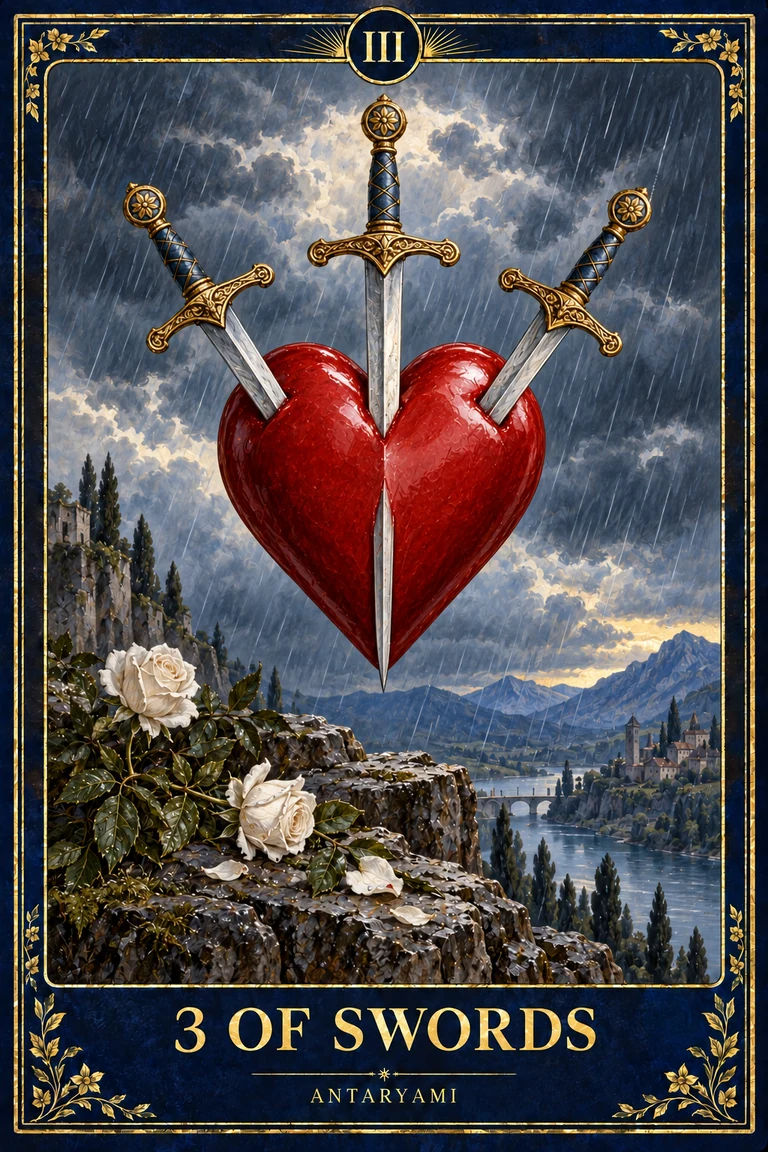
Three of Swords meaning: a painful experience deserves an accurate name
Contemporary Three of Swords interpretations commonly emphasise heartbreak, disappointment, separation, difficult communication or painful clarity. These themes can give an existing experience a recognisable image. They do not establish that an experience must occur because the card appeared. Start with the actual circumstances. Has a plan ended, a conversation hurt or an expectation changed? A meaningful reading can help you name what is present without adding a more dramatic event merely to make your life resemble the illustration.
Suppose a collaboration you valued does not continue. You may be disappointed about the practical loss, the imagined future or the way the decision was communicated. Those are related but distinct kinds of hurt. Naming them separately can make a response more appropriate. You might need clarity about unfinished work, a private conversation or time to reconsider your plans. The card does not decide which is needed. It can prompt you to examine the experience more accurately than the broad conclusion that everything important has been taken away.
Painful clarity can also involve realising that an expectation was not shared. That realisation may change an arrangement, but it does not automatically make the earlier experience false or worthless. Keep the scale of the conclusion connected to the information. A disappointment can matter deeply without becoming a verdict on your ability to trust, create or belong. The Three's useful role is to make room for what hurts while preserving the possibility that your understanding, circumstances and response can develop beyond the first difficult moment.
The heart and rain: emotional imagery is not a medical reading
Antaryami's original Three of Swords places three blades across a red heart against dark clouds and rain, with roses and an open landscape below. The contrast makes the heart impossible to overlook, while the wider scene remains visible. Our Museum Tarot illustration uses recognisable imagery in a newly created composition. The landscape and floral detail are artistic choices. They should not be presented as a code that diagnoses bodily illness or identifies exactly which person will cause a future hurt.
Waite's historical account describes the pierced heart and rainy setting, with meanings connected to absence, division and rupture. His reversed vocabulary includes confused or disordered states. This article draws on that historical context while using a contemporary distinction between acknowledging hurt and predicting it. The image is symbolic, not anatomical evidence. A physical symptom needs appropriate medical attention; a card cannot establish its cause, seriousness or treatment. A source's age or influence does not convert its divinatory claims into verified knowledge about a person's health.
Rain can make the emotional atmosphere visible without fixing its duration. Do not read the clouds as a timetable for suffering or the roses as a guaranteed recovery date. Ask instead which part of the scene draws your attention and why it feels relevant to the present question. Your response to an image can be worth exploring while remaining your response. The illustration's power lies in what it helps you articulate, not in an authority to determine what has happened, what will happen or how long a difficult experience must last.
Sources: Waite: Three of Swords heart, rain, division and absence
Upright: recognise the hurt before deciding what it means about everything
An upright Three of Swords reflection can encourage honest acknowledgement. Something may have disappointed you, and pretending it did not matter can make the next conversation less clear. Describe the event and its effect without requiring yourself to explain the whole experience immediately. You can say that a comment hurt or a change felt disappointing while still being uncertain about what should happen next. The card does not demand a dramatic confession or make immediate disclosure the only valid response to a difficult feeling.
It can help to separate the event from a conclusion about your entire life. A rejected proposal is not proof that you have no useful ideas. A difficult exchange is not proof that every relationship will repeat it. Those broad conclusions may feel persuasive at the moment, but they require more than the event supplies. The Three lens can make that distinction visible. Acknowledging pain does not require reducing it, yet it can leave room for a more proportionate account of what the experience does and does not establish.
If a practical matter remains unresolved, identify it separately. You may need to confirm a deadline, return an item or decide who completes an unfinished responsibility. Attending to those details does not mean you have finished processing the feeling. It means the experience has more than one dimension, and each can receive an appropriate response. An upright reflection becomes useful when it helps you recognise the hurt clearly enough to choose the next manageable action, rather than requiring a complete emotional resolution before ordinary life can continue.
Reversed: repair may be possible, but it cannot be ordered by a card
A reversed Three of Swords can be read through release, attempted repair, a hurt kept private or a difficult story being revisited. Methods differ, and the reversal does not automatically mean that healing is complete. Ask what has changed in the actual situation. Has there been an apology, a clarification or a different pattern of conduct? Is the experience still unresolved, or are you repeating a conclusion that newer information has complicated? The card can prompt these questions without deciding the answers.
Suppose a misunderstanding has been clarified but you still feel unsettled by the way it happened. You do not have to declare everything repaired simply because the factual issue has been explained. Nor do you have to preserve the original interpretation if it no longer fits. A proportionate response may recognise both: the new information matters, and the conversation's effect still deserves attention. The reversed theme can support that nuanced account, allowing repair to involve more than replacing a painful story with forced reassurance.
Another possibility is pressure to forgive or reconcile before you wish to. A card does not supply consent to resume contact, and no symbolic meaning obliges you to trust someone whose conduct remains concerning. Consider your actual boundaries and appropriate support. The contemporary repair lens is an invitation to examine what is possible, not a requirement to restore an arrangement. Waite's reversed list is different from a simple healing keyword, so this guide makes its interpretive choice explicit rather than presenting a comforting modern reading as the only historical meaning.
Relationships: ask about conduct instead of using the card as an accusation
In relationship reflection, the Three of Swords is often discussed through heartbreak. That association can be relevant to an existing disappointment, but the card cannot confirm an affair, identify a rival or reveal that a partner will leave. Those claims can damage trust when treated as evidence. Begin with observable conduct and an appropriate question. If a conversation is needed, describe the concern without announcing that tarot has established the other person's guilt. An image of hurt is not a record of what someone has done.
Imagine feeling excluded after friends make a plan without you. The hurt may be real, while its explanation remains uncertain. There may have been a misunderstanding, a practical limit or a change in the friendship. You can ask what happened and decide how you wish to participate after hearing the answer. The Three lens can help you acknowledge the impact without selecting the most painful explanation before information is available. A clear question leaves room for a reality that may be different from the story the image first brought to mind.
If a relationship has ended, the card should not promise reunion or demand a specific timetable for moving on. Different people and circumstances require different responses. You may need practical arrangements, privacy, trusted company or professional support for a serious concern. A reflective guide can offer language, but it cannot replace that context. The useful invitation is to treat your experience with enough honesty that the next choice is connected to what actually happened, not to an imagined destiny of being hurt or a symbolic instruction to restore what no longer feels right.
Work: separate useful feedback from the sting of receiving it
A Three of Swords workplace reflection can help when feedback, rejection or a project ending feels personal. Read the actual information carefully. Which part concerns the work, which part concerns the process and which part is an interpretation you have added about yourself? A disappointing result may contain useful detail without defining your worth or future capability. The card can support that separation, while the practical evaluation still depends on the work itself, the standards applied and whether the feedback is relevant and fair.
Suppose a presentation is declined because it does not fit the audience. That may hurt after substantial effort. You can acknowledge the disappointment and still ask which part missed the need. Perhaps the idea can be adapted, used elsewhere or set aside. None of those possibilities is guaranteed. The useful response comes from clearer information about the mismatch. A symbolic reading should not tell you to ignore criticism because success is destined, or abandon the project because a painful card proves the rejection will continue.
Communication also matters when you must deliver disappointing news. Give the relevant information plainly and respectfully, without adding unnecessary personal judgments. A clear explanation can reduce confusion even when it cannot remove the hurt. Do not make reassurance so broad that it becomes misleading. The Three theme can remind you that words have effects and that practical decisions are received by people. A professional response balances the necessary message with enough consideration that the person can understand the outcome and ask an appropriate question about what happens next.
Three of Swords versus Five of Cups and Ten of Swords
The Three of Swords often foregrounds a painful separation or clarifying hurt. The Five of Cups often foregrounds disappointment and the tension between what was lost and what remains. The Ten of Swords often foregrounds a difficult ending or the point at which an exhausted pattern cannot continue in its old form. These are interpretive distinctions, not measurements of suffering. A person does not have to experience a more dramatic event because one image appears more severe than another.
Consider a project that has closed. A Three lens may ask about the conversation or realisation that hurt most. A Five lens may ask what remains available despite the disappointment. A Ten lens may ask which phase is genuinely over and what responsibility continues after it. The comparison helps you choose a question appropriate to the part of the experience you are examining. It does not supply an objective ranking of how bad the situation is or tell you which card you should draw to obtain a more comforting account.
Another misconception is that the Three always means three people. The number and image do not establish a romantic triangle, a particular group or a count of future losses. Some readers use numerical associations, but those belong to a named method and still do not verify an event. Here the card is approached through its emotional and communicative theme. That leaves room for substantial reflection without turning a familiar symbol into a literal accusation or a reason to search your life for a catastrophe that has not occurred.
An Antaryami hurt-and-response note: event, meaning and support
For an Antaryami tarot draw, ask what would help me acknowledge this disappointment without enlarging its claim. The Three's named position may frame a challenge of painful communication or a resource of honest recognition. The inspected walkthrough can organise the question and show whether reversals are enabled; it cannot certify betrayal, diagnose distress or predict recovery. If an image feels overwhelming, you can stop the reading. Your freedom to disengage matters more than obtaining another symbolic explanation of a difficult feeling.
In your own journal, write three separate entries: the event that occurred, the meaning you have attached to it and the support or information that could help now. Keep the response small enough to be practical. Perhaps you need a clarification, a conversation with someone you trust or appropriate professional help for a serious concern. After taking the step, review what changed in your understanding. This exercise is not a cure or a score. It helps the image become a careful question rather than an expanding verdict about your life.
Explore Antaryami's tarot walkthrough and current app information before deciding whether its reflective approach suits you. Nitish Raj Walia's Journal for Temior Technologies Pvt Ltd gives each original card a detailed explanation instead of leaving visitors alone with a frightening keyword. The Three of Swords shows why that depth matters: an arresting picture can open a sensitive question, while context keeps the question humane. Look closer for the meaning, not for a guaranteed forecast, and choose access from the product's verified details rather than from fear about what a card might imply.
Keep the experience distinct from the verdict
A disappointment has become a conclusion that everything will repeat it
Write the specific event separately from the broad prediction. The event can deserve care without providing enough evidence to decide the shape of every future relationship or opportunity.
I want to use this card to confront someone about suspected betrayal
The card cannot verify that accusation. Focus on observable conduct and an appropriate request for clarification, with your actual boundaries and safety determining whether a conversation is suitable.
Astrological interpretations are for reflection, not a diagnosis, a guaranteed prediction or a substitute for professional advice. Journal guides are prepared with AI assistance; they are educational content, not individual consultations.


