 Antaryami
Tarot card meanings
Three of Wands tarot card: look beyond the launch and learn from what comes back
You sent the proposal, shared the first version or finally opened the invitation. Now the project exists outside your imagination, and the next stage involves responses you cannot manufacture by thinking harder. The Three of Wands gives this moment a wide horizon and ships already on the water. Nitish Raj Walia's Antaryami guide explores the difference between expecting progress and paying attention to it. There is room here for ambition, cooperation and a longer view, but also for a very practical skill: noticing what returns, following up appropriately and changing the plan when the real response differs from the hoped-for one.
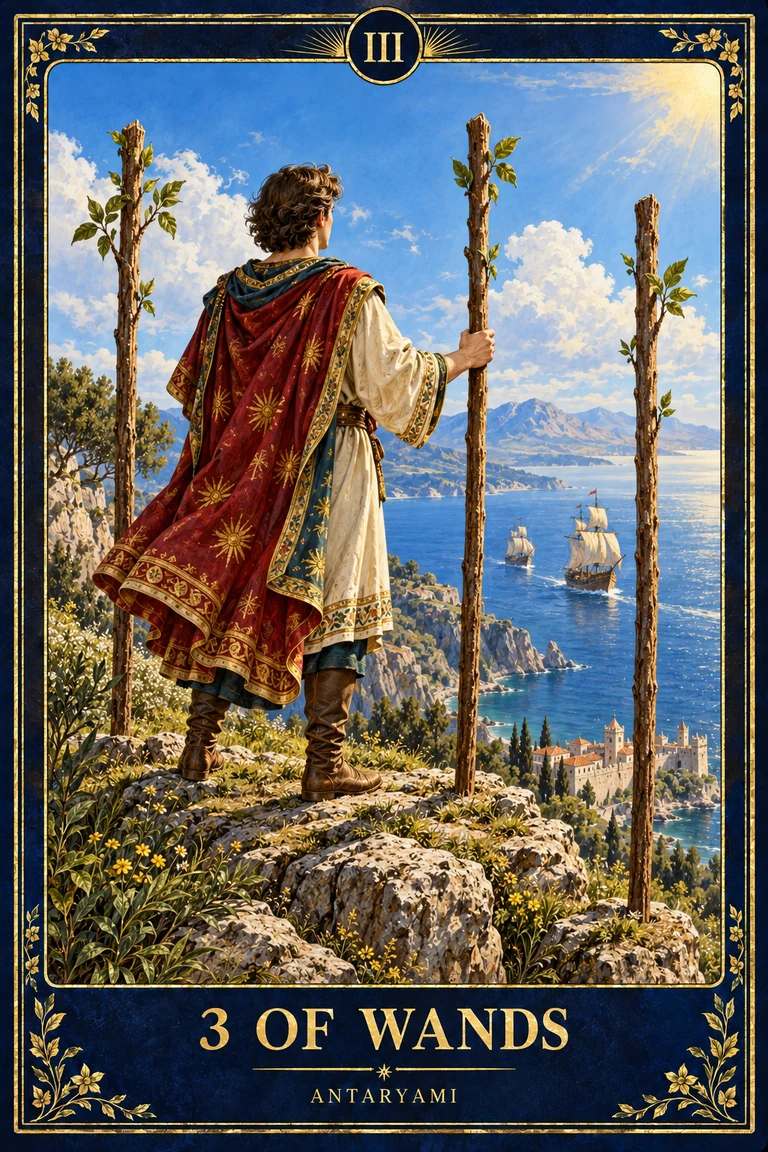
Three of Wands meaning: your work has entered a wider world
Contemporary Three of Wands readings often emphasise expansion, foresight, outward movement and the stage after an initial commitment. Something has been put in motion, so your attention can turn toward its interaction with the wider world. The useful question is how you remain involved without pretending every result is under your control. A proposal may need another person's review; a collaboration may need several schedules to align; a creative work may meet an audience with expectations you did not anticipate.
This card's spaciousness can be encouraging for someone who has kept an idea private for too long. Once a first version is shared, the question changes from whether it looks good in your head to whether it serves people in practice. Feedback may reveal unexpected strengths as well as weaknesses. Perhaps the section you considered minor helps readers most, while the ambitious introduction confuses them. That discovery is not a failure of vision. It is information the vision could not obtain while it remained untested.
Expansion also needs definition. More attention, more customers or more activity is not automatically better if the delivery cannot support it. Ask what you want to extend and what must stay reliable while it grows. A Three of Wands reflection can help you think beyond the immediate announcement toward fulfilment, communication and learning. It does not predict that the ships will bring profit, but it can remind you to watch the actual journey rather than mistaking departure for completion.
The ships and planted staffs: a viewpoint after the first commitment
Antaryami's Three of Wands shows a figure looking across the sea, framed by three staffs and a rocky outlook. Unlike an image of frantic activity, the scene gives space to observation. The figure has a position from which to watch, but the ships move beyond immediate reach. That composition can make an ordinary project question vivid: what have you already established, and which part of the process now requires monitoring rather than another dramatic beginning? The view is wide, while the responsibilities remain specific.
Waite describes a calm figure watching ships and connects the scene with established strength, enterprise, trade and cooperation. Those historical associations support the card's outward-looking character. His reversed account includes relief from difficulties, which differs from the modern habit of automatically reading reversal as blocked expansion. We therefore identify our waiting-and-feedback discussion as a contemporary interpretation. The primary text is a source for the tradition, not a rule that every modern reader or every original illustration must reproduce exactly.
The ships can inspire a literal travel question if travel is already relevant, but they do not establish an overseas move or successful shipment. Real journeys depend on schedules, permissions, transport and other conditions. The three staffs likewise do not guarantee a three-week answer. Let the scene guide your attention to reach, dependencies and response. Its symbolic usefulness grows when you resist converting every object into an unsupported timetable, destination or commercial promise. The horizon is an invitation to consider a wider context, not a hidden tracking dashboard.
Sources: Waite: Three of Wands ships, enterprise and cooperation
Upright: keep your attention on the response, not just the announcement
An upright Three of Wands reflection could fit a maker who has released a small collection. The photographs are posted and the announcement is finished, but useful work continues. Are enquiries answered clearly? Can buyers understand the options? Does delivery match the promise? A launch becomes meaningful through those ordinary interactions. The card can prompt you to look past the satisfying moment of publication toward the experience people actually receive when they respond to your invitation.
For someone seeking a new role, the same theme may mean following up within the employer's stated process, preparing for possible next stages and continuing other appropriate enquiries. Waiting does not require suspending your whole life around one response. Identify what can reasonably be done while the decision is elsewhere. You may improve a work sample, gather references or attend to an existing responsibility. Those actions remain valuable whether or not a particular opportunity develops, which gives the waiting period a more stable purpose.
When feedback arrives, distinguish what can be acted on from what is merely a preference you are not obliged to satisfy. One reader may want a different style, while several people may be unable to find essential information. The second pattern deserves closer attention. A wide view does not mean trying to please everyone simultaneously. It means noticing the relationship between your intention and the actual response, then deciding which adjustment strengthens the work without erasing what made it worth offering in the first place.
Reversed: a wider reach may require a better foundation
A reversed Three of Wands can be used to examine delayed responses, overextended plans, mismatched expectations or a reluctance to move beyond familiar conditions. Begin with the actual stage of your project. If nothing has been shared, the concern may be hesitation. If a version is already circulating, the concern may be follow-through. These require different actions. The card cannot diagnose a hidden obstacle, so make the question small enough to investigate through facts, communication or an appropriate trial.
Suppose a service receives interest from another region, but the delivery process was designed only for local customers. Expanding immediately might create disappointment. A useful reversed reflection asks which condition must be solved before wider promotion: payment terms, language clarity, delivery cost or support availability. Saying not yet can protect both the business and its customers. Growth is not demonstrated by accepting every request. Sometimes the responsible next step is to make the current offer dependable before extending its reach.
Another possibility is waiting without a defined follow-up plan. You may have sent an unclear message and assumed the recipient would know what to do next. Check whether the request, deadline and response route were actually stated. If appropriate, send one concise clarification rather than a stream of anxious reminders. The reversal can help turn a vague complaint about delay into a specific communication question. It should not become a claim that someone is deliberately withholding success from you or that every slow response has spiritual significance.
Relationships: distance needs arrangements, not romantic guesses
For relationships, the Three of Wands can frame growth beyond a current routine, a shared project or the practical questions of distance. If two people live apart, affection matters but does not automatically settle communication, visits or expectations. A useful reflection asks how the relationship is being maintained across that distance. Are plans clear? Can both people initiate contact? Is there room to discuss the cost and effort involved without treating those concerns as evidence that love is insufficient?
A couple planning a change may find it helpful to distinguish a shared aspiration from an actual agreement. Saying it would be lovely to travel together is not the same as agreeing on dates, budget and responsibilities. The card's horizon can make the aspiration visible, while conversation supplies the details. Each person should be able to state what they can genuinely offer. A plan built from mutual information has more substance than a beautiful future one person imagines while assuming the other will arrange it.
Do not use the ships as proof that an absent person will return, contact you or make a commitment. Those events depend on their choices and circumstances. You can decide how long you are willing to leave a question open, and what respectful communication is available. For a friendship, the card might simply encourage making room for new experiences together rather than repeating the same catch-up conversation. Expansion can be modest and local. The important question is whether the connection has space to develop in a way both people welcome.
Work: expansion depends on people who can actually deliver
A Three of Wands workplace reflection can be particularly useful for collaboration. You may understand your own part while assuming another team has the same deadline or definition of completion. Check the handoff. What exactly will they receive? What must they provide? Who answers questions when the work crosses the boundary between teams? Wider activity creates more opportunities for misunderstanding, so clear coordination is part of expansion rather than an administrative detail to be added only after something goes wrong.
For a small business, consider whether the product can be repeated reliably. A successful first delivery may depend on heroic effort that cannot be sustained for twenty customers. Before scaling, record the process and identify the bottleneck. Perhaps a template, clearer instructions or a narrower offer would make the experience more consistent. Tarot cannot validate a business model, but the card can inspire this operational question: which part of the journey becomes fragile when more people begin to participate?
Resource decisions need actual figures. Shipping pictures on a tarot card are not evidence that an investment, export plan or new market will be profitable. Examine demand, costs, obligations and relevant advice. You can remain ambitious without making the interpretation a financial endorsement. The useful version of foresight is noticing dependencies early enough to respond. It asks how the work will reach people, what they will receive and whether the promise can still be kept after the initial enthusiasm has turned into routine delivery.
Three of Wands versus Two of Wands and Eight of Wands
The Two of Wands often frames selecting a direction; the Three frames looking outward after something has been initiated. The Eight of Wands, by contrast, is commonly used to discuss speed, movement and several things arriving close together. These distinctions can improve a reading. Planning, observing progress and responding quickly are not the same task. If you collapse them into one general message to move forward, you may miss the kind of attention your situation actually requires.
Imagine applying to an exhibition. Choosing which work to submit fits the Two's decision threshold. Sending the application and preparing for possible acceptance fits the Three's outward stage. Receiving several time-sensitive instructions could fit the Eight's pace. The cards do not establish that this sequence will happen, nor are they evidence that acceptance is imminent. They help you describe different stages that may already be relevant. The next action should follow the real stage, not the most flattering story you can attach to the pictures.
Expectation also differs from entitlement. Investing effort makes it reasonable to hope for a response, but it does not require another person to prefer your offer or share your timetable. Ask whether your follow-up respects the process and leaves room for an honest no. You can learn from a disappointing response without declaring that the entire venture was misguided. This card becomes more mature when its horizon includes other people's agency, practical limitations and the possibility that a useful adjustment is waiting beyond your original plan.
An Antaryami horizon check: what went out, what returned, what changes?
In Antaryami, bring a focused question to the tarot walkthrough: what should I notice now that this work has been shared? A named spread position can help separate resources, obstacles and possible next steps. If the Three appears as a resource, you might examine your ability to see the larger context. If it appears as a challenge, you might examine overextension or an unanswered dependency. The symbolic reading remains a prompt for inquiry, not a substitute for messages, records or real customer feedback.
Make a horizon check in your own notebook with three entries. First, describe what you actually sent into the world. Second, record the response without embellishment: a reply, no reply yet, a repeated question or an unexpected request. Third, choose one appropriate adjustment. Perhaps you will clarify an instruction, ask for a realistic date or reduce an offer that is difficult to deliver. Revisit the note when new information arrives. That creates a useful bridge between reflection and action without repeatedly redrawing cards to force reassurance.
Nitish Raj Walia's Antaryami guides for Temior Technologies Pvt Ltd invite you to understand the experience before choosing access. Browse the app page for current availability and the product walkthroughs for the difference between a daily card and an interactive draw. The Three of Wands offers a fitting way to explore a product too: look beyond its first impression, inspect how the tools work and decide from the information provided. An inviting horizon matters most when there is a clear, credible path toward it.
Review the journey after the first release
My idea is public, but I am unsure what to do next
Record the actual response and identify one change that would improve clarity or delivery. The next stage may be answering a useful question rather than creating another announcement.
Interest is growing faster than I can fulfil it
Find the weakest delivery step and define a manageable limit while you improve it. Wider reach should not require customers to absorb the cost of promises the process cannot yet keep.
Astrological interpretations are for reflection, not a diagnosis, a guaranteed prediction or a substitute for professional advice. Journal guides are prepared with AI assistance; they are educational content, not individual consultations.


