 Antaryami
Reading thoughtfully
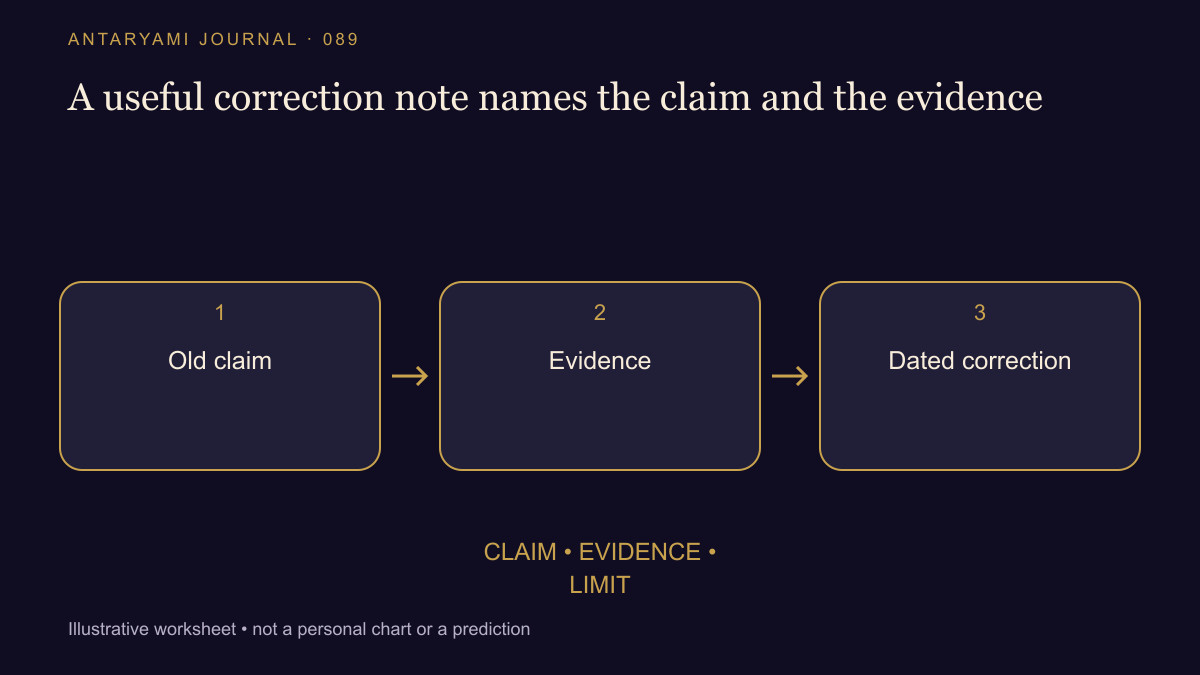
A useful correction note names the claim and the evidence
A useful correction note identifies the exact claim being corrected and the evidence supporting the change. Saying updated for accuracy is not enough when a reader may already have acted on the earlier statement. The note should also state what has not been checked. This is particularly important when an explanation combines a numerical chart result with a traditional interpretation and practical advice.
Name the old claim and the corrected one
Use a fictional example in which an article displayed a subtraction as 25 degrees when the correct difference was 35 degrees. The note should identify the affected example, show the corrected arithmetic and say which dependent sentence was revised. Do not quietly change the number while leaving an interpretation based on the old value.
If the source input was wrong rather than the arithmetic, say that instead. A corrected time or selected date can change a result even when the calculation procedure was functioning as defined. Distinguishing input, method and explanation errors helps readers understand the actual scope of the correction.
Point to evidence without oversharing
For an arithmetic example, show the values and operation. For a sourced factual claim, link the relevant primary source. For a private support incident, use a redacted record or a reference available through the authorised support channel. Publishing birth details, passwords or unrelated conversation history is not necessary to make a correction credible.
Avoid claiming a unique technical cause when the evidence only shows a mismatch. A fresh successful observation can establish that the checked output now matches; it may not establish why the earlier failure occurred. State that distinction rather than filling the gap with a plausible story.
Preserve dates and limits
Keep the original publication date and add a genuine modification or correction date. If only one example was reviewed, do not imply that every historical page and every live feature has been reverified. A bounded note is more useful than a sweeping assurance that nothing can go wrong again.
The final note can be short: what was wrong, what is now stated, why it changed and what remains outside the review. If the correction affects a recommendation, explicitly withdraw or qualify that recommendation. Readers should not have to infer the practical consequence from a changed digit. Accuracy is a continuing practice of making claims inspectable and revisable, rather than a promise of permanent perfection. A clear record allows the old mistake to remain understandable while giving the reader a trustworthy account of the limited repair.
Astrological interpretations are for reflection, not a diagnosis, a guaranteed prediction or a substitute for professional advice. Journal guides are prepared with AI assistance; they are educational content, not individual consultations.